
Yes, you can sell self-published books on Shopify, and for many authors it is one of the best ways to build a direct relationship with readers while keeping more profit per sale. In my experience building Shopify apps and working with independent merchants, owning your storefront, customer data, and checkout experience is often the difference between building a real brand and simply listing products on someone else’s marketplace.
That does not mean Shopify should replace Amazon, Kobo, or other channels entirely. In most cases, the best strategy is hybrid: use marketplaces for discovery, and use Shopify for higher-margin direct sales, signed editions, bundles, special launches, and reader retention.
If you are a self-publisher wondering how to sell books as a self publisher on Shopify, this guide covers the full process: store setup, print-on-demand, ebooks, shipping, pricing, marketing, and the mistakes I see authors make most often.

Why should self-publishers sell books on Shopify?
Shopify gives self-publishers more control, better margins, and direct access to customer data. That makes it especially useful for authors who want to build a long-term business rather than rely entirely on marketplace algorithms.
A lot of authors start on Amazon because it is easy to list there and the built-in demand is huge. That still makes sense. But the trade-off is obvious: you do not own the customer relationship, your product page sits next to competitors, and your royalties can be squeezed by pricing rules, printing costs, and distribution terms.
The original case for Shopify is still true today. When you sell through your own store, you keep the sale price minus Shopify fees, payment fees, fulfilment, and printing costs. You also get the customer email address, purchase history, and the chance to sell again with launches, bundles, and reader exclusives.
That matters more in 2026 because acquisition costs are rising across Meta, Google, and Amazon ads. If you are paying to acquire a reader, you need lifetime value, not just one sale. A direct store helps you turn one buyer into a repeat customer.
Can you sell self-published books on Shopify?
Yes, Shopify works well for both print books and digital books. You can sell paperbacks, hardbacks, signed copies, box sets, ebooks, audiobooks, merchandise, and reader bundles from the same store.
For print books, you can either ship inventory yourself or connect a print-on-demand provider. For ebooks, you can sell direct and deliver files through a digital delivery workflow. Many authors also use Shopify as the central brand hub while keeping Amazon KDP for marketplace visibility and IngramSpark for wider retail distribution.
That is usually the most practical setup. Amazon is great for discovery. Shopify is great for ownership and margin. IngramSpark is useful for bookstore reach. Each channel solves a different problem.
What is the best way to sell books direct without handling all the shipping yourself?
The simplest option is to connect Shopify to a print-on-demand book fulfiller. For most self-publishers selling print books direct, the standout option is Lulu Direct.
When I look at Shopify setups for authors, the biggest operational hurdle is not building the storefront. It is fulfilment. Packing books, managing stock, dealing with international shipping, and guessing demand can quickly become a distraction from writing and marketing.
That is why print-on-demand is so appealing. With Lulu Direct, books are printed when ordered and shipped directly to the customer. That means no bulk inventory, less upfront risk, and a cleaner workflow for authors testing direct sales.
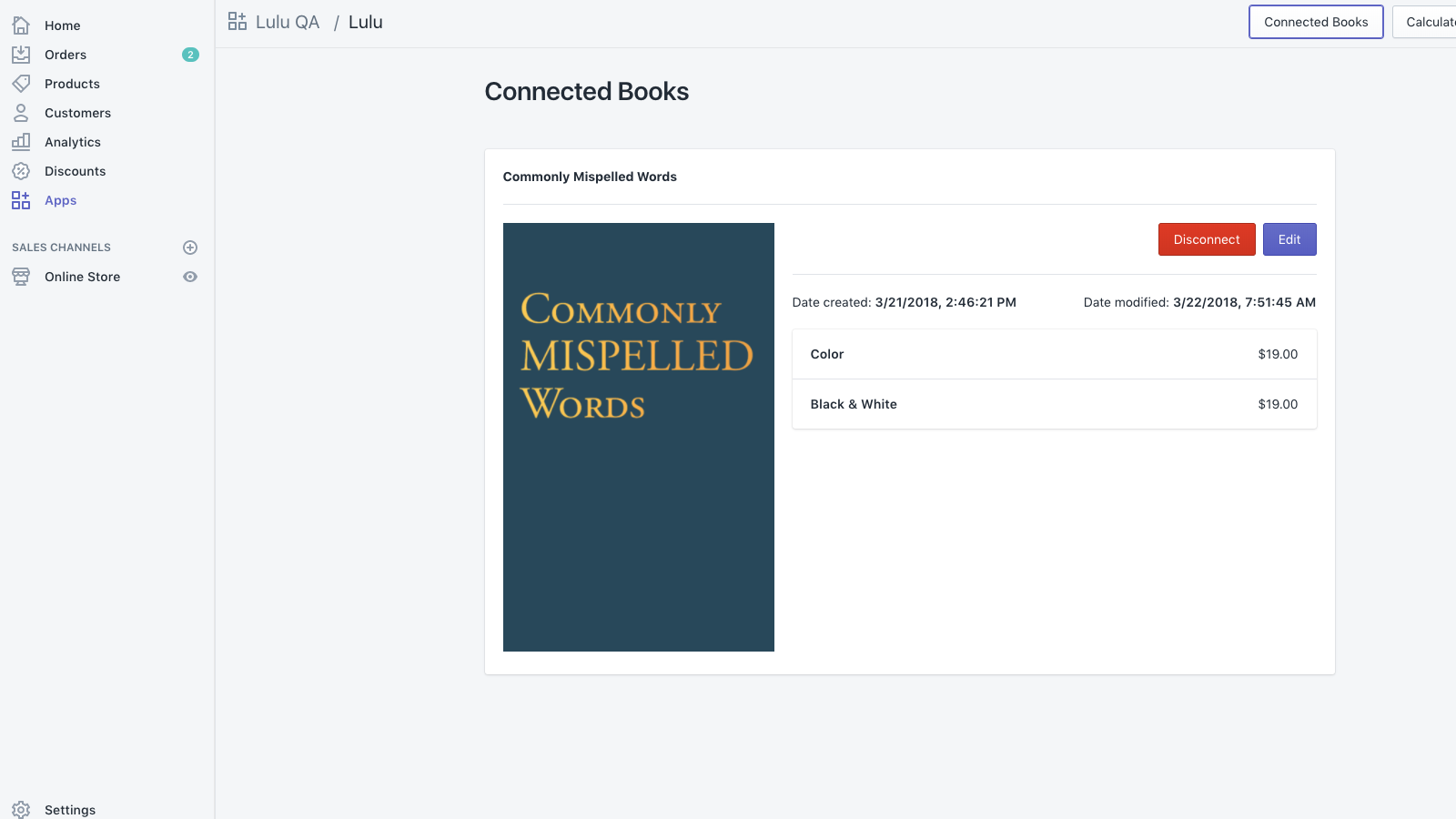

Lulu Direct integrates with Shopify and is designed specifically for book printing and fulfilment. It is one of the few options that feels purpose-built for authors rather than adapted from generic print-on-demand.
- No handling fees or setup charges
- Print-on-demand fulfilment for direct orders
- A wide range of trim sizes, bindings, cover types, and colour options
- Global shipping support for many markets
- Useful for authors selling single titles, bundles, and special editions
If you want to compare routes, here is how I would frame the main options.
| Platform | Best for | Main strength | Main limitation |
|---|---|---|---|
| Shopify + Lulu Direct | Direct-to-reader print sales | Higher margins and brand control | You need to drive your own traffic |
| Amazon KDP | Marketplace discovery | Huge built-in audience | Lower control and weaker customer ownership |
| IngramSpark | Bookstore and wholesale distribution | Broader retail reach | Less suited to branded direct sales |
| Self-fulfilment | Signed stock and premium editions | Full control over packaging | Time-intensive and harder to scale |
How much does it cost to sell books on Shopify?
The cost of selling books on Shopify depends on your plan, payment fees, app stack, and fulfilment model. For most self-publishers, the monthly software cost is not the biggest issue. Printing, shipping, and customer acquisition usually matter more.
The original article referenced Shopify Basic at $29 per month, but Shopify pricing changes over time and often varies by billing cycle and region. For that reason, I always recommend checking Shopify’s current pricing page directly before launching. What matters strategically is that Shopify’s fixed monthly cost is predictable, while your variable costs come from payment processing, printing, packaging, and marketing.
If you sell direct, your rough cost stack usually includes:
- Shopify subscription
- Card processing fees
- Print cost per book if using POD
- Shipping cost or shipping subsidy
- App costs if you add upsells, reviews, or email tools
- Advertising spend if you run paid traffic
In practical terms, authors often make the mistake of comparing Shopify only to Amazon royalties. The better comparison is net profit plus customer lifetime value. A direct buyer who later purchases book two, a signed hardback, and a launch bundle can be worth far more than a single marketplace sale.
Is Shopify better than Amazon for self-published authors?
Shopify is better for margin, branding, and reader ownership. Amazon is better for discoverability. For most authors, it is not an either-or decision.
Amazon still matters because readers search there first, especially for ebooks and genre fiction. But if you rely on Amazon alone, you are building on rented land. You do not control the checkout, you cannot fully shape the customer journey, and you are competing in a crowded interface built to maximise Amazon’s sales, not your brand.
By contrast, a Shopify store lets you create an author-first buying experience. You can sell signed copies, book bundles, special launch editions, merch, and reader magnets tied to email capture. You can also add product recommendations and cart upsells in ways marketplaces simply do not allow.
If you want to improve average order value, this is where Shopify becomes especially powerful. I have written a lot about this from the app side, and the same principles apply to books as they do to any DTC niche. Related reads include How to Maximize Revenue from Your Shopify Product Pages, How to Create Shopify Cart Drawer Upsells That Boost AOV, and How to Upsell on Shopify in 2026.
| Factor | Shopify | Amazon |
|---|---|---|
| Customer ownership | High | Low |
| Brand control | High | Low |
| Built-in traffic | Low | Very high |
| Upsells and bundles | Excellent | Limited |
| Launch flexibility | Excellent | Moderate |
| Operational simplicity | Moderate | High for listing |
How do I set up a Shopify store for selling books?
Set up your store like a focused author brand, not a generic product catalogue. Readers should immediately understand who you are, what you write, and what to buy first.
In my experience, the best-performing Shopify stores are clear within five seconds. That is just as true for authors as it is for fashion or skincare brands. If a visitor lands on your homepage, they should see your genre, your lead book or series, and a simple path to purchase.
- Choose a clean theme with strong product pages and mobile performance.
- Organise books by series, genre, or format so readers can browse logically.
- Create key pages including About the Author, Contact, Shipping Policy, and Returns Policy.
- Add trust signals such as reviews, media mentions, and reader testimonials.
- Set up email capture with a reader magnet, sample chapter, or launch list signup.
- Optimise mobile navigation because a large share of traffic will come from phones.
If you are selling multiple formats, create separate product pages for paperback, hardback, signed edition, and ebook where it improves clarity. Trying to cram everything into one messy listing often hurts conversion.
It is also worth thinking about AI and search visibility from day one. Structured product content, clear metadata, and accessible page copy help both search engines and AI discovery tools understand your store. For that, see How to Get Your Shopify Store into ChatGPT and How to Optimise Your Shopify Store for AI Shopping Agents.
How should I create book product pages that actually convert?
The best book product pages combine retailer clarity with author personality. You need enough information to remove friction, but also enough storytelling to make the book feel desirable.
Too many author stores use thin product pages with only a title, cover image, and a short blurb. That is rarely enough. A converting product page should include the hook, format details, page count, shipping expectations, and a clear sense of who the book is for.
- Use a strong title and subtitle if relevant
- Lead with the core promise or premise
- Include edition details such as paperback, hardback, signed, or illustrated
- Add high-quality cover images and, if possible, spine and interior shots
- Use bullet points for specs like trim size, language, and page count
- Add reviews or endorsements near the add-to-cart button
- Include shipping times and fulfilment notes clearly
For nonfiction especially, I recommend treating the product page almost like a landing page. Explain the problem the book solves, who it is for, what readers will learn, and why they should buy from you directly rather than from a marketplace.
If you sell premium versions, this is also where direct sales shine. A signed copy, a bonus workbook, a bookmark, or a limited launch bundle can materially lift conversion and AOV.
How do I sell ebooks on Shopify?
You can sell ebooks on Shopify as digital products, either on their own or alongside print editions. The key is secure, reliable delivery and a simple post-purchase experience.
Many authors use Shopify to sell EPUB or PDF files directly, then deliver them through a digital fulfilment workflow or an external service such as BookFunnel for reader-friendly downloads. The exact setup depends on your preferred delivery method, but the principle is simple: the product page sells the ebook, and the fulfilment flow delivers it automatically after payment.
Selling ebooks direct can be attractive because margins are high and fulfilment is instant. It also works well for lead generation. For example, you can sell a full ebook while also offering a free prequel, sample chapter, or bonus scene in exchange for an email signup.
If your catalogue includes both digital and physical formats, make sure your navigation and product labelling are crystal clear. Readers should never be unsure whether they are buying a paperback or a download.
How should I handle shipping for physical books?
Use the cheapest reliable shipping option that preserves margin and sets accurate expectations. For many US-based sellers, Media Mail can make physical book sales much more viable.
Shipping is one of the biggest conversion killers for books because books are relatively heavy for their value. If a customer sees a modestly priced paperback with expensive shipping at checkout, conversion drops fast. That is why you need a deliberate shipping strategy.
- Offer free shipping above a threshold to increase basket size
- Use Media Mail where appropriate for domestic US orders
- Set clear international shipping zones and delivery estimates
- Be transparent about print-on-demand production times
- Consider flat-rate shipping for simpler customer expectations
If you are shipping signed stock yourself, factor in packaging materials and handling time. If you are using print-on-demand, explain that books are made to order so customers understand why delivery may take longer than Amazon Prime.
That expectation-setting matters. In ecommerce generally, customers are more forgiving of slower delivery when the product feels special, exclusive, or personalised.
What should self-publishers sell besides the book itself?
The easiest way to increase revenue is to sell more than a single standalone book. Bundles, signed editions, and reader extras are where Shopify often outperforms marketplaces.
This is one of the biggest missed opportunities I see. Authors often recreate an Amazon listing on Shopify and stop there. But your own store gives you the freedom to package products in a way that increases both conversion and average order value.
- Signed copies
- Book bundles by series or theme
- Collector editions with exclusive covers
- Bookmarks, art prints, or companion materials
- Launch bundles with bonus chapters or merchandise
- Workbooks, journals, or templates for nonfiction titles
From a conversion standpoint, these offers work because they create differentiation. If a reader can buy the standard edition anywhere, give them a reason to buy direct from you.
For more on the mechanics of increasing basket size, see How to Cross-Sell Matching Variants and How to Upsell Subscription Products on Shopify. The examples are broader than books, but the conversion logic is the same.
How do I market my Shopify book store and get traffic?
You will need to market actively because Shopify does not come with built-in demand like Amazon. The upside is that every visitor you acquire can become part of your owned audience.
In practice, the best traffic strategy for author stores is usually a mix of email marketing, content, social, and selective paid ads. If you already have readers on Amazon, Kickstarter, Substack, or social media, direct them to your Shopify store for premium products and future launches.
How do I build an email list as an author on Shopify?
Email is the most valuable marketing asset for most self-publishers. It is the channel you own, and it consistently outperforms social media for launches and repeat sales.
Offer something genuinely useful in exchange for signup: a free novella, sample chapter, character art pack, reader guide, or launch discount. Then segment subscribers by genre, series interest, or purchase history if your list becomes large enough.
Owning your customer data is a major advantage of direct sales. If this is a priority, you may also find How to Manage Shopify Customer Data Without Losing Sales and Best CRM for Shopify useful.
Should I use social media and content marketing?
Yes, but use them to support your store, not replace it. Social platforms are distribution channels. Your Shopify store is the asset you control.
TikTok, Instagram, Facebook groups, YouTube, podcasts, and genre blogs can all work, depending on your audience. I would also strongly recommend publishing useful content on your own site if you write nonfiction or have a strong niche. Blog content can attract search traffic and give readers a reason to join your list before they are ready to buy.
If you run paid ads, send traffic to a focused landing page or a strong product page rather than a generic homepage. And make sure your store loads quickly. Slow stores waste ad spend, full stop. On that front, avoid gimmicky optimisation promises and read The Hidden Truth About Shopify Speed Optimisation Scams.
What mistakes do self-publishers make when selling books on Shopify?
The most common mistake is treating Shopify like a passive listing channel. It is a powerful direct-sales platform, but it works best when you actively shape the offer, experience, and retention strategy.
Here are the mistakes I see most often:
- Launching without an audience or email capture plan
- Using thin product pages with very little persuasive copy
- Offering nothing exclusive compared with Amazon
- Ignoring shipping economics until margins disappear
- Not collecting reviews or testimonials
- Making the homepage about the author instead of the books
- Overcomplicating the store with too many formats and poor navigation
The best stores are usually simpler than authors expect. One featured series, one strong lead magnet, one clear direct-sales offer, and one repeatable launch process can outperform a cluttered catalogue.
What is my recommended setup for most self-published authors?
My recommended setup is Amazon for discovery, Shopify for direct sales, and print-on-demand or selective self-fulfilment depending on the product. That gives you reach without giving up ownership.
If I were advising a self-publisher from scratch today, I would suggest this:
- Publish on Amazon KDP for visibility.
- Launch a branded Shopify store for direct sales.
- Use Lulu Direct for print-on-demand where it fits.
- Sell signed copies or premium bundles yourself if you want higher-value offers.
- Build an email list from day one.
- Use Shopify product pages to upsell series bundles and companion products.
This setup is practical, scalable, and resilient. If one channel changes its rules, you still have others working for you.
It also aligns with how modern ecommerce brands grow. They do not rely on one source of traffic, one product, or one platform. They use each channel for what it does best.
How to sell books as a self publisher on Shopify: step-by-step
The process is straightforward: set up your store, connect fulfilment, create strong product pages, configure shipping, and market to readers. The hard part is not the software. It is building demand and giving readers a reason to buy direct.
- Create your Shopify store and choose a clean, mobile-friendly theme.
- Add your books as products, separated by format where useful.
- Connect fulfilment using self-fulfilment or Lulu Direct.
- Write conversion-focused product pages with blurbs, specs, and trust signals.
- Set up shipping rates, including Media Mail or flat-rate options where relevant.
- Create key brand pages such as About, Contact, shipping, and returns.
- Add email capture with a reader magnet or launch incentive.
- Promote the store through email, social media, content, and partnerships.
- Increase AOV with bundles, signed copies, and related products.
- Review performance monthly and improve conversion, pricing, and merchandising.
That is the real opportunity with Shopify. You are not just selling a book. You are building a reader business.
So, should you sell books as a self publisher on Shopify? Yes, if you want better margins, stronger branding, and direct reader relationships. Just go in with the right expectations. Shopify is not magic traffic, but it is an excellent platform for turning your audience into a sustainable direct-sales channel.
My honest view is the same as in the original article, but stronger now: do both. Use Amazon and other marketplaces for reach, and use Shopify to build the part of your publishing business that you actually own.