
If you sell products with colours, patterns, finishes, sizes or styles, matching-variant cross-selling is one of the most underused ways to increase revenue on Shopify. The short version is simple: when a shopper selects a specific variant, you should show complementary products that match that exact choice, not generic recommendations.
In my experience building Shopify apps for merchants, this is where many stores quietly lose money. A customer lands on a navy handbag, a sage cushion, or a floral dress, and the store responds with random recommendations that do not fit the look they are building. That is bad merchandising, and it usually leads to a lower average order value, weaker conversion, and a less polished shopping experience.
This guide explains how to cross-sell matching variants and boost your Shopify store’s AOV in 2026, including where to place offers, how to measure performance, when to use manual rules versus AI, and which Shopify apps are actually useful for this job.
What does it mean to cross-sell matching variants on Shopify?
Cross-selling matching variants means recommending complementary products based on the exact variant a shopper is viewing or has selected. Instead of showing broad product-level suggestions, you show items that match the customer’s chosen colour, pattern, material, or aesthetic.
For example, if someone selects a blue sneaker, you might show a blue cap, matching socks, or a coordinating gym bag. If they choose a walnut desk, you could recommend a walnut monitor stand or matching shelving. The point is not to sell more for the sake of it. The point is to help customers complete a look, solve a related need, or buy a set that feels intentional.
That distinction matters because cross-sell and upsell are not the same thing. Upselling pushes a customer towards a higher-value version of the product they are already considering. Cross-selling suggests an additional product that complements it. If you want a broader primer on that, I covered related tactics in How to upsell on Shopify in 2026.
Why does variant-level cross-selling increase average order value?
Variant-level cross-selling increases AOV because it makes the add-on feel more relevant, more useful, and easier to justify. Relevance is what turns a recommendation from visual clutter into extra revenue.
Top-ranking AOV guides are right about one thing: revenue = traffic x conversion rate x AOV. Of those three levers, AOV is often the fastest to improve without increasing ad spend. If your store gets 200 orders per month and you lift AOV by £8 to £10, that can add thousands in annual revenue without needing more traffic.
Matching variants work especially well because they reduce decision fatigue. A shopper does not need to imagine whether a product fits their chosen style. You have already done that work for them. In categories like fashion, jewellery, home decor, beauty, gifting and sportswear, that can be the difference between a single-item order and a bundle-like basket.
There is also a margin angle here. Higher order values usually absorb shipping, packaging and payment fees more efficiently. So even when the extra item is lower priced, the order can still become more profitable.
Why do generic Shopify cross-sells fall short?
Generic cross-sells fall short because they ignore the shopper’s current intent. If someone has chosen a specific variant, broad recommendations often feel random and disconnected.
The biggest problem I see is that many recommendation widgets still work at the product level rather than the variant level. That means a shopper viewing a black leather boot might see tan sandals, a red scarf, and unrelated accessories simply because they are popular or in the same collection. That may technically count as merchandising, but it is rarely persuasive.
For style-led brands, this issue is even more obvious. Customers are often buying based on visual consistency, not just utility. They want matching colours, coordinated finishes, and products that belong together. If your recommendation engine ignores that, it breaks the flow of the purchase journey.
The result is usually one of three things: customers ignore the widget, they lose confidence in your curation, or they leave to compare elsewhere. None of those outcomes helps AOV.

What is the best strategy for cross-selling matching variants in 2026?
The best strategy is to combine strong product-page matching with lighter checkout and post-purchase offers. Start where intent is highest, then extend the same logic across the rest of the customer journey.
Based on what I have seen across Shopify stores, the highest-impact setup usually includes:
- Product page recommendations tied to the selected variant
- Cart or cart drawer reminders for matching add-ons
- Checkout offers kept minimal and highly relevant
- Post-purchase one-click offers for accessories or care products
- Email or SMS follow-up for products that match what was bought
This is also why cross-selling should not live in isolation. It works best as part of a wider AOV strategy that includes bundles, thresholds, and one-click offers. If you are working on that bigger picture, see How to Increase Your Shopify Store’s Average Order Value in 2026.
Where should you place matching variant cross-sells?
The product page is the most important placement, but it should not be the only one. Different placements solve different moments in the buying journey.
How do I cross-sell matching variants on the product page?
The product page is the best place to start because shoppers are still exploring and deciding. This is where matching recommendations feel most natural and least intrusive.
Place the offer below the buy button, near variant selectors, or slightly lower on the page under a heading like Complete the look, Pairs well with, or Match this colour. If the recommendation updates when the shopper changes the selected variant, even better. That creates the feeling of a smarter, more personalised storefront.
For fashion and accessories, I usually recommend showing 2 to 4 tightly matched products. For home decor, furniture and gifting, visual grouping can work well too. If you want ideas for adjacent placements, my guide on how to display Pair It With and Combine It With on Shopify covers practical examples.
Should I show matching variant cross-sells in the cart drawer?
Yes, but keep them focused. The cart drawer is a strong place to recover missed add-ons, especially if the shopper skipped the product-page offer.
This is a good spot for lower-friction extras like care kits, matching accessories, gift wrap, or a second coordinating item. The key is to avoid overwhelming the customer with too many choices. One or two relevant suggestions usually outperform a crowded grid.
I have seen cart drawer offers work particularly well when they reinforce the exact variant already in the cart. If this is an area you want to improve, I wrote a more detailed guide on Shopify cart drawer upsells.
Can matching variant offers work at checkout?
Yes, but checkout cross-sells need restraint. This is your last pre-purchase chance to lift AOV, so relevance matters more than volume.
Small complementary products, protection plans, or practical add-ons tend to work best here. The worst thing you can do is interrupt checkout with something that feels like a second major buying decision. For Shopify Plus stores, checkout extensibility gives you more room to target offers cleanly, but the principle stays the same: minimal friction, high relevance.
Why is post-purchase cross-selling so effective?
Post-purchase cross-selling is effective because there is no cart abandonment risk. The order has already been placed, so the customer is more open to a simple one-click add-on.
This is one of the easiest places to test matching accessories, refills, or care items. Industry benchmarks often put post-purchase acceptance rates in the 3% to 8% range, and while that varies by category, it is still a valuable revenue layer because it happens after payment.
If you want to build a broader post-purchase flow, my post on one-click upsells goes deeper into setup and examples.
How do I map matching variants without creating a maintenance nightmare?
The simplest approach is to start with your bestsellers and highest-traffic variants. You do not need to map every possible combination on day one.
One mistake merchants make is trying to build a perfect system before launching anything. In practice, I would start with the products that already drive the most sessions and orders, then create matching rules for the top 10 to 20 product groups. That gives you enough data to see whether the strategy is moving AOV before you invest more time.
There are a few common ways to map matching products:
- Manual pairing by variant, ideal for curated catalogues
- Tag-based logic, such as matching by colour family or collection
- Metafields to define exact relationships between products or variants
- AI-assisted matching for larger catalogues with many combinations
For smaller stores, manual pairing often gives the best control. For larger catalogues, manual setup becomes expensive and brittle. That is where automation starts to matter.
When should you use AI for variant matching?
AI is most useful when your catalogue is too large or too dynamic to manage manually. If you have hundreds of products, many variants, or frequent launches, AI can save a huge amount of setup time.
In 2026, this matters more than it did a few years ago because Shopify catalogues are more complex and merchants expect more personalised merchandising. In my experience building apps in this space, AI is not magic, but it is very good at spotting patterns across colour palettes, style groupings, and product relationships that would take ages to configure by hand.
That said, AI is only useful if the output is relevant. I would still review its suggestions, especially for premium brands or stores with a strong visual identity. The ideal setup is often AI for scale and manual overrides for your hero products.
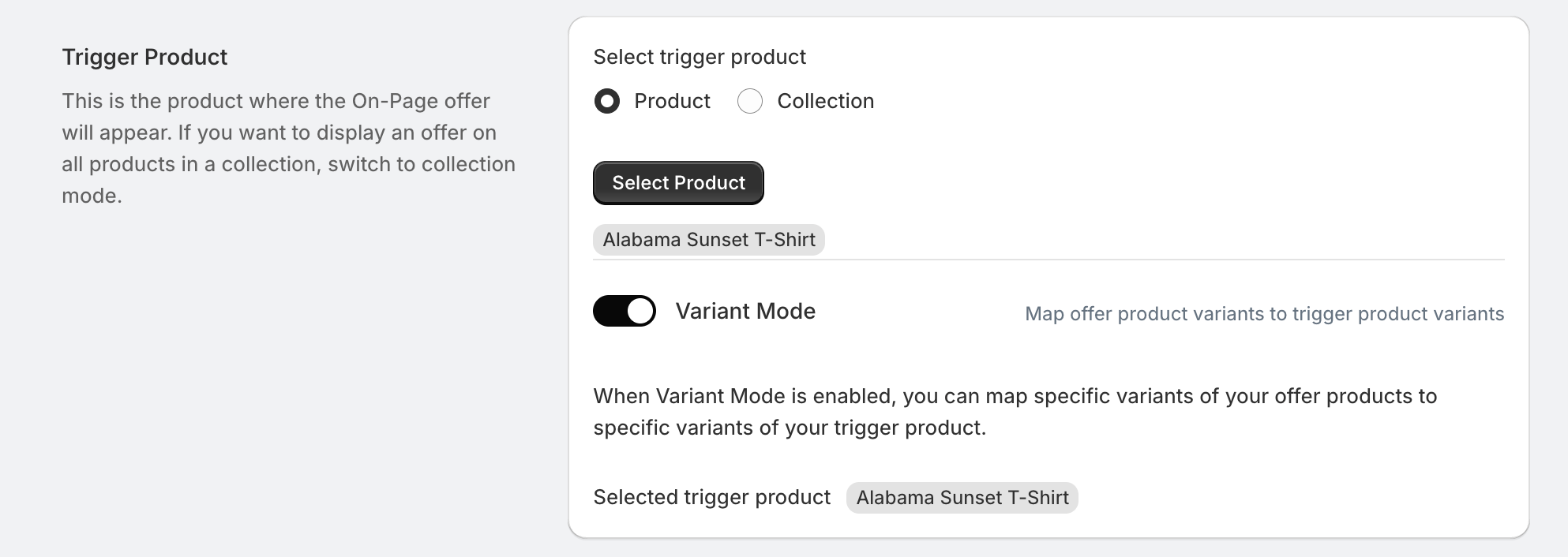
Another practical benefit is speed. If your team launches new seasonal colours or limited editions every month, AI can help keep cross-sells fresh without requiring someone to remap every new variant manually.
What are the best Shopify apps for matching variant cross-sells?
The best Shopify apps for this use case are the ones that support variant-aware recommendations, flexible placement, and easy testing. For most merchants reading this, two apps are especially relevant.
| App | Best for | Key strength | App Store |
|---|---|---|---|
| SellUp | Curated upsells and cross-sells | Manual control over offers and placement across product, cart and post-purchase flows | View app |
| Variant Match Upsell on your Store | Variant-based matching | Built specifically around matching products based on the selected variant or look | View app |
Why would I use SellUp for this?
SellUp is a strong option if you want flexible offer placement and straightforward control over which products appear where. I built apps in this ecosystem because merchants often need something practical rather than bloated, and SellUp fits that mindset well.

It is useful when you want to manually define which products should appear together on the product page, in the cart, or after checkout. That makes it especially good for stores with a curated range where the merchant knows exactly which combinations convert best. You can see the listing here: SellUp on the Shopify App Store.
Why would I use Variant Match Upsell on your Store?
Variant Match Upsell on your Store is designed for merchants who want the recommendation itself to respond to the selected variant. That makes it more specialised for the exact problem this article is about.

If your products rely heavily on matching colours, coordinated patterns, or style-led collections, this type of app is often a better fit than a generic recommendation engine. You can view it here: Variant Match Upsell on your Store.

How do manual rules compare with AI matching?
Manual rules are best for control. AI matching is best for scale. Most stores eventually benefit from using both.
| Approach | Best for | Pros | Cons |
|---|---|---|---|
| Manual variant mapping | Small catalogues, premium brands, curated collections | Maximum control, brand-safe pairings, easy to fine-tune | Time-consuming, harder to maintain as catalogue grows |
| Tag or metafield logic | Mid-sized catalogues with structured data | More scalable than manual pairing, relatively predictable | Needs clean data, can become messy over time |
| AI variant matching | Large catalogues, frequent launches, many combinations | Fast setup, scalable, adapts to catalogue complexity | Needs review, may suggest weak pairings without overrides |
If I were advising a merchant with fewer than 100 products, I would usually start manual. If the catalogue is larger, seasonal, or design-heavy with lots of variants, I would seriously consider AI or at least semi-automated logic.
How do I measure whether matching variant cross-sells are working?
You should measure both AOV and conversion rate. A cross-sell that increases basket size but hurts completed orders is not a win.
The core metrics I would track are:
- Average order value
- Conversion rate
- Attach rate for the recommended product
- Revenue per visitor
- Items per order
- Offer acceptance rate by placement
Run simple A/B tests where possible. Compare traffic that sees the matching offer against traffic that does not. If AOV rises but conversion dips, the offer may be too distracting, badly placed, or not relevant enough.
I also recommend segmenting by product type. Matching cross-sells for fashion may behave very differently from homeware or beauty. Looking only at site-wide averages can hide useful patterns.
What products work best for matching variant cross-sells?
The best products are complementary, lower-friction additions that clearly belong with the main item. They should complete the purchase, not compete with it.
Examples that often work well include:
- Fashion: matching hats, belts, scarves, jewellery, socks
- Home decor: cushions, throws, lampshades, wall art
- Beauty: cleanser plus moisturiser, serum plus tool, refill plus case
- Sports and outdoor: bottle plus backpack, gloves plus hat, shoe care products
- Furniture: matching finishes, compatible storage, desk accessories
A good rule is that the cross-sell should feel like a natural extension of the original item. If it creates confusion or forces the customer to rethink the whole purchase, it is probably not a good cross-sell.
What are the biggest mistakes merchants make with variant cross-selling?
The biggest mistakes are irrelevance, overloading the page, and failing to test. Most poor-performing cross-sells can be traced back to one of those three issues.
- Showing too many recommendations and creating choice overload
- Using product-level logic only when the store clearly needs variant-level matching
- Promoting products that do not visually or functionally fit
- Ignoring mobile layout, where many recommendation widgets become cluttered
- Not measuring conversion impact, only AOV changes
- Trying to automate everything immediately without validating the core pairings first
In my experience, less is often more. A single highly relevant recommendation can outperform a whole row of generic ones.
How should small stores start with matching variant cross-sells?
Small stores should start manually with their top-selling products. You do not need enterprise tooling to see results.
If you are a smaller merchant, here is the rollout I would use:
- Identify your top 10 best-selling products
- List the most important variants for each one
- Choose 1 to 3 complementary products per key variant
- Add offers to the product page first
- Measure AOV, attach rate and conversion for 2 to 4 weeks
- Expand to cart drawer and post-purchase once the pairings are proven
This approach keeps setup manageable and gives you clean data. You can always add more sophistication later.
Is variant cross-selling still worth it in 2026?
Yes, variant cross-selling is absolutely worth it in 2026, especially for stores with visual, style-led or accessory-friendly catalogues. Personalised merchandising is no longer a nice extra. It is part of what shoppers expect.
Search results around AOV in 2026 are full of broad advice like free shipping thresholds, bundles and post-purchase offers. Those tactics still matter. But matching-variant cross-selling gives you something many competitors still miss: precision. It helps you sell more without making the shopping experience feel pushy.
That is why I like it so much. It does not rely on gimmicks. It simply uses your catalogue more intelligently.
What should you do next?
Your next step is to audit your current recommendations and fix the obvious mismatches. If a shopper selects a specific variant and your store responds with generic products, start there.
Then choose whether your catalogue is better suited to manual curation or AI-assisted matching. For many stores, using a purpose-built app such as SellUp or Variant Match Upsell on your Store is the fastest way to get live and start testing.
If you want to go further with upsells and cross-sells across the whole funnel, these LaunchTip guides will help:
- Shopify Upsell on the Product Page
- How to Upsell on Your Shopify Store: 6 Methods
- How to Display Customizable Add-Ons and Upsells on Shopify
When matching recommendations are done well, they do not feel like a sales tactic. They feel like good service. And in ecommerce, that is usually what drives the best results.