

Last Updated on by Dan S
Originally Published October 2, 2022.
Generating more revenue for your Shopify store can be done in numerous ways. Presenting new products or extra services are just two ways, along with increasing your prices. But these don’t always boost your revenue. One important method is how you as a merchant sell your products to your customers.
This guide will demonstrate why cross-selling is important for your store. We’ll discuss how you can use it in your business to drive more sales, which in turn leads to better customer lifetime value.
Table of Contents
What is cross-selling?
Cross-selling is a technique that is used to get your customers to purchase more from your store. It normally means the customer will purchase a complementary or related product to the initial one they were going to buy. It’s an easy way to increase your average order value.
Recent data shows that cross-selling is highly effective for ecommerce businesses. Studies indicate that cross-selling contributes to 10-30% of ecommerce revenues, and brands using cross-selling tactics typically see a 20% increase in profit. This makes it one of the most powerful strategies for boosting revenue without additional customer acquisition costs.
Let’s take this example of cross-selling. A customer purchases a phone case for their phone from your online store. Cross-selling in this scenario would be offering the customer a screen protector for the same phone model. The screen protector is an additional product to be purchased alongside the phone case. It adds value to the customer’s order whilst increasing your revenue.
Cross-selling is super effective when the complimentary or relevant product is lower in cost than the main product. Research shows that when choosing cross-sell products, you should avoid suggesting items that increase the overall order by more than 25%. This approach helps maintain customer comfort with spending while still boosting your average order value.
Another example where this scenario works would be when a customer purchases a new laptop and the seller offers an extended warranty. The customer is more likely to purchase the warranty, as it’s much lower in cost compared the laptop. The customer also receives value from purchasing both items together.
Let’s take a look at some examples of cross-selling.
Cross-selling examples
Other methods of cross-selling include getting customers to buy from “Frequently bought together” or “Customers who bought this item also bought” sections on your product pages.
Examples include:
- Ordering a takeaway online and getting asked if you want to add an extra side dish
- Showing a customer shopping on your retail store an item of clothing and then displaying a whole outfit to encourage them to buy all the pieces instead of just one
- A customer purchases a phone case and you display the matching AirPods case
- If you’re buying a new car and the dealer encourages you to add an upgraded sound system
- An online golf store shows you a golf club and also displays golf balls as an add-on
Not only can you display complimentary and relevant items on a product page, you can also use pop-ups to encourage customers to buy more.
When a customer adds a product to their cart, a pop-up can display, showing the customer a relevant product to compliment the one in their cart. Create a sense of urgency by displaying a discount too to urge the customer to add the item to their cart also.
To get started with cross-selling, SellUp is a Shopify app that offers easy implementation on your store. You can set up cross-sells in minutes and start generating extra revenue.
Just ensure you don’t go overboard. Sometimes customers can be put off by too many offers and pop-ups. Data shows that 85% of customers are unlikely to respond to cross-selling requests that are irrelevant to their needs, so keeping your recommendations targeted and relevant is crucial.
The best ways to use cross-selling
Always ensure that cross-selling techniques on your store improve your customers’ satisfaction, not hinder it. Some of the best ways to use cross-selling are:
- Bundle related products together so that customers don’t have to spend time searching on your store
- If using bundles, offer discounts to encourage customers to purchase quicker
- Recommend a relevant and complimentary product to the main item they customer is purchasing
- Personalize recommendations based on customer behavior and purchase history – studies show personalized recommendations can increase sales by up to 35%
When offering product add-ons to your customers, you need to work out which products complement each other. The goal of cross-selling is to increase your average order value whilst creating customer satisfaction. Research indicates that 44% of online shoppers are likely to repeat purchases from retailers offering personalized product recommendations.
How to maximize cross-selling
When a merchant incorporates cross-selling into their marketing strategy, they can increase their revenue significantly. Studies show that companies implementing cross-selling strategies have seen revenue increases of up to 30%. It’s a simple way to grow your revenue without spending money on marketing. The examples above are a great starting point to implement cross-selling on your online store.

In 2025, leveraging AI-powered product recommendations and customer data analysis has become even more important for successful cross-selling. The most effective merchants use customer behavior data to deliver relevant suggestions at the right time in the shopping journey.
5 effective cross-selling examples
Now you’ve gained an understanding of what cross-selling is and how you can use it, let’s take a look at some effective strategies you can implement on your Shopify store.
1. Key product suggestions
When consumers browse online, there is nobody there to help offer related items. That is where product suggestions come in. eCommerce lets you leverage browsing data, meaning you can offer personalized offers to your customers.
These product suggestions are one of the easiest cross-selling techniques. The example below from Mango, shows how they cross-sell to their customers by using ‘Complete your outfit’.

This encourages consumers to complete the outfit look. By doing this, they are more likely to add extra items to their cart. This in turn increases their order value, which means a higher average order value for you.
It’s a great method to use, because it’s not pushy to the consumer. You’re purely just suggesting the other outfit items. Research shows that about 44% of consumers have made an impulse purchase following a recommendation, demonstrating the power of strategic product suggestions.
2. Product page offers and add-ons
Although this method could also be thought of as product suggestions, it is different. Instead of offering cross-sell products below the product details, you display the offers just above or below the Add to Cart button.
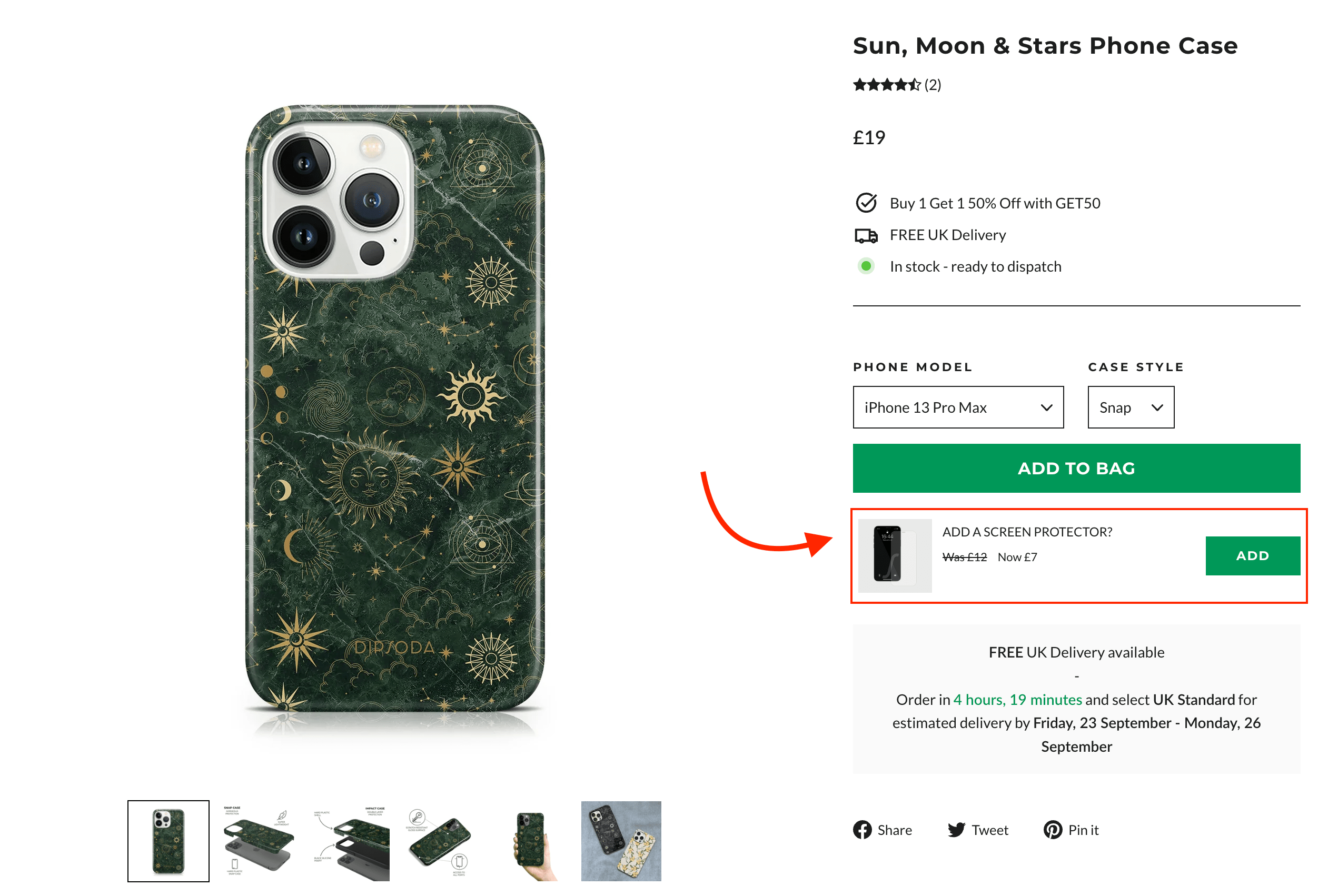
The example below shows this method being used.

DIPSODA uses the product page add-ons to offer a screen protector alongside the main phone case product. Showcasing another complementary product near the Add to Cart button ensures that consumers notice it.
You could even go on to say that a screen protector is a necessary item with the phone case. Both these products go hand in hand and offer a device great all round protection.
Just ensure that you keep cross-sell options to a minimum, as you don’t want to overcrowd the page. This can put consumers off purchasing from your store.
3. Cross-sell popup
Another cross-sell method to use is a popup window offer. These convert well and require an action from the consumer.

SellUp is the perfect Shopify app for this cross-selling method. Again, the offer should be relevant to the original product the customer was looking at. The item that shows in the popup is relevant and improves the consumer’s experience.
Using popups in a timely manner is key. Customers don’t want to be bombarded with too many popups. Having it appear after the customer adds an item to their cart is a great way to use it.
Ensuring the popup matches your store’s branding is also a great way to get it to convert. If the product is eye-catching, the customer is more likely to add it to their cart.
4. Product bundles
Using product bundles is a great way to cross-sell to your customers. Bundles offer more value to your customers and normally for sets of items that are relevant to each other.
Cleancult offers great product bundles that are relevant to their customers.

When looking at the product bundle above, it’s clear to see the customer can save money when they purchase the bundle option.
Subscribe and save is a great option to give more to your customers for less. It also pushes them to convert more often, as they’re getting more value for money. The subscription ecommerce market is projected to grow significantly, with bundled offerings providing perceived value through slight discounts.
Grouping relevant products together in a bundle creates a higher average order value too.
5. Thank you page offers
You might be wondering why it’s a good idea to present another product to a customer after they’ve checkout on your store. But truthfully, consumers are still in shopping mode.
It never hurts to offer another relevant product or item that is relevant to one they have just purchased.

This last minute offer gives customers who have checked out an opportunity to purchase another product that is relevant to the one they just bought.
As consumers are still in buying mode, having an offer that they cannot resist will help them to convert. Post-purchase cross-selling can be highly effective without significantly impacting the checkout experience, and it can increase customer lifetime value by encouraging additional purchases.
Conclusion
Cross-selling is a powerful strategy to boost your Shopify store’s revenue and enhance customer satisfaction. By strategically offering complementary or related products, you can increase your average order value without additional marketing expenses.
With recent data showing that cross-selling can contribute 10-30% of ecommerce revenues and increase profits by up to 20%, it’s clear that this strategy remains essential for online merchants in 2025. From product suggestions to pop-ups and product bundles, there are numerous ways to implement cross-selling effectively.
The key is to ensure that these techniques provide value to the customer and enhance their shopping experience rather than overwhelming them. Focus on relevance, personalization, and strategic timing to maximize the effectiveness of your cross-selling efforts.