

If you want DTC inspiration from real founders rather than recycled LinkedIn advice, Starter Story is still one of the best resources I recommend. It is especially useful for Shopify merchants because it shows how businesses actually started, what they spent, what worked first, and where growth really came from.
As someone who builds Shopify apps and spends a lot of time analysing what makes stores grow, I like founder interviews because they reveal the bits you do not see on polished brand homepages. You get the messy starting point, the early traction channels, the failed ideas, and the practical constraints. That is often far more valuable than reading generic advice about branding or performance marketing.
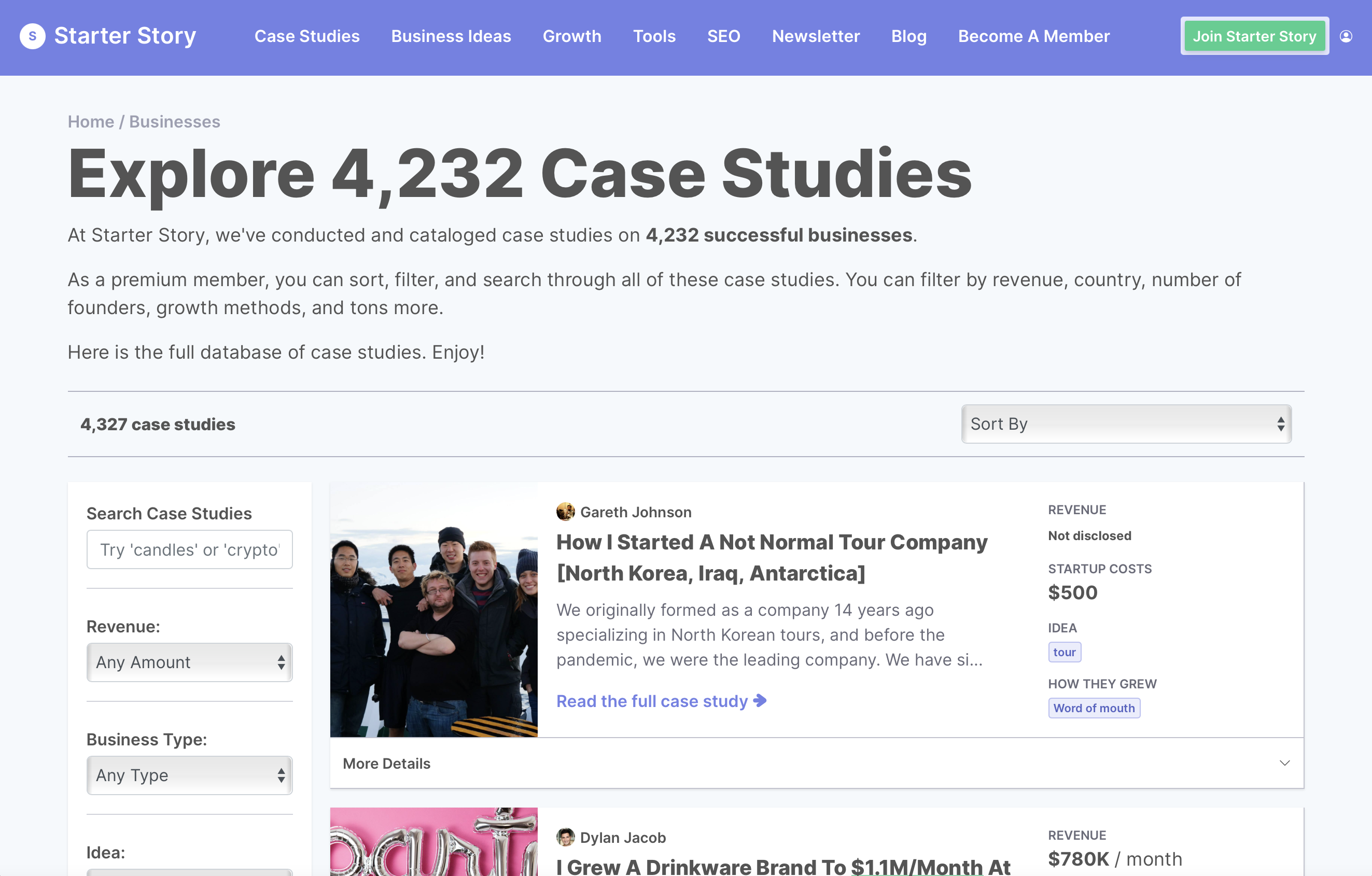
Starter Story was founded by Pat Walls in 2017 and has grown into a huge library of founder interviews, business ideas, growth breakdowns, and educational resources. Based on the latest research, the platform now attracts roughly 1.4 to 1.6 million monthly visitors and has reportedly grown to $500K to $1M+ in annual revenue, largely through content, SEO, and smart automation.
That scale matters because it means Starter Story is no longer just a nice side project. It is now one of the biggest searchable databases of founder stories on the web, including hundreds of eCommerce and DTC examples that overlap directly with what Shopify merchants are trying to build.
What is Starter Story and why does it matter for DTC founders?
Starter Story is a founder interview platform that documents how real businesses started, grew, and made money. For DTC founders, it matters because it turns vague entrepreneurial ambition into specific, repeatable patterns you can actually learn from.
Most content about direct-to-consumer brands focuses on polished outcomes. Starter Story is more useful because it often shows the startup cost, the original acquisition channel, the founder's background, and the timeline to revenue. In my experience building Shopify apps, those are the details merchants need most when they are deciding whether an idea is realistic.
It also fits the way modern eCommerce founders research. Before launching a store, people want proof that others have started small, validated demand, and built something meaningful without raising venture capital. That is exactly the gap Starter Story fills.
How did Starter Story start?
Starter Story began after Pat Walls moved on from a failed B2B SaaS side project and decided to build a simpler, more manageable content business. He launched it in October 2017 by interviewing entrepreneurs and publishing detailed case studies.
One part of Pat's story that I think resonates with Shopify founders is that he did not start with a grand media empire plan. He started with a practical format, a clear audience, and a workflow he could sustain. According to the research, he even built a custom CMS after running into WordPress limitations, then scaled from interviews with friends to dozens of case studies a month.
That is a familiar pattern in eCommerce too. Many solid businesses begin with a constrained, low-risk version of the idea rather than a big launch. The lesson is simple: start with a repeatable process, not a perfect brand ecosystem.
If you are in that early stage yourself, my advice is to pair founder research with practical setup work. Our guides on must-have apps for new Shopify stores and the best Shopify apps for beginners are a good next step once inspiration turns into action.
Why should I read about other entrepreneur journeys?
Reading founder journeys helps you compress years of trial and error into a few focused hours. It gives you pattern recognition, realistic expectations, and a better sense of what matters in the first 12 months.
I have seen merchants waste months obsessing over logos, colour palettes, and homepage animations while ignoring offer clarity, product positioning, and retention. Founder stories help correct that. They show that many successful DTC brands started with a narrow niche, a simple product angle, and one reliable acquisition channel.
Starter Story is useful here because it makes those patterns visible at scale. When you read enough of the interviews, you start noticing the same themes repeating across very different businesses.

-
Inspiration with context
It is easier to stay motivated when you can see how someone else started from a normal situation. Many of the best stories begin with a side hustle, a personal frustration, or a small skills advantage rather than a huge budget. -
Learning from real execution
You can see what founders did first, how they got their first customers, and which channels actually moved revenue. That is much more helpful than broad advice like “build a community” or “focus on branding”. -
Avoiding common mistakes
Founder interviews often reveal what did not work. In eCommerce, that might be poor margins, over-reliance on paid ads, stocking the wrong products, or building too broad a catalogue too early. -
Finding business models that suit your constraints
Some people have cash but no audience. Others have skills, content reach, or a niche community. Reading different stories helps you find a path that matches your reality. -
Building better judgement
After reading enough case studies, you start to analyse opportunities better. You get a feel for whether an idea has repeat purchase potential, strong margins, a clear pain point, or enough differentiation.
That last point matters a lot. In my experience, the biggest benefit of founder content is not motivation. It is better decision-making.
What can Shopify merchants learn from the best Starter Story eCommerce examples?
The best Starter Story eCommerce examples show that successful DTC businesses usually start with a niche, a clear problem, and a manageable first sales channel. They do not usually begin with a huge catalogue or a complicated brand strategy.
Looking at the current success stories ranking in search, the strongest examples cover a wide revenue range. That is useful because not everyone needs inspiration from a nine-figure brand. Sometimes a $200K per year business with a tiny team is actually the more relevant model for a new Shopify founder.
| Business | Reported revenue | Startup cost | What stands out | Key lesson for Shopify founders |
|---|---|---|---|---|
| FactoryPure | $36M/year | Not specified | Pivoted from a failed venture into drop-shipping air purifiers via manufacturer relationships | Niche focus and margin discipline can beat broad general-store thinking |
| Blindster | $36M/year | $50K | Started after a poor buying experience in custom window treatments | Exceptional service can be the differentiator in boring categories |
| OWC | $162M/year | $20K | Built over decades through reliable Apple upgrade products and word-of-mouth | Trust and product depth matter massively in technical niches |
| Gumroad | $21.2M/year | $0 | Started as a weekend project to simplify selling online | MVP speed often beats overplanning |
| Xero Shoes | $48M/year | Not specified | Grew from a personal running need into a scaled product business | Founder-product fit can create stronger messaging and product conviction |
| SFKshop | $216K/year | $1.5K | Started by helping a family business sell garage door motors online | Low-cost execution is still a valid route into eCommerce |
| TopWhiskies | $210K/year | Not specified | Turned a whisky content hobby into product sales | Audience-first businesses can transition naturally into DTC |
The common thread is not “raise money and spend heavily on ads”. It is usually solve a specific problem, start with the assets you already have, and keep the model simple enough to survive the early months.
What patterns show up again and again in successful DTC founder stories?
The most common DTC pattern is a founder spotting a clear problem they understand personally and building a focused offer around it. The second most common pattern is starting smaller than expected.
After reading a lot of founder stories and working with Shopify merchants through my own apps, these are the patterns I keep seeing:
- Personal pain point - The founder experienced the problem first-hand, which made the messaging sharper and the product angle clearer.
- Niche before scale - They did not try to sell everything to everyone. They began with one category, one audience, or one use case.
- Low to moderate startup costs - Many businesses started for under $20K, and some with far less.
- SEO, content, or word-of-mouth first - Plenty of stories show traction before serious paid acquisition.
- Operational realism - The founders often chose models that matched their cash flow, skills, and time constraints.
This is why I think Starter Story is particularly helpful for Shopify beginners. It makes entrepreneurship feel less mythical and more operational.
If you are still at the idea stage, our post on small online business ideas to start on Shopify is a useful companion piece because it helps turn inspiration into a practical shortlist.
Starting out in ecommerce with Shopify
Shopify is still one of the easiest ways to turn a DTC idea into a real store quickly. It is especially strong when you want to validate demand, launch fast, and add functionality as you grow.
Starter Story and Shopify work well together conceptually. Starter Story gives you the business model inspiration and founder proof. Shopify gives you the infrastructure to test the idea without building everything from scratch.
The DTC market opportunity remains huge, but the stores that win are not always the ones with the fanciest design. In my experience, the better-performing Shopify stores usually get the basics right first: product-market fit, clear copy, believable reviews, fast navigation, and a strong post-add-to-cart experience.

That matters because many of the stories on Starter Story started with simple storefronts and straightforward offers. The lesson is not to launch an ugly store. It is to avoid using design perfection as a substitute for market validation.
If you are launching a Shopify store inspired by these founder stories, I would focus on this order:
- Choose a narrow product angle with clear demand or a clear pain point.
- Write intent-driven product titles and descriptions so shoppers instantly understand the offer. Our guide on intent-based product titles helps with this.
- Add trust signals early such as reviews, delivery messaging, and FAQs.
- Set up one meaningful upsell or cross-sell flow rather than cluttering the store with ten apps.
- Choose one primary acquisition channel such as SEO, short-form content, email capture, or creator partnerships.
That is a much more realistic launch plan than trying to copy a mature eight-figure DTC brand on day one.
Is Starter Story worth it for new eCommerce founders?
Yes, Starter Story is worth using if you learn best from examples and want practical founder-led inspiration. It is most valuable for people who are still validating an idea, choosing a niche, or trying to understand what realistic growth paths look like.
I would not treat it as a magic shortcut. Reading founder stories will not replace customer research, offer testing, or conversion optimisation. But it can save you from choosing the wrong model or expecting the wrong timeline.
For newer merchants, the biggest value is seeing that not every successful business began with a huge budget. Some of the most compelling examples started as side projects, family businesses, or content-led experiments. That is encouraging, but it is also strategically useful.
| Who it helps most | Why it is useful | Potential limitation |
|---|---|---|
| First-time Shopify founders | Shows realistic starting points and common growth paths | You still need to execute, not just consume content |
| Side hustlers | Many stories begin with low startup costs and limited time | Some case studies may not match your exact niche |
| DTC operators stuck for ideas | Useful for spotting niche opportunities and overlooked categories | Can create idea overload if you do not filter properly |
| Content-led founders | Strong examples of SEO and audience-first growth | Not every story includes full operational detail |
How can I use Starter Story without getting stuck in research mode?
The best way to use Starter Story is to read for patterns, not entertainment. Pick a narrow goal, extract the useful lessons, and apply them to your store within the same week.
This is important because founder content can become productive procrastination. I have done this myself with industry research, and I have seen merchants do it too. You read 20 stories, feel inspired, and still do not launch anything.
Here is the approach I recommend:
- Choose one lens - niche ideas, acquisition channels, pricing, or startup costs.
- Read 5 to 10 relevant stories rather than browsing randomly.
- Write down recurring patterns such as “SEO first”, “problem-solving product”, or “family business pivot”.
- Turn those patterns into decisions for your own store.
- Set a deadline for launch, first content piece, or first product upload.
If your current challenge is traction rather than ideation, read our post on how to get your first sale on Shopify. It complements founder inspiration with more immediate actions.
What should I copy from successful DTC stories and what should I ignore?
You should copy the principles, not the surface details. The right takeaway is usually about positioning, customer understanding, or channel focus, not about copying a product category or homepage layout.
For example, if a founder built a strong business in a niche category, the lesson is not “sell blinds” or “sell whisky”. The lesson is that specialisation creates trust, improves conversion, and makes content easier to produce. If a founder grew through SEO, the lesson is not “start a blog because everyone says so”. It is that search intent compounds when your category lends itself to education and comparison.
What I would ignore is survivorship bias. Not every story is equally repeatable, and not every channel will work for every product. Some businesses benefited from timing, unusual founder expertise, or a market that was less crowded than it is now.
That is why I always suggest combining inspiration with store mechanics. For instance, if you see a founder win through better average order value, then implement a practical upsell strategy. Our articles on Shopify cart drawer upsells and a real upsell case study are good examples of turning a principle into execution.
What are the biggest lessons from Starter Story for building a modern DTC brand in 2026?
The biggest lesson is that strong DTC brands still begin with simple fundamentals. In 2026, the tools are better and the competition is tougher, but the core formula has not changed much.
From what I see across Shopify stores and founder case studies, the most durable lessons are these:
- Start with a believable offer, not a bloated catalogue.
- Use your constraints as a strategy. Limited budget often forces better focus.
- Pick a channel that fits the product. SEO, creators, paid social, and email all work differently depending on the category.
- Obsess over trust. Reviews, delivery clarity, returns information, and post-purchase communication matter more than many founders expect.
- Improve AOV and retention early. New customer acquisition is expensive, so every order needs to work harder.
In my experience building Shopify apps, merchants often underestimate how much growth comes from small conversion improvements rather than dramatic rebrands. Better product recommendations, clearer messaging, and stronger social proof can have a bigger impact than launching three new collections.
That is another reason Starter Story remains relevant. It reminds you that businesses are built through a series of sensible decisions, not one viral breakthrough.
So where should you start if you want DTC inspiration today?
Start by reading a handful of relevant Starter Story interviews, then use what you learn to make one concrete move on your Shopify store. Inspiration only becomes valuable when it changes your next decision.
If you are at square one, browse the broader eCommerce store success stories and eCommerce brand success stories collections. If you already have a store, read with a more tactical lens: customer acquisition, retention, niche positioning, or average order value.
Personally, I still like Starter Story because it makes entrepreneurship feel tangible. It shows that plenty of successful eCommerce founders did not begin with perfect timing, perfect branding, or perfect certainty. They started with a problem, a product, and a willingness to keep refining.
That is also how most good Shopify stores are built.
If you want to explore it yourself, you can check out Starter Story here or jump straight into the explore section to filter stories by business type, revenue, and more.


