

You can create a customer quotation in Shopify by using Draft Orders. Shopify does not offer a dedicated native quote feature, but draft orders work as quotes for most merchants because you can add products, adjust pricing, apply discounts, and send an invoice link for approval or payment.
In my experience building Shopify apps and helping merchants with custom workflows, this is the simplest and most reliable way to handle quotes inside Shopify. If you need customers to request quotes themselves from the product page or cart, then a quote app is usually the better option.
Does Shopify have a quotation feature?
No, Shopify does not have a standalone quotation tool. The closest native option is Draft Orders, which let you build a custom order, save it, and send it to a customer as an invoice-style quote.
This matters because many merchants search for a quote feature and assume Shopify has a button labelled “Create Quote”. It does not. Instead, Shopify expects you to use Orders > Drafts for admin-created quotes, or install an app if you want request-a-quote buttons, custom forms, or automated quote workflows.
If you sell bespoke products, wholesale packs, made-to-order items, furniture, trade supplies, or anything with negotiated pricing, Draft Orders are often enough to get started. I have seen plenty of stores use them successfully before graduating to a more advanced setup.
How do I create a customer quotation in Shopify?
To create a customer quotation in Shopify, go to Orders, open Drafts, create a new draft order, add products or custom items, assign a customer, and send the invoice. That invoice acts as your quote.
This is the exact workflow most merchants need. It is free to use, built into Shopify, and it keeps the quote close to your real order data so there is less admin to manage later.
Step 1: Go to Draft Orders in Shopify admin
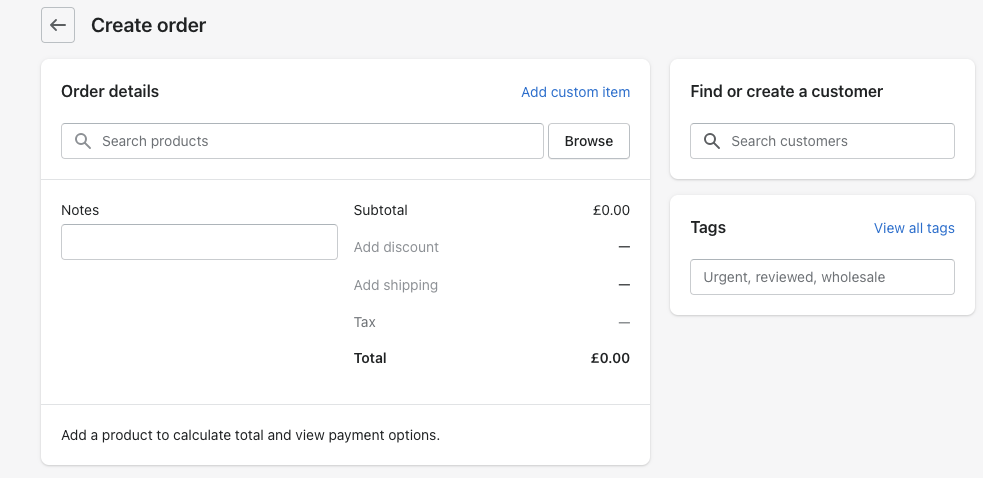
Open Shopify admin and navigate to Orders > Drafts. Then click Create order to start building the quotation.
This is where Shopify stores all draft orders that have not yet been completed. If you create a lot of phone, email, or trade orders, this area quickly becomes one of the most useful parts of the admin.
Step 2: Add products, services, or custom items
Add the products the customer wants quoted. You can browse your catalogue, add variants, adjust quantities, or include custom line items for services, setup fees, installation, or one-off charges.
This flexibility is the main reason Draft Orders work so well as quotes. For example, if a customer wants a bundle, a trade discount, or a special delivery charge, you can build that directly into the draft instead of trying to explain it over email.
Step 3: Adjust pricing or apply discounts
You can edit prices inside the draft order before sending it. Shopify also supports discounts at line item or order level, which is useful for negotiated quotes.
In practice, this is how most merchants create a proper quotation rather than just sending a standard basket. You can reflect trade rates, bulk pricing, goodwill discounts, or project-based pricing without changing your live product prices for everyone else.
Shopify has also introduced price locking on draft orders, which helps preserve the quoted price even if your catalogue price changes later. That is especially useful when a customer takes a few days to approve the quote.
Step 4: Add the customer details
Attach the quote to a customer before you send it. Add their name, email address, and any other relevant details so the quotation is personalised and easy to track.
This step is more important than it looks. Once a customer is attached, the draft order becomes easier to manage, easier to resend, and easier to convert into a real order later. It also gives your team a clear record of who requested what.
Step 5: Save the draft and send the quote
Click Save, then use Send invoice to email the quotation. The customer receives a link where they can review the quote and complete checkout if they accept it.
This is the point where a draft order behaves like a real quote. You are not just emailing a number in plain text. You are sending a structured, trackable Shopify object that can become a paid order with far less friction.
If you need Shopify’s official documentation for this workflow, the Help Centre guide on creating draft orders is still the best starting point.
What is the best way to send a quote to a customer in Shopify?
The best native way is to send the draft order invoice link. This gives the customer a clean, branded path to review the quote and pay, without needing extra software.
Some merchants assume they need a PDF quote or a separate invoicing tool straight away. In reality, for many stores the built-in invoice link is enough. It is fast, low-maintenance, and avoids duplicate admin work.
If you want more polished quote documents, branded PDFs, or formal estimate templates, you may want to pair Shopify with a document app such as Sufio or a PDF/invoice tool. But for most stores, native Draft Orders are the quickest route.
Can customers edit or change a quotation in Shopify?
Not directly in the way they can edit a cart. If a customer wants to change quantities, add products, or revise the quote, you usually need to update the draft order and resend it.
This is one of the main limitations of Shopify’s native approach. It works well when you control the quote creation process, but it is less elegant if your customers expect a self-serve quoting portal.
In my experience, this is where merchants start looking for apps. If your sales process involves multiple revisions, approvals, or back-and-forth pricing, a dedicated quote app can save a lot of time.
Adding more products to a quotation
If the customer wants extra items, update the draft order and send a fresh invoice link. That keeps the quote accurate and avoids confusion around old pricing or outdated line items.
This is still a workable process for lower-volume stores. But if your team is handling dozens of quote revisions a week, native Draft Orders can start to feel manual.
Do Shopify quotations expire automatically?
Not in the way most merchants expect. Shopify does not provide a short custom quote-expiry setting for Draft Orders, although inactive draft orders are subject to Shopify’s longer retention rules.
As of the latest guidance, draft orders created on or after 1 April 2025 are automatically deleted after 1 year of inactivity. Any edit resets that timer. That is useful for housekeeping, but it is not the same as a 7-day or 30-day quote expiry.
If you want a quotation to expire after a shorter period, you will need to manage that manually in your process. The simplest way is to state the validity period clearly in the message you send, then update or delete the draft if it is no longer valid.
For merchants with more complex quoting needs, this is another strong reason to use an app with proper expiry settings, reminders, and status tracking.
When should I use Draft Orders instead of a quote app?
Use Draft Orders if you create quotes manually and do not need customers to request them on-site. Use a quote app if you need automation, product-page quote buttons, hidden pricing, or customer-submitted quote requests.
I usually frame it like this: Draft Orders are best for simple admin-created quotes, while apps are better for scalable quote workflows. Neither is universally better. It depends on how your store sells.
| Method | Best for | Cost | Strengths | Limitations |
|---|---|---|---|---|
| Shopify Draft Orders | Manual quotes created by staff | Included in Shopify | Fast setup, native workflow, discounts, custom items, invoice links | No true quote portal, limited automation, no built-in short expiry controls |
| Quote Apps | Customer-requested quotes and advanced B2B workflows | Usually paid monthly | Request buttons, forms, file uploads, notifications, hide prices, automation | Extra app cost, setup time, possible theme integration work |
A good rule of thumb is this: if your team creates fewer than a handful of quotes a week, native Draft Orders are often enough. If quotes are central to your sales process, an app usually pays for itself quickly.
What are the best Shopify apps for customer quotations?
The best Shopify quote apps are the ones that fit your workflow. For most merchants, the key features to compare are request-a-quote buttons, form flexibility, draft order integration, and price hiding.
Over the years, I have seen merchants choose quote apps for very different reasons. Some want a simple “Request a Quote” button on selected products. Others need full B2B behaviour, such as hiding prices from retail visitors, collecting specifications, and turning requests into approved orders.
| App | Best for | App Store | Notable strengths |
|---|---|---|---|
 Quick Quote |
Cart-based quote requests | View app | Lets customers request a quote from the cart, strong fit for merchants who want a straightforward quoting flow |
 SA Request a Quote |
B2B and price-hiding setups | View app | Useful for replacing add-to-cart with quote requests and collecting lead details |
 Qteedy |
Flexible quote workflows | View app | Designed for merchants who want dedicated quote management beyond basic drafts |
 YouQuote |
Simple request-a-quote journeys | View app | Good for stores wanting a more customer-facing quote request process |
There are also other tools in this space, including QuoteMachine and specialist invoicing apps. My advice is to shortlist two or three, check how they handle theme compatibility, draft order conversion, and mobile UX, then test them in a duplicate theme before going live.
What features should I look for in a Shopify quote app?
The best quote app features are request buttons, custom forms, automated notifications, and draft order conversion. If you are running wholesale or custom-product workflows, price hiding and file uploads are also valuable.
- Request a Quote button on product pages, collection pages, or cart
- Hide prices or hide Add to Cart for selected products or customer groups
- Custom fields for measurements, specifications, notes, and uploads
- Automatic email notifications to staff and customers
- Draft order or invoice conversion for easy checkout
- Theme-friendly design that works on mobile and does not look bolted on
- Status tracking for pending, approved, expired, and converted quotes
Mobile matters more than many merchants realise. With 50%+ of ecommerce traffic often coming from mobile devices, a quote form that is clunky on phones can quietly hurt lead volume.
What is the best quotation setup for B2B or wholesale Shopify stores?
For B2B stores, a quote app is usually the better setup. Wholesale buyers often expect request forms, negotiated pricing, hidden retail prices, and account-specific workflows that native Draft Orders do not handle elegantly on their own.
If you are on Shopify’s B2B features or Shopify Plus, you may already have more advanced customer and pricing controls. Even then, many merchants still add a quote app because it solves the front-end request flow more cleanly.
In B2B projects I have worked around, the winning setup is often a combination of customer tagging, hidden prices, quote requests, and draft order follow-up. That gives the sales team control without forcing every buyer through a standard retail checkout.
If you are growing into that model, you may also want to read When to Upgrade Your Store to Shopify Plus.
How do I make my Shopify quotations look more professional?
Use clear pricing, a validity date, customer details, and a clean message. Even if you are using Draft Orders, a professional quote comes down to how clearly you structure and present it.
I recommend including the following every time:
- Customer name and company name
- Quote reference number for easy follow-up
- Itemised products or services
- Delivery or shipping costs
- Tax treatment where relevant
- Validity period, such as 7 or 14 days
- Payment or acceptance instructions
If you need a more document-style output, consider using a specialist invoicing app or PDF tool. Some merchants also pair quotes with internal notes and approval workflows using apps like NoteDesk for order context, although that is more of an internal operations layer than a quote app.
What are the main limitations of Shopify Draft Orders for quotations?
The main limitations are automation, self-service, and expiry control. Draft Orders are excellent for simple quoting, but they are not a full quotation management system.
Here are the limitations I see most often:
- No native request-a-quote button on product or cart pages
- No built-in short expiry logic like automatic 7-day expiration
- Manual revisions when customers want changes
- Limited form capture for measurements, uploads, or technical requirements
- No dedicated quote dashboard with statuses and approval pipelines
That said, for many small and mid-sized stores these limitations are acceptable. I would not overcomplicate the setup on day one if your quote volume is still low.
How do I choose between a quote app and a custom build?
Most stores should start with an app, not a custom build. A custom quote workflow only makes sense when your process is genuinely unique or tightly tied to ERP, CRM, or manufacturing systems.
As an app developer, I say this quite bluntly: custom builds are often overkill for quote requests. They introduce maintenance costs, theme fragility, and edge cases around checkout, tax, and order conversion.
An app is usually the sensible middle ground. If you later prove that your quoting process is a competitive advantage, then a custom solution can make more sense.
If your sales process also includes upsells before or after the quote is accepted, these guides may help: How to upsell on Shopify in 2026, How to Create Shopify Cart Drawer Upsells That Boost AOV, and How to Maximize Revenue from Your Shopify Product Pages.
What is my recommended approach for most Shopify merchants?
My recommended approach is to start with Draft Orders, then upgrade to a quote app only if the workflow becomes too manual. That keeps your setup lean and avoids adding unnecessary app bloat.
Here is the framework I use:
- Use Draft Orders if quotes are occasional and created by staff
- Use a quote app if customers need to request quotes on-site
- Use a more advanced stack if you are running B2B, trade, or highly customised products at scale
In my experience, this progression matches how stores actually grow. Merchants often start simple, learn where the friction is, and only then add tooling. That is usually the most cost-effective route.
Final thoughts on creating customer quotations in Shopify
Shopify can absolutely handle customer quotations, but it does so through Draft Orders rather than a dedicated quote feature. For many merchants, that is enough to create, send, and convert quotes without paying for another app.
If you need more than that, the app ecosystem is strong. Tools like Quick Quote, SA Request a Quote, Qteedy, and YouQuote can give you a much smoother customer-facing quoting process.
The key is not to ask whether Shopify has a quotation feature in theory. The key question is how your customers expect to buy. If they email or call for pricing, Draft Orders are often perfect. If they expect to request quotes directly on your storefront, install an app and make the process frictionless.
And if you are optimising the wider customer journey around quoting, conversion, and data capture, these are worth reading next: How to Manage Shopify Customer Data Without Losing Sales and How to Optimise Your Shopify Store for AI Shopping Agents.