
The best way to manage long AliExpress shipping times on Shopify is to set accurate delivery expectations before purchase, choose the fastest viable shipping method for each market, and repeat that message on product pages, checkout, and post-purchase emails. If you hide long delivery windows, you will usually pay for it later through support tickets, chargebacks, and refunds.
In my experience building Shopify apps and working with merchants in the ecosystem, shipping transparency converts better than vague promises. A store that clearly says "delivery in 2-4 weeks" will often outperform a store that implies fast delivery and disappoints customers after the sale.
AliExpress is still widely used for Shopify dropshipping in 2026 because it offers huge product variety, low upfront risk, and access to suppliers that can test products cheaply. The trade-off is obvious: shipping can take 2-4 weeks or more, especially when products are sent from China with lower-cost methods.
This guide covers how I would manage long AliExpress shipping times on Shopify today, including shipping method selection, customer communication, checkout wording, email automation, and when it makes sense to move away from AliExpress entirely.
Why are AliExpress shipping times so long?
AliExpress shipping times are long because many sellers ship internationally from China using cost-effective postal or consolidated shipping methods. Distance, customs processing, supplier handling time, and last-mile handoff all add days or weeks to delivery.
That is the core reality merchants need to accept. You are not usually competing with Amazon-style fulfilment here. You are balancing low product cost against slower fulfilment.
Most delays come from a mix of factors:
- Supplier processing time before the parcel is dispatched
- International transport from China or another origin country
- Customs clearance in the destination country
- Local carrier handoff after the parcel arrives domestically
- Seasonal peaks such as Q4, Chinese New Year, and major sales events
In practice, the customer does not care which leg caused the delay. They only care whether your store told them the truth upfront.
What is the average AliExpress shipping time in 2026?
The average AliExpress shipping time for Shopify dropshipping is usually 2-4 weeks, but it can be faster or slower depending on the supplier, destination country, and shipping method. Some routes arrive in 7-15 days, while others can stretch beyond 30 days.
That range is why generic promises like "fast shipping" are risky. You need product-level and country-level estimates wherever possible.
As a rough rule, these are the ranges I see merchants work with:
| Shipping method / setup | Typical delivery window | Tracking | Best use case |
|---|---|---|---|
| AliExpress Standard Shipping | 15-45 days | Usually yes | Best balance of cost and reliability for many stores |
| ePacket where available | 7-20 days | Usually yes | Good for markets where ePacket still appears and margins allow it |
| Premium couriers such as DHL/FedEx | 3-10 days | Yes | Higher-ticket products with room for expensive shipping |
| US or local warehouse supplier | 2-7 days | Usually yes | Best for conversion rate if stock is reliable |
These are not guarantees. Always check the live listing, the supplier handling time, and whether the estimate changes by destination.
What is the best AliExpress shipping option for Shopify dropshipping?
For many Shopify dropshippers, AliExpress Standard Shipping is still the best default option because it is usually affordable, trackable, and more reliable than the cheapest untracked methods. If ePacket is available for your target country and still fits your margins, it can be a strong option too.
The best method is not always the fastest one. It is the one that gives you a delivery window you can confidently communicate without destroying margin.
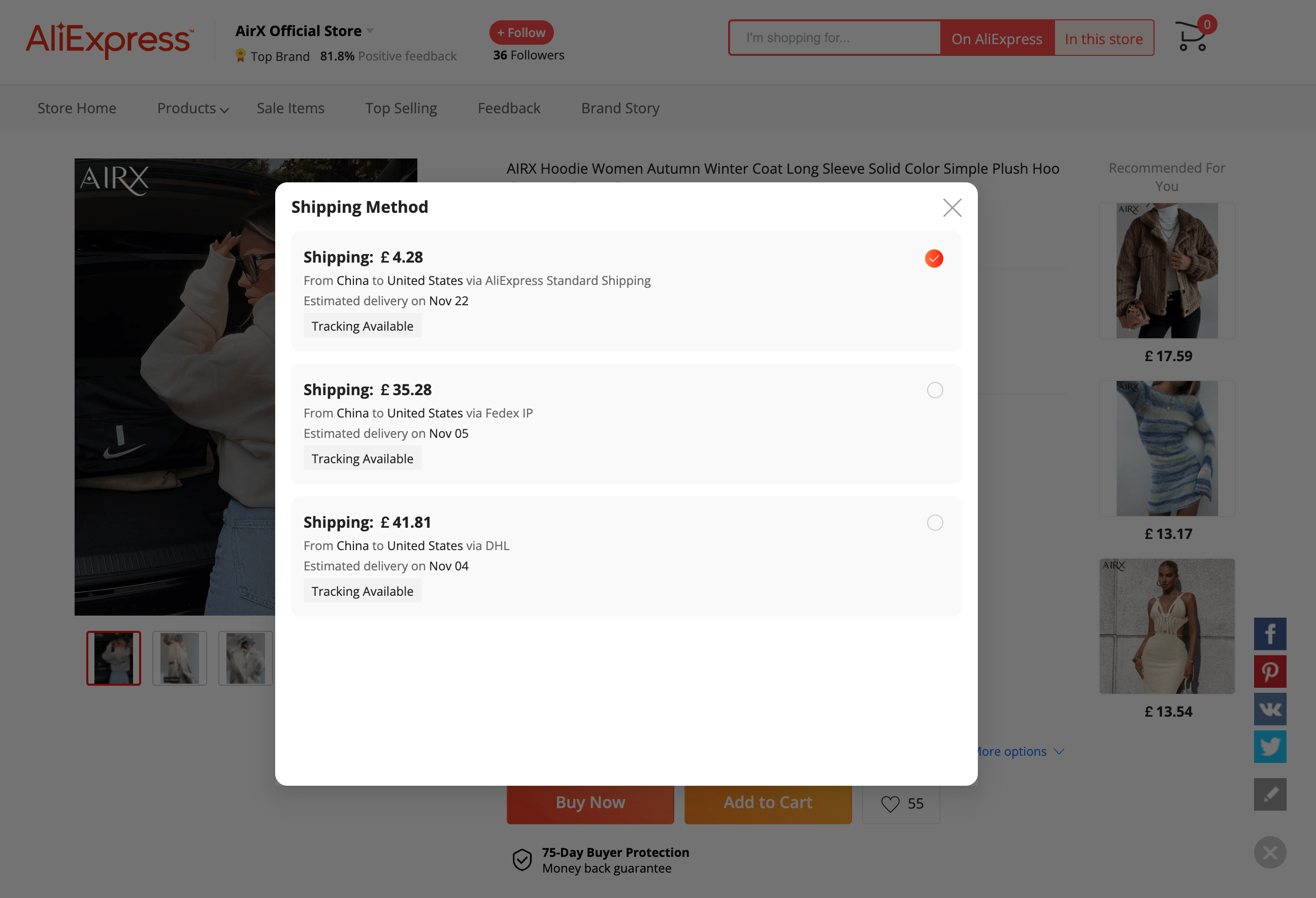
When I assess shipping options for a product, I look at four things:
- Total landed cost after shipping
- Estimated delivery range by destination country
- Tracking quality and carrier reliability
- Supplier consistency across multiple test orders
A common mistake is choosing the absolute cheapest shipping method and then spending the saved margin on refunds. Cheap shipping is expensive when it creates support headaches.
How should you choose between shipping methods?
You should choose the shipping method that gives you the shortest reliable ETA without eating all of your profit. If shipping costs more than the margin it protects, it is not the right option.
My advice is to test at least one order to your main market. If you sell mostly to the US, order to a US address. If you sell mostly to the UK, test UK delivery. Supplier estimates are useful, but real test orders tell you far more.
- Use AliExpress Standard Shipping as your baseline
- Compare it with ePacket or local warehouse options where available
- Avoid untracked methods unless the product is extremely low risk
- Do not advertise faster delivery than the slowest realistic outcome
How do I set realistic delivery expectations on Shopify?
The best way to set realistic delivery expectations is to show delivery windows before the customer buys, not after. Product pages, shipping policy, cart, checkout wording, and emails should all reinforce the same timeline.
This is the part many stores get wrong. They add a vague shipping policy page, then wonder why customers complain. Most buyers never read policy pages in detail. They read the product page and the checkout.
I recommend building your messaging around a simple principle: repeat the ETA in every high-intent touchpoint.
What should I show on the product page?
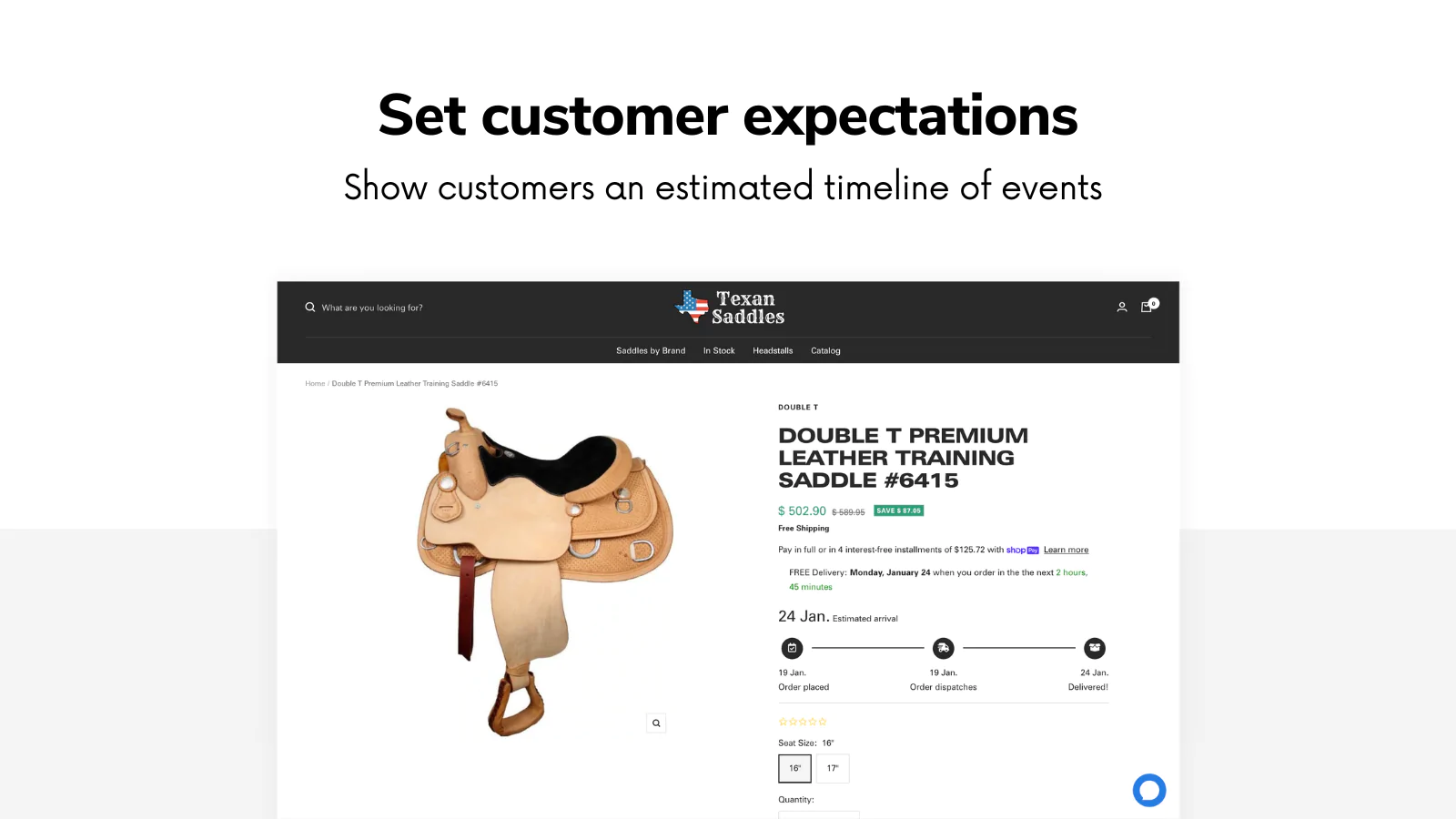
Your product page should clearly state the expected delivery window for that product. A simple line like "Estimated delivery: 2-4 weeks" is better than making shoppers hunt for the information.
That message should sit near the add-to-cart button, not buried in a tab. If you sell products with different fulfilment origins, show the timing per product or per variant where possible.
Useful product-page messaging examples:
- Estimated delivery: 10-18 business days
- Ships from overseas warehouse - delivery usually takes 2-4 weeks
- Tracked shipping included
- Made to order / imported item - worth the wait if that fits your brand
If you want to show delivery dates more dynamically, I covered this in How to Show Estimated Delivery Date on Your Shopify Store and also in How to Show Shipping on the Product Page in Shopify.
What should I show at checkout?
Checkout should repeat the shipping timeframe in plain English. Do not let the customer reach payment without seeing the expected delivery speed.
One of the recurring tips in Shopify community discussions is to rename or clarify shipping methods so the customer sees something like "Standard Shipping (2-4 weeks)" instead of a vague label. That advice still holds up well.
If your store uses multiple suppliers or split fulfilment, clarity matters even more. If relevant, read How to Split Orders into Multiple Shipments in Shopify so customers are not surprised when items arrive separately.
What should I include in the shipping policy?
Your shipping policy should explain the expected delivery window, where products ship from, and what happens if a parcel is delayed or lost. A clear shipping policy reduces disputes because it gives support a consistent reference point.
Keep it simple and specific. For example:
- Processing time: 1-5 business days
- Delivery time: 10-25 business days depending on destination
- Tracking: Sent by email when available
- Delays: Customs, peak periods, and carrier disruption may extend delivery times
Do not write legal-sounding fluff. Customers want timing, responsibility, and a next step if something goes wrong.
How do I communicate long shipping times without hurting conversions?
You communicate long shipping times positively by being transparent, specific, and reassuring. Honesty framed well converts better than ambiguity framed optimistically.
This is where brand positioning matters. If your product is unique, personalised, hard to find locally, or priced attractively, buyers will often accept slower delivery. What they will not accept is feeling misled.
Here are messaging angles that work better than pretending shipping is fast:
- Tracked international delivery
- Popular item - high demand means dispatch may take a few days
- Worth the wait for exclusive designs
- Free shipping included if your margin supports it
Free shipping can soften the friction of a longer wait. In my experience, customers are more tolerant of a 2-4 week delivery window when the product value feels strong and the shipping cost is not added as a nasty surprise at checkout.
Which Shopify apps help show accurate delivery times?
The most useful apps are the ones that make delivery expectations visible before purchase. For this use case, DeliveryTimer is a practical option for showing estimated delivery dates and dispatch cut-off messaging on product pages.
As an app developer myself, I like tools that solve a narrow problem clearly. A visible ETA widget often reduces the classic pre-purchase question: "When will this arrive?"

DeliveryTimer can help you:
- Show estimated delivery dates on product pages
- Display order cut-off times
- Set expectations for dispatch and arrival windows
- Reduce uncertainty that leads to abandoned carts and support tickets
If your store relies heavily on urgency and timing, you may also want to read Unlock the Power of an Order Timeline and How to Reduce Abandoned Carts in Shopify.
How do I reduce customer complaints about slow AliExpress delivery?
You reduce complaints by sending proactive updates, making tracking easy to find, and resolving missing parcels quickly. Silence creates more support tickets than slow shipping does.
Once an order is placed, the customer is mostly looking for reassurance. They want confirmation that the order is real, moving, and not forgotten.
What emails should I send?
You should send an order confirmation email that repeats the delivery window, then a shipping confirmation with tracking, then a delay update if needed. Post-purchase messaging is where trust is either preserved or lost.
Your order confirmation can say something like:
Thanks for your order. This item is shipped internationally and usually arrives in 2-4 weeks. We will email your tracking details as soon as your parcel is dispatched.
Your shipping confirmation can add:
Your order is on the way. Delivery times can vary slightly during customs and carrier handoff, but your parcel is fully trackable. If you need help, reply to this email and our team will assist.
Even if you are a solo operator, this kind of communication makes the store feel organised and reliable.
What should I do if an order looks lost?
If a parcel appears lost, act before the customer escalates. Replacements are often cheaper than chargebacks, especially on low-cost AliExpress products.
The research behind this topic consistently points to a simple commercial reality: if a product is inexpensive, sending a replacement can be smarter than arguing over a refund. I agree with that. Protecting your payment profile and customer trust is usually worth more than the unit cost.
- Set an internal threshold for when an order is considered delayed
- Contact the supplier before the customer has to chase you
- Offer a replacement or refund promptly if tracking stalls too long
- Track your refund rate carefully and keep operational issues under control
How can I get faster shipping times on AliExpress?
You can get faster AliExpress shipping by filtering for local warehouses, choosing better shipping methods, narrowing your target countries, and removing unreliable suppliers. The biggest speed gains usually come from better sourcing, not better copywriting.
Many merchants try to solve a fulfilment problem with marketing. That only works for so long.
1. Filter by "Ships From" local warehouses
The fastest improvement is often to choose products with stock in the United States, United Kingdom, or another local market. If the same product is available from a domestic warehouse, delivery can drop from 2-4 weeks to 2-7 days.
This is not available for every product, and local stock can be less stable, but for winning products it is often worth prioritising.
2. Focus on fewer target countries
Shipping performance varies a lot by destination. If you are new, it is often smarter to focus on one or two countries where you have tested delivery times rather than advertising globally from day one.
Less geographic complexity means fewer surprises.
3. Remove weak suppliers quickly
If a supplier has poor communication, inconsistent handling times, or misleading estimates, replace them fast. A slightly higher product cost from a more reliable supplier can improve your margins overall once you factor in fewer refunds and less support time.
4. Consider moving beyond AliExpress for scaling
AliExpress is often fine for testing, but it is not always ideal for scaling. Once you validate demand, you may want to move to a private supplier, buy inventory in bulk, or use faster dropshipping networks.
That is usually the point where stores start improving both delivery speed and repeat purchase rate.
Is AliExpress dropshipping still worth it on Shopify?
AliExpress dropshipping is still worth it for product testing and low-risk store launches, but it is less attractive for long-term brand building if shipping remains slow. It works best as a validation channel, not always as the forever fulfilment model.
I would not dismiss AliExpress. It still gives merchants a cheap way to test offers without buying stock upfront. But customer expectations in 2026 are high, and faster fulfilment is a real competitive advantage.
| Approach | Pros | Cons | Best for |
|---|---|---|---|
| AliExpress from China | Low upfront cost, huge catalogue, easy testing | Long shipping times, variable supplier quality | Beginners and product testing |
| AliExpress local warehouse | Faster delivery, easier conversion | Less stock depth, sometimes higher cost | Scaling proven products |
| Private supplier / agent | Better control, branding options, faster fulfilment | More setup work, usually volume needed | Established stores |
| Bulk inventory and 3PL | Best customer experience, fastest shipping | Inventory risk, cash tied up | Brands with validated demand |
What is my recommended process for managing long AliExpress shipping times?
If I were launching a Shopify store with AliExpress today, I would use a simple operating process: test shipping, publish honest ETAs, automate communication, and replace weak suppliers quickly. The stores that handle this well are usually the ones that treat shipping as part of conversion, not just fulfilment.
Here is the process I would follow:
- Choose one main target country first
- Compare shipping methods on every shortlisted product
- Place test orders to verify real delivery speed
- Add ETA messaging to product pages near the add-to-cart button
- Clarify shipping labels at checkout where possible
- Update your shipping policy with real delivery windows
- Send post-purchase emails that repeat the ETA and tracking steps
- Monitor support tickets and refunds by supplier
- Move winning products to local warehouses or better suppliers as soon as possible
This is not glamorous, but it is what works. In my experience, merchants who do this well get fewer angry emails, fewer refund requests, and a much stronger chance of turning first-time buyers into repeat customers.
How should you talk about long shipping times to customers?
You should talk about long shipping times clearly, early, and confidently. Do not apologise for your fulfilment model on every page, but do not hide it either.
A good rule is this: if a customer can reasonably say "I didn't know it would take that long", your store messaging is not strong enough yet.
Use straightforward language such as:
- Delivery usually takes 2-4 weeks
- Tracked international shipping
- We will email your tracking details once dispatched
- Some items may arrive separately if sourced from multiple warehouses
If you can make the timeframe visible on the product page, in the cart, in the shipping policy, and in the confirmation email, you are already ahead of many stores competing in this space.
The reality is simple: you do not beat long AliExpress shipping times by pretending they are short. You beat them by sourcing better where possible, communicating properly everywhere else, and building enough trust that customers feel informed rather than misled.