
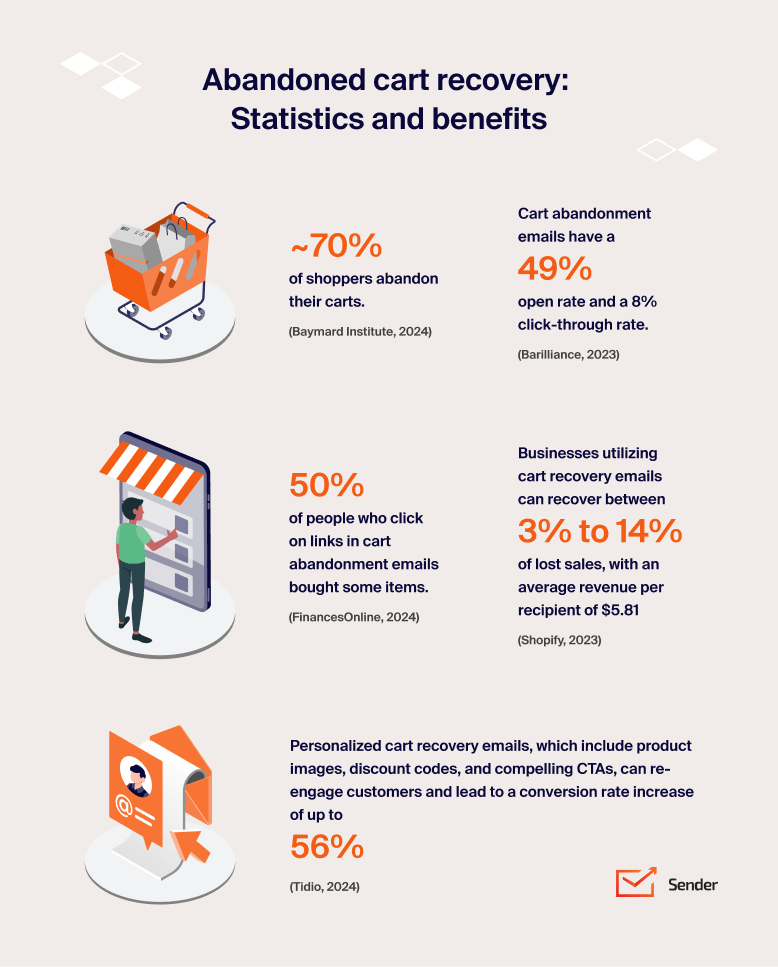
Shopify abandoned cart statistics 2026 show a familiar pattern: most stores still lose around 70% of carts, but the gap between average stores and top performers is getting wider. In my experience building Shopify apps and working with merchants on conversion problems, abandoned cart recovery is one of the few retention channels where a few tactical fixes can create a measurable revenue lift in days, not months.
The headline number matters, but context matters more. A store with a 72% abandonment rate is not automatically broken, and a store recovering only 2-3% of carts is often leaving easy money on the table. What actually moves results in 2026 is a mix of better checkout prevention, faster recovery timing, and multi-channel follow-up that matches how people shop on mobile.
What are the latest Shopify abandoned cart statistics for 2026?
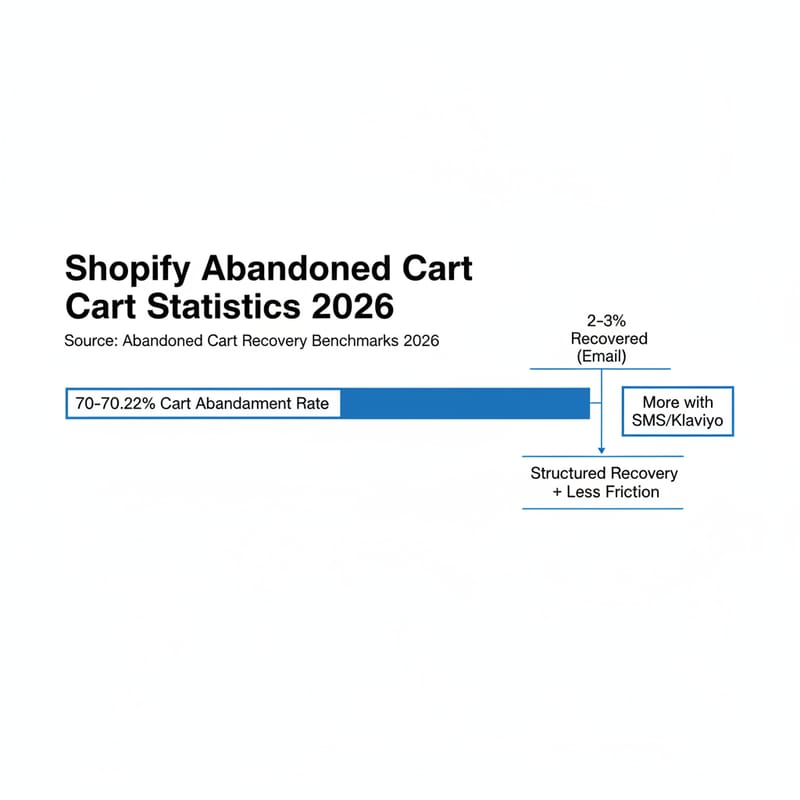
The average Shopify cart abandonment rate in 2026 is about 70-70.22%. Most stores recover only a small portion of those lost carts unless they use a structured recovery sequence and reduce checkout friction first.
Based on the latest benchmark data, standard Shopify email recovery often brings back only 2-3% of abandoned carts. More mature setups using tools like Klaviyo, SMS, and personalized flows can push recovery into the 6-8% range, while the top 10% of stores can reach 12-15%.
That difference is huge. If your store creates 1,000 carts per month and your average order value is $75, moving from a weak recovery program to a strong one can be worth thousands in monthly sales. I have seen merchants obsess over theme tweaks while ignoring abandoned carts, even though recovery automation usually pays back faster.
| Metric | 2026 Benchmark | What it means |
|---|---|---|
| Overall cart abandonment rate | 70-70.22% | About 7 in 10 carts do not turn into orders |
| Standard email recovery | 2-3% | Typical baseline using simple default flows |
| Established recovery programs | 6-8% | Common with better segmentation and timing |
| Top-performing stores | 12-15% | Strong multi-channel recovery with prevention work |
| Email open rate | 41.18% | Healthy abandoned cart email benchmark |
| Email click rate | 9.50% | Indicates message relevance and intent quality |
These numbers also line up with what broader ecommerce studies continue to report, including benchmark references from Baymard Institute, Shopify content, and several 2026 Shopify-focused studies. The benchmark has been stubbornly stable for years, which tells me abandoned carts are less about a single platform issue and more about buyer behavior plus checkout friction.
How do I calculate my Shopify cart abandonment rate correctly?
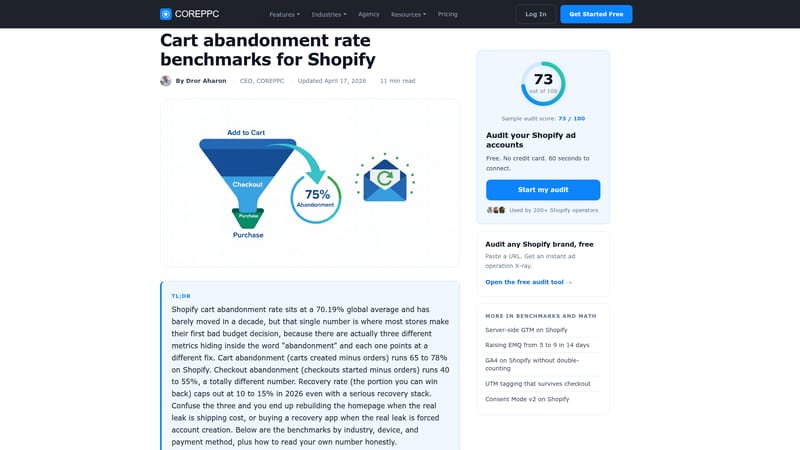
Shopify cart abandonment rate is calculated as abandoned carts divided by total carts created, multiplied by 100. If you do not separate cart abandonment from checkout abandonment, your analysis will be misleading.
The basic formula is straightforward:
(Abandoned Carts ÷ Total Carts Created) x 100
For example, if your store had 1,000 carts created and 700 were abandoned, your cart abandonment rate is 70%. If your average order value is $75, that can represent around $52,500 in abandoned cart value before any recovery efforts.
Where merchants get tripped up is mixing three different metrics:
- Cart abandonment - shoppers added to cart but did not purchase
- Checkout abandonment - shoppers started checkout but did not complete it
- Recovery rate - the percentage of abandoned carts you win back
These are not interchangeable. A store can have a normal cart abandonment rate but still have a serious checkout problem because shipping, payment options, or mobile UX cause drop-off later in the funnel.
If you want a broader conversion framework, I recommend also reviewing our guide on how to optimize your conversion rate on Shopify. Abandoned cart performance is usually a symptom of what happens before and during checkout, not just after the customer leaves.
What is a good abandoned cart recovery rate on Shopify in 2026?
A good Shopify abandoned cart recovery rate in 2026 is usually 6-8%, while 10%+ is strong and 12-15% is top-tier. Anything below 5% is usually a sign that your timing, channel mix, or checkout experience needs work.
I like to frame performance in tiers because merchants often compare themselves to unrealistic case studies. If you are using only basic email reminders, then 2-3% is common. If you have a proper sequence with email, SMS consent, dynamic cart content, and a clean checkout, then 6-8% is a realistic target.
| Recovery rate | Interpretation | My take |
|---|---|---|
| 0-3% | Basic or underperforming | Needs improvement fast |
| 4-5% | Below average but salvageable | Usually timing or messaging issues |
| 6-8% | Healthy benchmark | Good for most Shopify stores |
| 9-11% | Strong performance | Often driven by segmentation and mobile UX |
| 12-15% | Top performer range | Excellent and hard to sustain |
Be careful with claims of 30-38% recovery. Those numbers can happen in narrower contexts, especially with pre-abandonment tools or highly qualified traffic, but they are not the normal benchmark for the average Shopify store. In my experience, merchants get better decisions when they benchmark against what is sustainable, not what is theoretically possible in the best campaign window.
How do abandoned cart rates vary by device and industry?
Mobile has the highest abandonment rate, and fashion tends to abandon more than digital products. Device mix and product type can shift your numbers more than most merchants expect.
In 2026, mobile abandonment typically lands around 73-78%, while desktop is closer to 65-68%. Since mobile often drives 70% of traffic, the mobile experience has an outsized effect on your overall benchmark.
Industry also matters. Apparel shoppers compare more, browse more, and abandon more often than shoppers buying a digital download or a lower-friction replenishment product.
| Segment | Typical 2026 abandonment rate | Notes |
|---|---|---|
| Mobile | 73-78% | Highest friction, smaller screens, more distractions |
| Desktop | 65-68% | Usually stronger intent and easier checkout completion |
| Fashion and apparel | 75-80% | Comparison shopping and fit uncertainty increase exits |
| Beauty and personal care | 68-72% | Trust and shipping expectations matter a lot |
| Electronics | 65-70% | Price sensitivity but often stronger purchase intent |
| Digital products | 55-65% | Lower shipping friction and faster checkout path |
If your store is mobile-heavy, your first fix should not be another email template. It should be a mobile checkout audit, especially around payment methods, shipping clarity, and field length.
Why do shoppers abandon carts on Shopify?
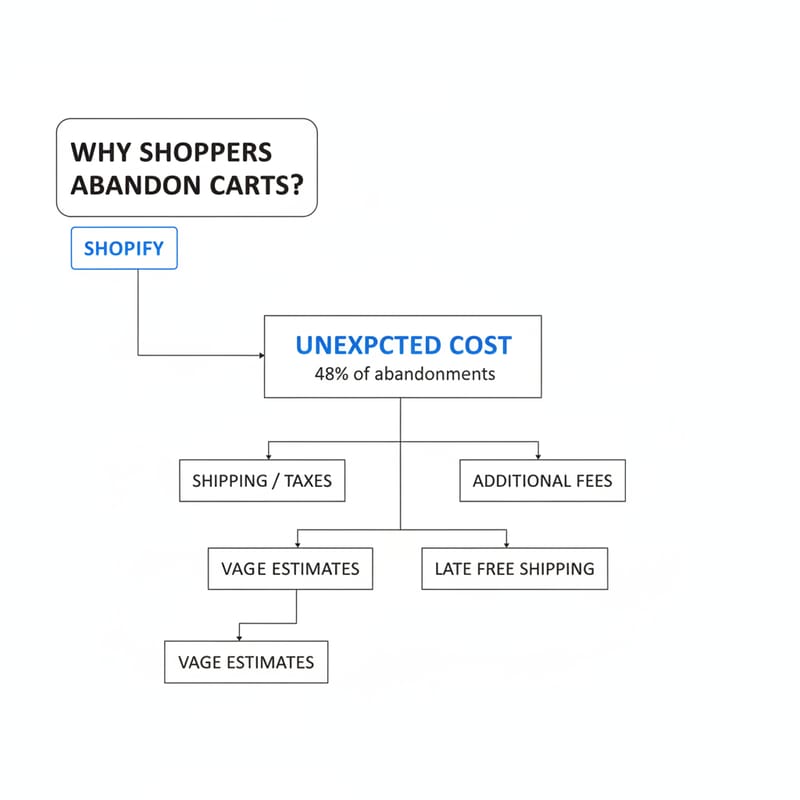
The top reason shoppers abandon carts is unexpected cost. In 2026, the biggest single cause remains surprise shipping, taxes, or fees, followed by checkout friction and mobile usability issues.
The most cited benchmark puts unexpected costs at 48% of abandonments. I see this constantly when reviewing Shopify stores: free shipping is mentioned late, shipping estimates are vague, or taxes appear too far into the process.
- Unexpected shipping, taxes, or fees
- Forced account creation or too much form friction
- Poor mobile checkout UX
- Limited payment options
- Slow pages or buggy discount code behavior
- Low trust, especially for first-time buyers
- Comparison shopping or using cart as a wishlist
This is why recovery alone is not enough. If the root problem is checkout friction, your reminder sequence just sends people back into the same broken experience. Our Shopify checkout guide goes deeper on the structural fixes that reduce drop-off before you need to recover it.
What are the best abandoned cart recovery practices for Shopify in 2026?
The best practices in 2026 are fast timing, multi-channel automation, mobile-first design, and personalized messaging. Recovery works best when it feels helpful, not desperate.
When I test abandoned cart programs, I usually see the biggest gains come from fixing sequence timing first, then improving message relevance, then layering in SMS or retargeting. The stores that win do not rely on one reminder sent a day later. They build a short, intentional system.
How quickly should I send the first abandoned cart email?
The first abandoned cart email should usually go out within 1-4 hours. Most abandoned cart revenue comes from the first message, and intent decays quickly after that.
Benchmark data suggests 69% of recovered revenue comes from the first email. My preferred starting point is:
- First message: 1-4 hours after abandonment
- Second message: 24 hours later
- Third message: 48-72 hours later with urgency or incentive
If your products are low-ticket impulse buys, send earlier. If they are higher-ticket or more considered, you can give shoppers a little more breathing room.
What should I include in abandoned cart messages?
The best abandoned cart messages show the exact items left behind, include a direct checkout link, and answer likely objections. Generic reminders underperform because they do not reduce friction.
- Product image and title
- Clear call to action back to cart or checkout
- Shipping or delivery reassurance
- Trust signals like reviews, guarantees, or return policy
- Optional incentive only if margin allows
This is one reason review content matters. If you use a reviews app like Lumo Reviews, social proof can support recovery messaging by reducing buyer hesitation. Trust is often the difference between an abandoned cart and a completed order.
Should I offer a discount in abandoned cart emails?
Discounts should be used selectively, not by default. A discount can recover margin-sensitive carts, but overusing it trains shoppers to wait.
I usually recommend holding the discount until the second or third message, especially if the customer is new or the product is price-sensitive. If your brand has strong demand, test non-discount nudges first, like free shipping thresholds, low-stock urgency, or delivery clarity.
For merchants trying to raise order value without giving away too much margin, our guide on increasing Shopify average order value pairs well with abandoned cart work.
Which channels work best for abandoned cart recovery?
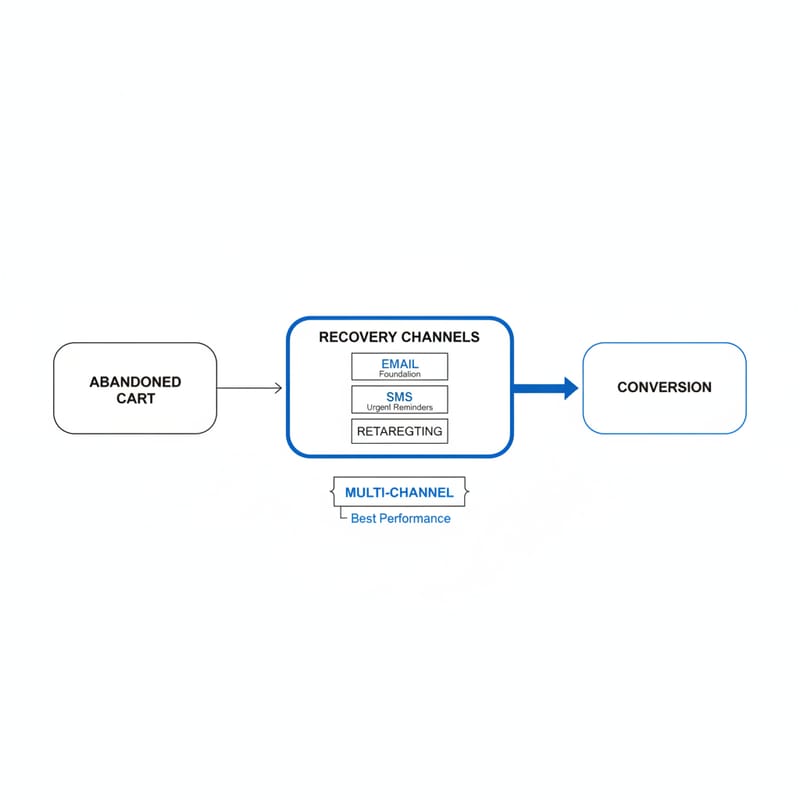
Email is still the foundation, but the best-performing stores use email plus SMS and retargeting. Multi-channel recovery consistently beats email-only setups when consent and execution are handled well.
Email remains the most scalable channel because it is cheap, easy to automate, and expected by shoppers. But SMS often performs better for urgent reminders, especially for high-intent visitors who have already opted in.
| Channel | Typical 2026 performance | Best use case |
|---|---|---|
| 2-3% baseline, higher with strong flows | Core abandoned cart automation | |
| Klaviyo email flows | 3.33% placed order rate, $5.81 revenue per recipient | Segmentation and dynamic personalization |
| SMS | 3-8%, often higher in multi-channel programs | Fast reminders for opted-in shoppers |
| Retargeting ads | 2-5% assistive impact | Reinforcement and repeat visibility |
| AI or pre-abandonment tools | Can be much higher in narrow use cases | High-intent intervention before exit |
For many stores, the practical stack is simple: Shopify or Shopify Email for the baseline, Klaviyo for deeper flows, and SMS through a compliant provider if the economics support it. If you also run upsells, there is a strong connection between recovery and post-add-to-cart monetization, which is why merchants often pair these tactics with tools like SellUp or checkout offers.
What apps should I consider for Shopify abandoned cart recovery?
The best app depends on whether you need simple automation, advanced segmentation, or revenue expansion around the cart. No app can fix a broken checkout, but the right one can absolutely improve recovery execution.
Here are the tools I most often see merchants use effectively:
- Klaviyo - best for advanced email and SMS flows
- Shopify Email - best simple starting point
- SMSBump - useful for SMS cart recovery
- Facebook & Instagram - supports retargeting audiences
- ReConvert - post-purchase recovery and upsell support
If your store needs help increasing cart value after recovery, my own app SellUp focuses on upsells and cross-sells. It is not an abandoned cart app by itself, but in practice I have seen merchants recover a cart and then lift AOV enough to make the whole retention program more profitable.
For merchants thinking more broadly about cart monetization, our article on Shopify cart drawer upsells is a useful companion read.
How can I reduce cart abandonment before it happens?
The best abandoned cart strategy is prevention. Reducing friction before a shopper leaves is usually cheaper and more effective than recovering them afterward.
In my experience building Shopify apps, the highest-leverage prevention fixes are usually boring. They are not flashy AI widgets. They are clear shipping expectations, faster load times, better mobile forms, and stronger trust signals.
- Show shipping costs or thresholds early
- Offer guest checkout whenever possible
- Enable fast payment methods like Shop Pay
- Reduce mobile form friction
- Add reviews, guarantees, and return clarity
- Test cart and checkout UX continuously
Shop Pay and other accelerated payment options matter more than many merchants realize. Every extra field, page load, and moment of uncertainty increases abandonment. If your mobile checkout is clunky, no recovery app will fully compensate for it.
For a bigger-picture retention playbook, see our guide on how to reduce abandoned carts in Shopify. That article pairs nicely with the benchmarks in this one.
How should I benchmark my store against Shopify averages?
Benchmark against stores with a similar device mix, price point, and product category. Comparing your store to a generic 70% average is useful only as a starting point.
Here is the framework I use when reviewing a store:
- First, check cart abandonment rate against your vertical
- Second, compare mobile vs desktop separately
- Third, review checkout start-to-order conversion
- Fourth, measure recovery by channel, not just total recovered revenue
- Fifth, segment new vs returning customers
If your recovery rate is under 5%, that is usually an underperformance flag. If your mobile abandonment is more than a few points above benchmark, I would look at checkout speed, wallet support, and shipping transparency before changing your email copy.
And if you are serious about improving this over time, do not rely on one-off redesigns. Use a testing mindset. Our post on continuous A/B testing for Shopify is the right next step for that.
What does a practical 2026 abandoned cart recovery workflow look like?
A practical 2026 workflow combines prevention, fast recovery, and post-recovery optimization. The best systems are simple enough to maintain and specific enough to improve each month.
This is the workflow I would implement for most Shopify stores today:
- Audit checkout friction on mobile and desktop
- Set up a 3-message email flow at 1-4 hours, 24 hours, and 72 hours
- Add SMS for opted-in high-intent users
- Use dynamic cart content in every reminder
- Delay discounts until later in the sequence
- Track recovery rate by device and channel
- Improve AOV after recovery using upsells or bundles
This is not complicated, but it does require discipline. The stores that consistently outperform benchmarks are usually not doing something magical. They are just executing the basics better and reviewing the data more often.
If you also want stronger email copy, our collection of abandoned cart subject lines for Shopify can help improve open rates without overcomplicating the flow.
What is my final take on Shopify abandoned cart statistics in 2026?
Shopify abandoned cart statistics 2026 confirm that abandonment is still normal, but weak recovery is not. A 70% abandonment rate may be average, yet there is a big difference between a store recovering 2% and one recovering 10%+.
In my experience, the best merchants treat abandoned carts as both a conversion problem and a retention opportunity. They fix mobile friction, send the first reminder quickly, personalize the sequence, and benchmark honestly against stores like theirs. That is how you turn a frustrating industry average into a reliable revenue channel.