Upselling means persuading a customer to buy a better, pricier version of the same product. Cross-selling means recommending related or complementary products that go alongside the item they already want. That is the simplest and most accurate difference.
I have worked with Shopify merchants for years and built apps around order value and conversion optimisation, so I see this confusion constantly. Store owners often use the terms interchangeably, but in practice they solve different commercial problems, appear in different places in the buying journey, and affect profit margins in different ways.
If you want the short answer, here it is: upselling increases the value of one item, while cross-selling increases the number of items in the basket. Both can lift average order value, but the best choice depends on your margins, shipping costs, product catalogue, and how customers actually shop on your store.
What is the difference between upselling and cross-selling?
The key difference is that upselling asks the customer to upgrade their choice, while cross-selling asks them to add something extra. Upselling replaces the original product with a higher-tier option, whereas cross-selling keeps the original product and adds complementary items.
This distinction matters because the customer decision is different. With an upsell, the shopper is comparing versions of the same purchase. With a cross-sell, they are deciding whether an extra item improves the usefulness, convenience, or enjoyment of what they are already buying.
In my experience building Shopify apps, merchants get better results when they stop thinking in vague terms like “show more offers” and instead ask a more precise question: do I want the customer to trade up, or add on? That single question usually tells you whether you need an upsell or a cross-sell.
| Aspect | Upselling | Cross-selling |
|---|---|---|
| Primary goal | Increase revenue per item | Increase number of items per order |
| What is recommended? | A premium or higher-priced version of the same product | A related or complementary product |
| Customer action | Upgrade their choice | Add another item to basket |
| Typical message | “For just $X more, get better features” | “Customers also bought” or “Complete the set” |
| Margin impact | Often higher margin per unit | Often higher basket value without major margin improvement per item |
| Best timing | Usually before checkout | Before, during, or after purchase |
What is upselling?
Upselling is a sales technique where you encourage a customer to choose a more expensive, higher-value version of the product they were already considering. The goal is to increase revenue from that single purchase decision.
A classic ecommerce example is a shopper viewing a standard coffee machine and being shown a premium model with a built-in grinder, better warranty, and faster heat-up time. They still buy a coffee machine, but they buy the better version.
On Shopify, I usually see upsells work best when the difference between plans, bundles, sizes, or product tiers is easy to understand in seconds. If the value jump is obvious, the customer can justify spending a bit more. If the upgrade is confusing, the upsell usually underperforms.
What are common examples of upselling?
Common upsell examples include larger sizes, premium materials, upgraded subscriptions, extended warranties, and higher-capacity versions of the same product. The customer is still solving the same need, just at a higher tier.
- Fashion: swap a basic cotton T-shirt for a premium heavyweight version
- Electronics: move from a 128GB phone to a 256GB phone
- Beauty: choose the full-size product instead of the travel size
- Food and drink: upgrade from a regular meal to a large meal
- Software: move from a starter plan to a pro plan
The best upsells feel like a better outcome, not a more expensive version for the sake of it. That is why feature comparison, social proof, and clear price anchoring matter so much.
What is cross-selling?
Cross-selling is a sales technique where you recommend additional products that complement the main purchase. The goal is to increase basket size by helping the customer buy related items they are likely to need or want.
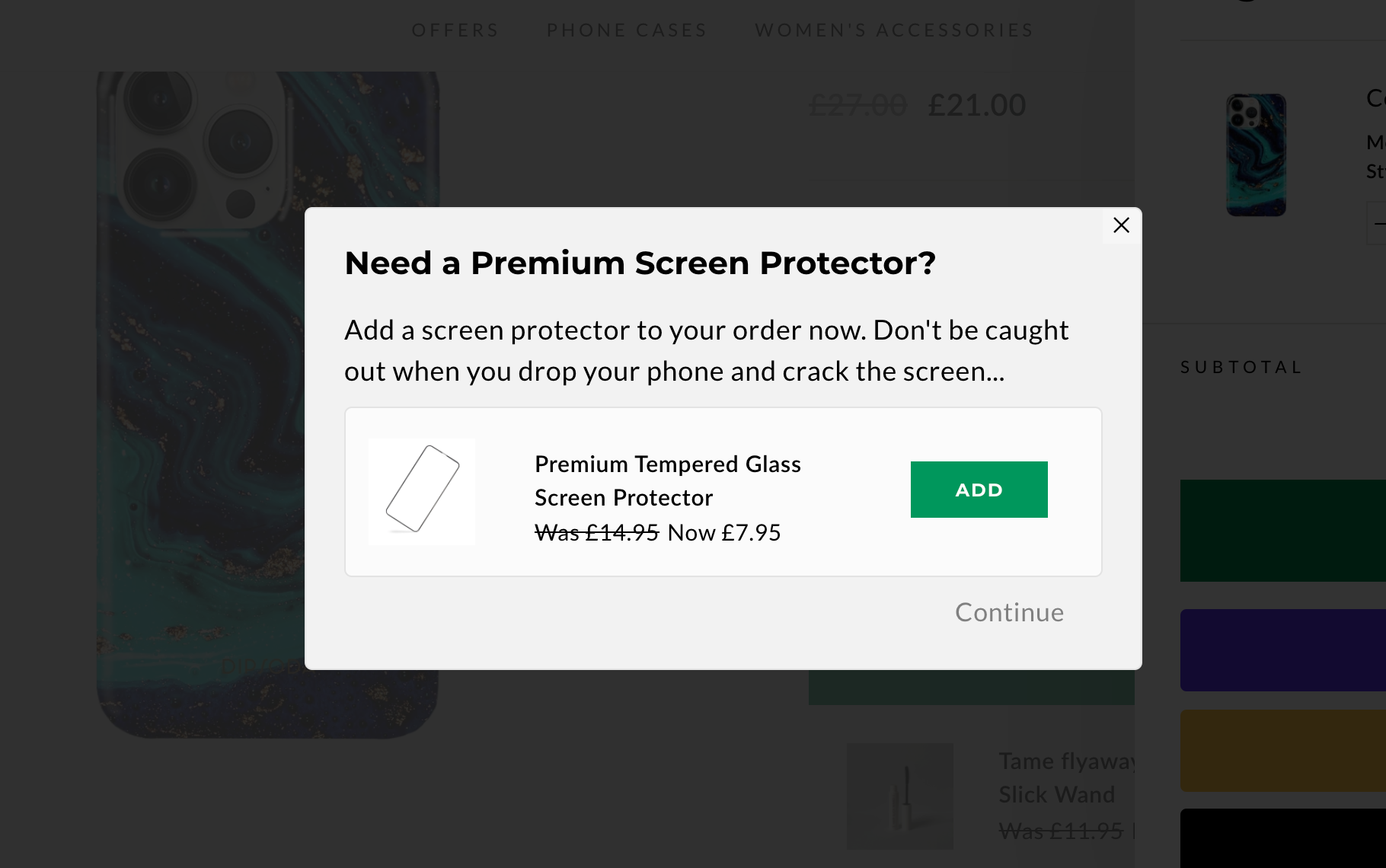
If someone buys a phone case and you suggest a screen protector, that is cross-selling. If someone buys a camera and you recommend a memory card and carrying case, that is also cross-selling.
In my experience, cross-sells tend to convert well when they reduce friction or make the original purchase more complete. Customers are far more likely to add an accessory if the recommendation feels practical, timely, and relevant.
What are common examples of cross-selling?
Common cross-sell examples include accessories, care products, add-ons, refills, and matching items. The customer keeps the original product and adds something that improves its use or value.
- Phones: case, charger, screen protector
- Jewellery: gift box, cleaning cloth, matching earrings
- Furniture: cushion covers, care kits, assembly tools
- Skincare: cleanser, moisturiser, SPF bundle
- Pet products: lead, bowl, treats, grooming brush
If you run a Shopify store with lots of natural pairings, cross-selling is often the fastest win. It is one reason I have written so much about what cross-selling is and how to use it and why related-product placements remain so effective.
How do upselling and cross-selling affect profit differently?
Upselling usually improves margin per sale more directly, while cross-selling often improves order economics by spreading shipping and acquisition costs across more items. Both can be profitable, but they improve different parts of the equation.
This is where many articles stay too basic. Revenue is not the same as profit. A cross-sell can add less gross profit per item than an upsell, but still be the better move if your shipping cost stays flat and your customer acquisition cost is already paid.
The latest data still supports using both tactics. Businesses are often cited as being 60-70% more likely to sell to an existing customer than a new prospect, and major retailers have long attributed a meaningful share of revenue to recommendation-led selling. In ecommerce, that makes upsells and cross-sells core conversion levers, not nice extras.
Why can cross-selling be so effective for Shopify stores?
Cross-selling works especially well on Shopify when shipping is flat, acquisition costs are rising, and the add-on product is easy to understand. A small add-on can produce a disproportionate profit gain.
For example, imagine you sell a product for $30 with a 50% gross margin, $3 shipping cost, and $2 customer acquisition cost. That leaves around $10 net profit. If you then cross-sell an $8 complementary item at a similar margin without increasing shipping, your net profit might jump to around $14.
I have seen this pattern repeatedly with accessories, gift wrap, protection plans, and low-bulk add-ons. It is one reason cart cross-sells and product add-ons are so popular in Shopify apps and themes.
Why can upselling be more profitable in premium categories?
Upselling tends to shine in premium categories where the price jump is large and shipping is a small percentage of the order value. In those cases, moving a customer to a better model can outperform adding a small accessory.
Think about mattresses, electronics, furniture, or subscription plans. If a shopper moves from a $499 product to a $699 product, the extra margin can be substantial. That is why strong comparison tables, premium feature callouts, and “best value” labels are so effective in upsell flows.
If you want to improve this on a Shopify store, I would also look at product-page offers and one-click post-purchase offers. We have covered this in more detail in our guides to Shopify upsells on the product page and one-click upsells.
When should you use upselling instead of cross-selling?
Use upselling when customers are choosing between tiers, versions, or plans and the premium option offers clear extra value. It is best when the upgrade path is simple and the customer can quickly understand why spending more is worthwhile.
In practical terms, upselling usually makes more sense if:
- You sell products with good-better-best pricing
- Your premium version has obvious feature improvements
- Your margins improve meaningfully on higher-tier products
- Your catalogue is relatively narrow, so add-on opportunities are limited
- The customer is still in the decision stage, not fully committed yet
One mistake I see a lot is trying to upsell too aggressively on low-consideration products. If the customer just wants a simple answer, showing five upgrades can hurt conversion. The best upsell is usually one strong recommendation, not a wall of options.
When should you use cross-selling instead of upselling?
Use cross-selling when the main product naturally pairs with accessories, refills, protection items, or matching products. It is especially effective when the add-on removes friction or helps the customer use the main product properly.
Cross-selling is often the better choice if:
- You have a catalogue full of complementary items
- Your shipping costs are mostly fixed per order
- You want to improve AOV without changing the core purchase decision
- Your main products are already price-sensitive
- You can recommend extras with high relevance based on cart contents
This is also why “frequently bought together” blocks work so well. They do not force the customer to reconsider the main product. They simply make it easier to buy the complete solution in one go. If that is your focus, our guides on adding related products on Shopify and cross-selling matching variants are worth reading.
Can you use upselling and cross-selling together?
Yes, and many of the best stores do. The most effective ecommerce funnels often use an upsell first to improve the main purchase, then a cross-sell to complete it with accessories or add-ons.
A simple example would be a customer shopping for trainers. First, you upsell them from the basic model to the premium model with better cushioning. Then, once they add to cart, you cross-sell socks, cleaning spray, and insoles.
On Shopify, this layered approach works well because different placements suit different jobs. The product page is often best for upselling. The cart drawer, checkout extensions, and post-purchase page are often better for cross-selling.
What are the best places to show upsells and cross-sells on Shopify?
The best placement depends on the offer type. Upsells usually perform best before the customer commits, while cross-sells can work before, during, and after checkout.
After testing this across stores and app flows, here is the placement logic I generally use:
| Placement | Best for | Why it works |
|---|---|---|
| Product page | Upsells | Customer is still comparing options and open to upgrading |
| Cart drawer or cart page | Cross-sells | Easy place to add accessories without disrupting the main choice |
| Checkout | Light cross-sells | Works best with low-friction add-ons and strong relevance |
| Post-purchase page | One-click upsells and cross-sells | No need to re-enter payment details, so acceptance can be high |
| Thank you page / email | Follow-up cross-sells | Good for replenishment, accessories, or future recommendations |
If you are trying to choose where to start, I would begin with one product-page upsell and one cart cross-sell. That gives you a clean test without overwhelming the customer journey.
What are real examples of upselling and cross-selling?
Real examples make the distinction obvious. Cross-sells add related products, while upsells present a superior version or coverage option for the same purchase.
DIPSODA is a useful cross-sell example. When a customer adds a phone case to their basket, the site can immediately suggest a compatible screen protector. That recommendation is highly relevant, easy to understand, and complements the original item rather than replacing it.
Apple is a familiar upsell example. When purchasing hardware, customers are often shown coverage options, storage upgrades, or premium configurations. The message is clear: spend more and get better protection, more capacity, or a better ownership experience.
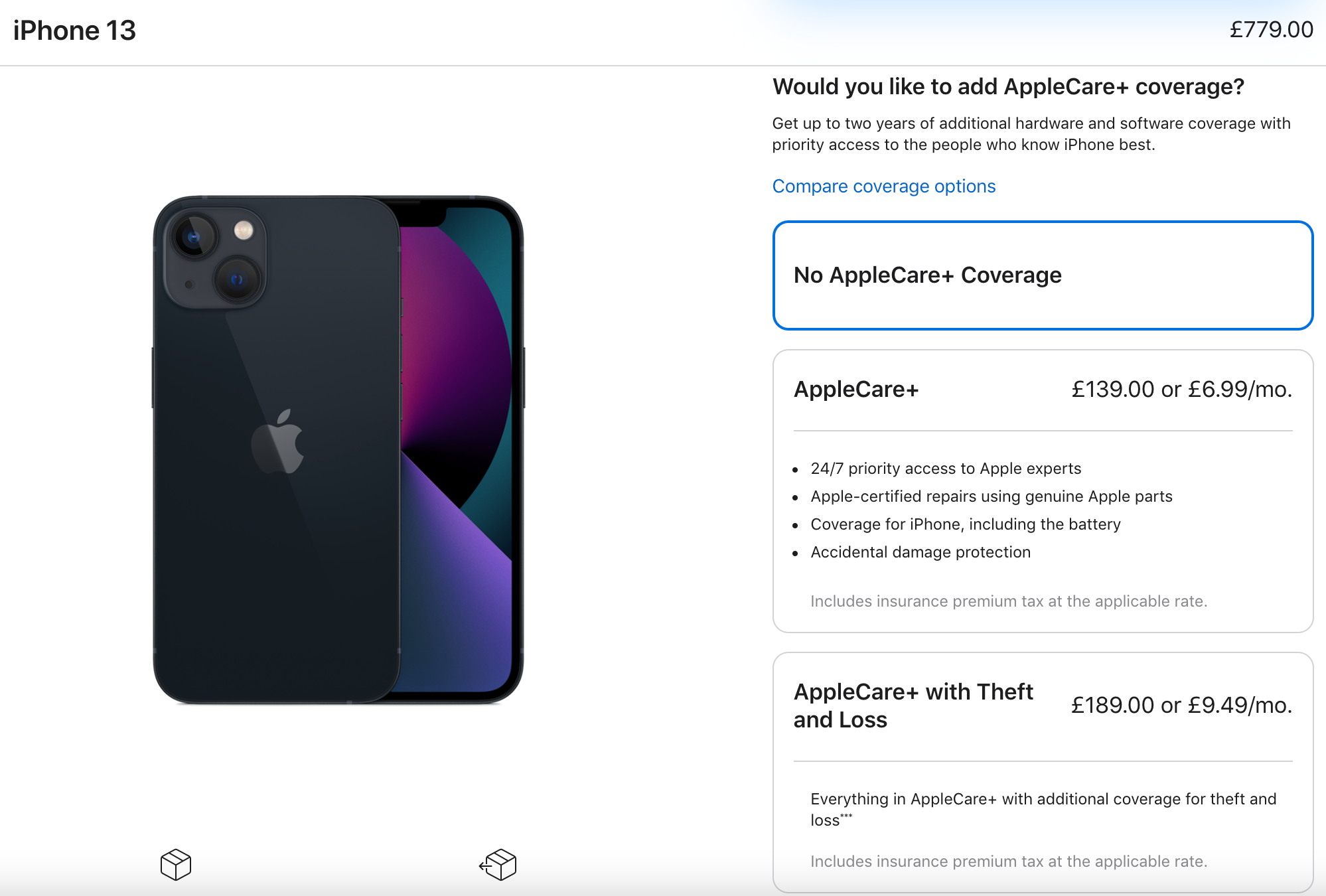
These examples work because they match the customer mindset. Apple helps customers upgrade the value of the main purchase. DIPSODA helps customers complete the purchase with an additional item.
How do you write effective upsell and cross-sell offers?
The best offers are specific, relevant, and low-friction. Customers respond to clear value, not generic sales language. Good merchandising beats aggressive copy every time.
For upsells, I recommend emphasising the difference in outcome, not just the difference in price. “For $20 more, get double the storage and a longer battery life” is far stronger than “Upgrade now”.
For cross-sells, focus on completeness and convenience. Phrases like “Complete the set”, “Protect your purchase”, or “Most customers add this” usually outperform vague labels like “You may also like”.
- Use one primary upsell, not too many competing upgrades
- Show price difference clearly, especially for upsells
- Keep cross-sells tightly relevant to the current item
- Add social proof where possible
- Test bundles, not just single add-ons
If you are actively optimising AOV, our articles on how to upsell on Shopify and upsell statistics in ecommerce will give you more ideas and benchmarks.
What mistakes should you avoid with upselling and cross-selling?
The biggest mistake is showing irrelevant offers. If the recommendation does not fit the product, the customer, or the moment, it will feel pushy and can hurt conversion.
Other common mistakes include offering too many options, hiding the price difference, recommending add-ons that increase shipping complexity, and using the same offer sitewide with no product logic. I have seen stores lose performance simply because every product page showed the same generic accessories.
Another mistake is measuring only top-line revenue. A cross-sell that adds low-margin bulky products may increase AOV but reduce net profit. A premium upsell with low take-up might still be the better commercial choice if the margin is much stronger.
What is the best strategy for most Shopify stores?
The best strategy for most Shopify stores is to use both, but assign each tactic a clear role. Use upsells to improve the main product choice, and use cross-sells to complete the basket.
If I were starting from scratch on a typical Shopify store, I would do this:
- Identify top products with the most traffic and sales
- Create a single clear upsell path for those products
- Add 1-3 highly relevant cross-sells in the cart
- Test a post-purchase one-click offer
- Measure AOV, conversion rate, attach rate, and profit, not just revenue
This is usually enough to find early wins without overcomplicating the store. Once you have data, you can segment by product type, collection, device, and customer cohort.
Should you use a Shopify app for upselling and cross-selling?
Yes, in most cases a Shopify app makes implementation much easier, especially if you want product-page offers, cart offers, post-purchase offers, or analytics. Native theme blocks can handle simple merchandising, but apps usually give you better targeting, testing, and reporting.
As someone who builds Shopify apps, I am obviously biased towards solid tooling, but the reason is practical. Merchants rarely struggle with the idea of upselling or cross-selling. They struggle with placement, logic, design consistency, and measuring what actually worked.
If your focus is AOV growth, you may want to compare specialist apps on the Shopify App Store or read our breakdown of the best one-click upsell apps for Shopify. The right app depends on whether you need pre-purchase, cart, or post-purchase functionality.
Is upselling or cross-selling better?
Neither is universally better. Upselling is better when premium tiers have strong margins and obvious value differences. Cross-selling is better when complementary products are highly relevant and can be added with minimal friction.
If you sell premium or configurable products, start with upselling. If you sell accessories, consumables, or products with natural pairings, start with cross-selling. If you have both, use both.
The real answer is commercial fit. In my experience, the stores that win are not the ones with the most offers. They are the ones that show the right offer at the right moment and make the customer feel that the recommendation genuinely helps.
Final thoughts on upselling vs cross-selling
Upselling and cross-selling are not the same, even though both aim to increase order value. Upselling upgrades the main purchase. Cross-selling expands the basket with complementary items.
For Shopify merchants, that difference is more than semantics. It affects where you place offers, how you write them, what metrics you track, and which products you promote. Done well, both tactics can increase revenue, improve order economics, and create a better buying experience.
If you are serious about growing AOV in 2026, start simple. Build one excellent upsell, one relevant cross-sell, and measure the result properly. That approach beats stuffing every page with random recommendations every time.