

Google is no longer just presenting ten blue links and asking shoppers to choose one. AI Overviews now answer many questions directly, often summarizing products, comparing brands, and citing a small selection of sources. For Shopify merchants, this means ranking on page one is no longer the only goal: your brand also needs to become a source that AI systems trust enough to mention or recommend.

In my experience building Shopify apps and working with merchants, this shift exposes a common weakness. Stores may have excellent products and hundreds of reviews displayed on their own product pages, but very little independent evidence elsewhere on the web. If you want to learn how to appear in AI Overviews, building a consistent external review presence should now be part of your visibility strategy.
How do AI Overviews choose which brands to surface?
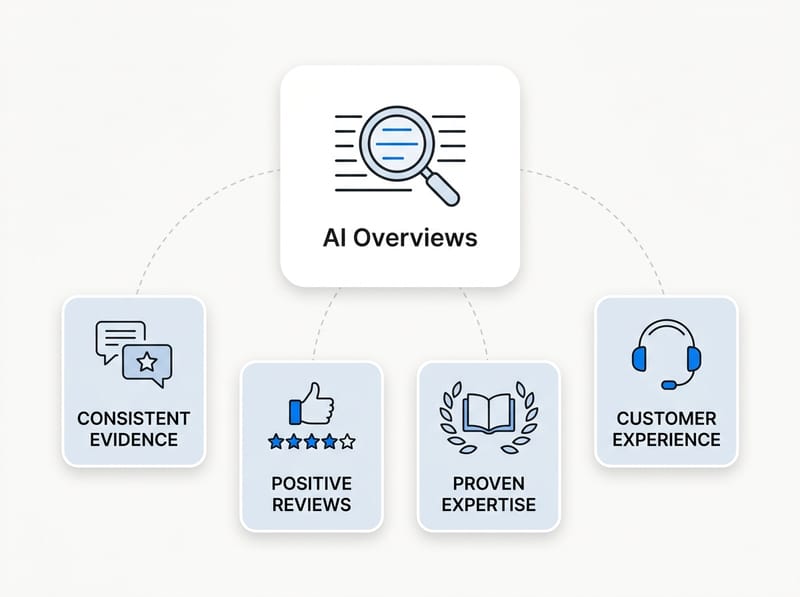
AI Overviews look for information that can be supported by reliable, relevant, and independent sources. A brand is more likely to be surfaced when multiple websites provide consistent evidence about its products, reputation, expertise, and customer experience.
Google does not publish a simple checklist guaranteeing inclusion in an AI Overview. Its documentation for AI features in Search instead emphasizes the same foundational practices used for standard search visibility, including useful content, indexable pages, good page experience, and accurate structured data.
However, AI-generated answers have an additional challenge. Before naming a store as a good option, the system needs enough evidence to confidently connect the brand with the question being asked. Your own store is an interested party, so claims found only on your product pages may not provide the independent confirmation needed for a confident recommendation.
Why does third-party consensus matter?
Third-party consensus exists when multiple independent sources describe a brand in similar terms. Reviews, business profiles, editorial mentions, comparison pages, community discussions, and reputable directories can collectively reinforce that consensus.
Imagine that a shopper searches for the best sustainable dog beds for large breeds. One Shopify store describes its own bed as durable, washable, and environmentally friendly. Another store makes the same claims, but customers also discuss its durability on Google, Trustpilot, Facebook, and a pet publication.
The second brand gives a search system more evidence to cross-reference. The AI can see that real customers repeatedly associate the product with large dogs, washable covers, durability, and sustainability. This does not guarantee inclusion, but it creates a much stronger foundation than self-published claims alone.
Which trust signals are AI systems looking for?
AI search systems look for signals showing that a business is real, active, relevant, and regarded consistently across the web. These signals overlap with Google's broader focus on experience, expertise, authoritativeness, and trustworthiness, commonly called E-E-A-T.
- Independent brand mentions: References to the store on websites it does not control.
- Review volume: A meaningful body of customer feedback rather than two or three isolated comments.
- Review recency: New feedback showing that the business is still active and serving customers.
- Review specificity: Detailed language about products, use cases, delivery, fit, quality, or support.
- Cross-platform consistency: Similar business details and customer sentiment across several reputable services.
- Clear entity information: A consistent brand name, website, address where relevant, social profiles, and contact details.
Reviews are only one component. Merchants should also maintain accurate product information, strong About and contact pages, sensible internal linking, and valid structured data. My guide to optimizing a Shopify store for AI shopping agents covers those on-site foundations in more detail.
Why do external reviews matter more than on-site reviews for AI visibility?
External reviews matter because they provide off-site validation on platforms the merchant does not directly control. On-site product reviews remain valuable for conversion, but they cannot create the same breadth of independent brand mentions across the web.
An on-site review helps a visitor decide whether to buy a specific item. An external review can help search engines confirm that the business exists, serves customers, and is publicly discussed beyond its own domain. Shopify merchants should use both rather than treating them as interchangeable.
| Review signal | On-site product reviews | External platform reviews |
|---|---|---|
| Primary purpose | Improve product-page trust and conversion | Build independent reputation and brand validation |
| Controlled by | The merchant and its review app | A third-party platform |
| Typical scope | Individual product experience | Brand, service, delivery, product, and support experience |
| Off-site brand mentions | Limited | Strong potential across indexed external profiles |
| Conversion value | High at the point of purchase | High during research and brand comparison |
| AI visibility value | Useful supporting evidence | Independent evidence that can be cross-referenced |
This distinction is particularly important for smaller DTC brands. A nationally recognized retailer may already have thousands of articles, discussions, listings, and citations. A growing Shopify store often has a far thinner public footprint, so external review profiles can become some of its clearest independent signals.
What makes an external review useful?
The most useful external reviews are recent, authentic, detailed, and connected to a genuine customer experience. A specific review gives both shoppers and search systems more context than a generic five-star comment.
For example, “Great product” communicates very little. A review explaining that a skincare product worked well for sensitive skin, arrived within four days, and used recyclable packaging contains several meaningful attributes. Those natural details can strengthen associations between your brand and the topics customers ask about.
Merchants should never write, buy, or solicit fake reviews. Artificial feedback creates legal, platform, and reputational risk, and it undermines the very trust you are trying to establish. The goal is to make it easy for real customers to describe real experiences.
What review problems stop Shopify stores from appearing in AI answers?
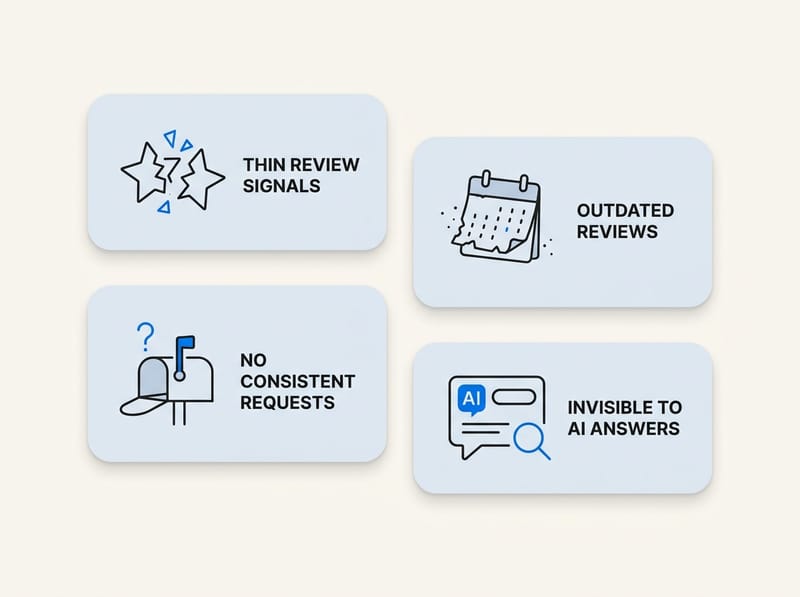
The biggest problems are thin, outdated, or concentrated review signals. A store can serve hundreds of satisfied customers each month while still appearing almost invisible externally if it has no consistent request process.
Do you have too few recent external reviews?
A profile with only a handful of old reviews does not clearly represent the store's current customer experience. Recency shows continued activity, while steady review collection creates a more credible pattern than a sudden one-time burst.
This is common when a merchant asks for reviews manually for a few weeks and then stops. In my experience, any reputation workflow that depends entirely on someone remembering to send emails will eventually become inconsistent. Automation makes the process sustainable without adding another daily task.
Are all your reviews concentrated on one platform?
A strong profile on one platform is valuable, but a broader presence creates more independent points of confirmation. The right mix depends on your audience, location, and product category.
A local retailer may prioritize a Google Business Profile, while a brand shipping nationally may also invest in Trustpilot. Facebook Pages may matter when the brand has an active social community, and Yelp can be relevant for businesses with a local or service component.
Are unhappy customers the only people motivated to post?
Customers with a problem often have stronger motivation to speak publicly than customers whose orders arrived as expected. A consistent request process gives every genuine customer a fair opportunity to share feedback.
The answer is not to suppress criticism. It is to ask consistently, listen carefully, and resolve problems quickly. Thoughtful public responses to critical reviews can demonstrate accountability and sometimes build more trust than a profile containing nothing but unexplained five-star ratings.
Are older and manual orders being missed?
Older orders, phone orders, and manually created Shopify orders are frequently excluded from automated marketing flows. That leaves a potentially valuable group of verified customers without a clear way to provide feedback.
A manual request option can responsibly close this gap. Requests should be relevant, recognizable, and sent only to actual customers. Avoid flooding an old customer list with repeated messages or contacting people without considering applicable consent and email rules.
Are stronger competitors occupying the recommendation space?
When several stores offer similar products, the brand with the clearest independent reputation may be easier for an AI system to cite. Competitors do not always win because their products are better; sometimes they simply provide more public evidence.
Review the search results and AI answers for the questions you want to own. Note which brands appear, where they are reviewed, how recently customers posted, and which product attributes recur. This gives you a practical benchmark without resorting to fake reviews or manipulative tactics.
What are the benefits of a multi-platform review presence?
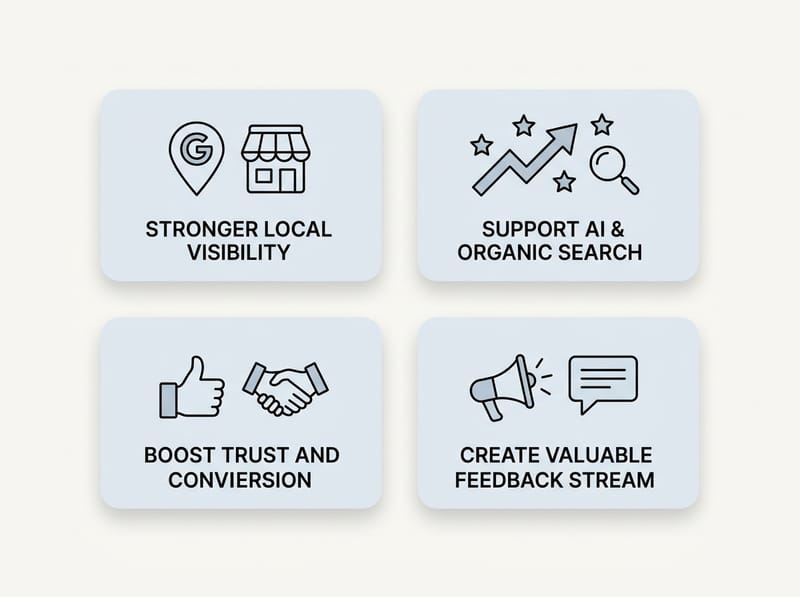
A strong multi-platform review presence can support AI visibility, local discovery, organic search, conversion, and customer trust. It also creates a valuable feedback stream that helps merchants fix product and service issues.
- More potential citation surfaces: Independent profiles create additional pages where your brand and product attributes can be discovered.
- Stronger local visibility: Google reviews and a complete business profile can support location-based discovery for eligible businesses.
- Higher research-stage trust: Shoppers can validate your claims before visiting your store or making a purchase.
- Better click-through potential: Familiar brands with visible reputations may earn more attention when cited alongside unfamiliar competitors.
- Improved conversion confidence: Consistent feedback across your site and external services reduces perceived purchase risk.
- Actionable customer insight: Repeated comments can reveal sizing confusion, packaging problems, shipping expectations, or popular use cases.
No merchant should promise that reviews alone will secure an AI Overview citation. The realistic outcome is that reviews create stronger evidence for search systems and greater confidence for shoppers. They work best alongside clear product data, helpful content, structured data, and consistent brand information.
External reviews can also reinforce broader AI visibility beyond Google. If that is a priority, follow the steps in my guide on getting a Shopify store into ChatGPT and AI search engines.
How can you build an external review strategy?
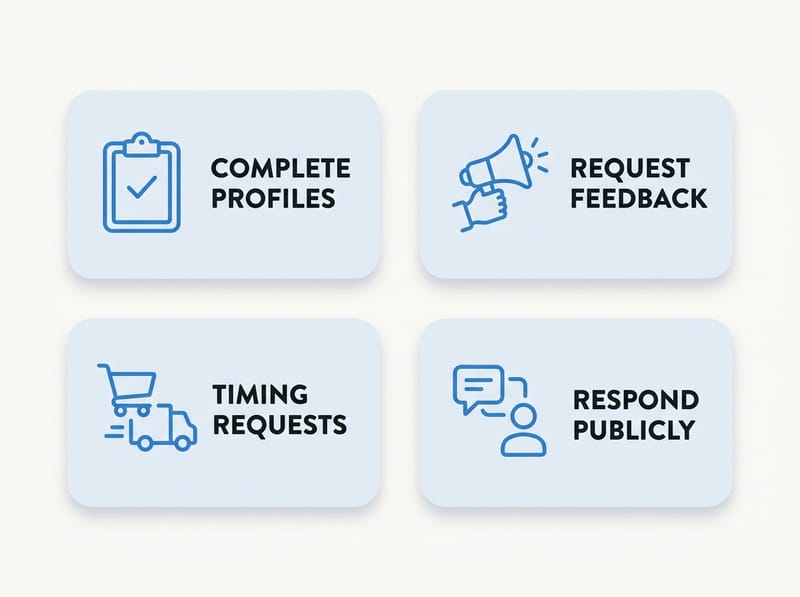
The best strategy is to complete your profiles, request feedback consistently, time requests after delivery, and respond publicly. Start with two or three relevant platforms rather than creating empty profiles everywhere.
1. Claim and complete your important profiles
Claim the profiles that match how customers discover and evaluate your store. Ensure your brand name, URL, category, contact details, description, and imagery are accurate and consistent.
Begin with Google if you operate an eligible business, then assess Trustpilot, Facebook, Yelp, and relevant regional or industry platforms. A complete profile is more useful to shoppers than a blank listing with no description or response activity.
2. Ask every eligible customer consistently
A consistent process reduces the bias created when only extremely happy or unhappy customers decide to post. The request should be neutral, clear, and open to honest feedback from every eligible customer.
Do not tell customers what rating to leave. Do not provide suggested praise, purchase reviews, or ask friends who have never ordered to post. Authenticity is essential for both platform compliance and long-term trust.
3. Send requests after the customer has used the product
The right timing is shortly after the customer has received and had enough time to evaluate the order. This may be 7 to 14 days after fulfillment for apparel, but longer for supplements, skincare, furniture, or products with an extended usage cycle.
Test timing by product type and shipping region. A request arriving before delivery creates frustration, while one arriving months later may be ignored. Use actual delivery data where possible, or add enough buffer to your fulfillment-based timing.
4. Build coverage across several relevant platforms
Choose platforms according to customer behavior rather than chasing every directory available. Two active, credible profiles are better than eight abandoned ones.
You can rotate the destination used in feedback campaigns or choose a platform based on region and business type. Always follow each platform's rules, since some services restrict review incentives, request wording, or how merchants direct customers.
5. Respond to positive and critical reviews
Public responses show that the business listens and remains active. Thank customers for useful feedback, address specific issues calmly, and move private order details to an appropriate support channel.
Avoid defensive template responses. When a customer reports a real failure, explain the next practical step and correct the underlying issue. Your response is written for the reviewer, but it is also read by future shoppers evaluating how your brand behaves when something goes wrong.
6. Measure progress monthly
Track review volume, recency, average rating, response rate, recurring topics, and platform coverage. Also monitor whether your brand appears for relevant searches and whether referral traffic arrives from external profiles.
AI Overview inclusion can change by query, location, and time, so avoid treating one test search as definitive. Review trends over several months and improve the wider set of signals around your brand. For additional tactics, see my guide to increasing LLM mentions for a Shopify store.
How can Lumo automate external review requests?
Lumo Reviews helps Shopify merchants automate customer feedback requests and build a more consistent external review process. I built it to solve the operational problem behind review visibility: most merchants know they should ask, but they do not have time to manually follow up with every order.

Lumo can send automated email review invitations a chosen number of days after an order. This lets merchants match the request timing to delivery speed and the amount of time customers need to experience the product.
The app supports destinations including Trustpilot, Google, Facebook, Yelp, Reviewcentre, Mamma, Yell, and more. You can focus on the platforms that genuinely matter to your audience instead of relying solely on reviews hosted inside your Shopify theme.
Can Lumo request feedback from older or offline customers?
Yes. Lumo supports manual review requests for older orders, phone orders, and manual orders, helping merchants include genuine customers who were not part of an automated post-purchase flow.
This feature is particularly useful when introducing a review strategy to an established store. Use it thoughtfully, contact real customers, and avoid repeatedly messaging people who have already received a request.
How does Reputation Shield™ help resolve customer issues?
Reputation Shield™ helps merchants catch and resolve customer problems privately and early. It creates an opportunity to understand a poor experience, provide support, and fix operational issues before frustration grows.
Reputation Shield™ should not be viewed as a way to block, filter, or hide negative reviews. Every eligible customer should be treated fairly, and merchants should continue to welcome honest feedback. The practical value is faster service recovery and a clearer process for handling problems.
Can merchants thank customers for giving feedback?
Lumo can help merchants provide discounts as a thank-you for giving feedback. Any reward should recognize the customer's time rather than require a positive rating or a review on a specific restricted platform.
Review platform policies vary, especially for services such as Google and Trustpilot. Merchants should check and follow each platform's current guidelines before enabling an incentive. Never make a discount conditional on praise, a five-star score, or the removal of critical feedback.
The expected outcome is not an instant AI ranking switch. It is a sustainable system that can strengthen SEO signals, brand reputation, customer insight, and revenue over time. That combination is more valuable than chasing a temporary review spike.
Frequently asked questions about reviews and AI Overviews
External reviews can support AI visibility, but they work as part of a wider search and reputation strategy. These are the questions I hear most often from Shopify merchants.
Do reviews affect AI Overviews?
Reviews can affect the evidence available to AI search systems by creating independent brand mentions, customer context, and reputation signals. They do not guarantee inclusion, but authentic reviews across trusted platforms can make a brand easier to verify and understand.
Which review platforms matter most for Shopify stores?
Google, Trustpilot, Facebook, and Yelp are common starting points, but the best platforms depend on your location, category, and customer behavior. Prioritize services that real customers already use and trust, including relevant regional or industry-specific review sites.
How many reviews does a Shopify store need?
There is no universal review threshold for appearing in AI Overviews. Aim for steady, authentic growth and current feedback rather than an arbitrary number or a sudden burst of reviews.
Should I remove negative reviews?
No. Merchants should not hide legitimate criticism simply to create a perfect-looking profile. Respond professionally, resolve the problem where possible, and use recurring complaints to improve products, shipping, or support.
Are on-site Shopify product reviews still useful?
Yes. On-site reviews remain highly useful for product-page trust, conversion, and product-specific context. The strongest approach combines them with independent external reviews that broaden your brand's public footprint.
How should you start improving your AI visibility today?
Start by auditing where your brand is reviewed, completing the profiles your customers use, and creating a reliable post-delivery request process. Consistency, authenticity, recency, and useful detail matter more than collecting a large number of generic ratings overnight.
AI Overviews are changing how shoppers discover Shopify brands, but the underlying requirement is familiar: businesses need to earn trust. External reviews turn private customer satisfaction into public, independent evidence that search systems and future buyers can evaluate.
If manual follow-up is preventing you from building that evidence, you can install Lumo Reviews from the Shopify App Store. Use it to request honest feedback consistently, identify customer problems earlier, and build a stronger reputation across the platforms that matter to your store.