
If you run a Shopify store and want to improve customer retention, support quality, and repeat revenue, the best Shopify CRM apps in 2026 are NoteDesk, Klaviyo, HubSpot CRM, Gorgias, ActiveCampaign, and Zoho CRM. Each tool solves a different problem, so the right pick depends on whether you need customer notes and order context, marketing automation, support-first CRM workflows, or a more traditional sales CRM.
In my experience building Shopify apps, merchants often use the term CRM to describe three different things. Some mean a classic contact and pipeline system, some really want email and SMS lifecycle marketing, and others just need a better way to keep customer context visible across orders, support tickets, and internal teams. That is why I have not ranked these apps purely by name recognition.
I have looked at Shopify integration quality, pricing, ease of setup, and how useful each app is in real merchant workflows in 2026. If you want a broader strategic breakdown first, I would also read our guide to the best CRM for Shopify. And if you are still weighing up budget options, our posts on free CRM apps for Shopify and customer service apps for Shopify are worth keeping open in another tab.
What is the best Shopify CRM app in 2026?
The best Shopify CRM app in 2026 depends on what type of customer relationship problem you are trying to solve. For stores that need better internal customer context and order-level notes, NoteDesk is my top pick. For retention marketing and customer data, Klaviyo is still one of the strongest options.
If you want a broader platform that combines sales, marketing, and service, HubSpot CRM is the best all-round enterprise-style choice. If your team is support-heavy, Gorgias makes more sense. For advanced automation, ActiveCampaign is excellent, and for lower-cost traditional CRM workflows, Zoho CRM remains a sensible option.
The biggest mistake I see is merchants installing a heavyweight CRM when what they really need is a simpler layer of customer context inside Shopify. In plenty of cases, a store does not need a giant external system first. It needs better visibility inside the admin, cleaner notes, and a way for staff to act on customer history quickly.
How did I choose these Shopify CRM apps?
I chose these CRM apps based on Shopify relevance, integration depth, 2026 pricing, reputation, and practical fit for ecommerce teams. A CRM can look brilliant in a demo and still be frustrating day to day if the data sync is messy or the team never updates it.
I reviewed the current SERP leaders, the latest research data, app positioning, and whether each tool is genuinely useful for Shopify merchants rather than generic sales teams. The strongest options consistently show G2 ratings between 4.1 and 4.6, starter pricing from free to $15/month for several tools, and either a native Shopify integration or a reliable sync path.
As a Shopify app developer, I care a lot about workflow friction. If an app creates duplicate contacts, unreliable order sync, or forces staff to keep switching tabs, it usually gets abandoned. The best CRM is usually the one your team will actually use every day, not the one with the longest feature list.
What should a good CRM for Shopify actually do?
A good Shopify CRM should centralise customer data, make follow-up easier, and help you generate more revenue from existing customers. It should not just store contacts. It should help you segment customers, personalise support, and act on order behaviour.
For most ecommerce brands, the most useful CRM features are practical rather than flashy. You want a system that keeps customer information accurate, makes it easier to reply with context, and helps your team spot opportunities for retention or upsell.
- Customer profiles with order history, spend, tags, and notes
- Shopify sync for customers, products, and orders
- Email and SMS automation for retention and repeat purchases
- Segmentation by lifecycle stage, spend, or buying behaviour
- Support visibility so agents can respond with context
- Internal collaboration tools such as notes, flags, or account handover context
- Reporting and attribution to analyse what drives revenue
- Pipeline management if you sell B2B, wholesale, or high-ticket products
If your main goal is increasing basket size rather than managing broader customer relationships, a specialist upsell tool may be a better fit. In that case, read our guide to the best upsell apps for Shopify.
Which are the best Shopify CRM apps for 2026?
The best 6 Shopify CRM apps for 2026 are NoteDesk, Klaviyo, HubSpot CRM, Gorgias, ActiveCampaign, and Zoho CRM. Together, these cover the main CRM use cases for Shopify merchants: internal customer management, lifecycle marketing, support, retention, and sales workflows.
Here is the quick comparison before I break down each option in more detail.
| CRM app | Best for | Starting price | Shopify integration | Rating signal | My verdict |
|---|---|---|---|---|---|
| NoteDesk | Customer notes, order context, internal CRM workflows | Varies by plan | Built for Shopify admin workflows | Shopify-focused use case | Best lightweight CRM layer for merchants |
| Klaviyo | Email, SMS, and customer data | Free for up to 250 contacts | Native official integration | 4.6/5 on G2 | Best for DTC retention |
| HubSpot CRM | Scaling sales, marketing, and service | Free for up to 1M contacts | Native app | 4.4/5 on G2 | Best all-round CRM |
| Gorgias | Support-first ecommerce teams | $10/month | Native Shopify support workflows | 4.6/5 on G2 | Best for support and retention |
| ActiveCampaign | Retention automation | $15/month | Native app | 4.5/5 on G2 | Best for lifecycle marketing |
| Zoho CRM | Budget-conscious teams | Free for 3 users | Via connector or middleware | 4.1/5 on G2 | Best budget traditional CRM |
1. Why is NoteDesk one of the best Shopify CRM apps?
NoteDesk is one of the best Shopify CRM apps because it solves a very common merchant problem that bigger CRMs often ignore: keeping useful customer context inside Shopify. If your team needs a lightweight, practical CRM layer without turning Shopify into a mess of spreadsheets, this is the one I would look at first.
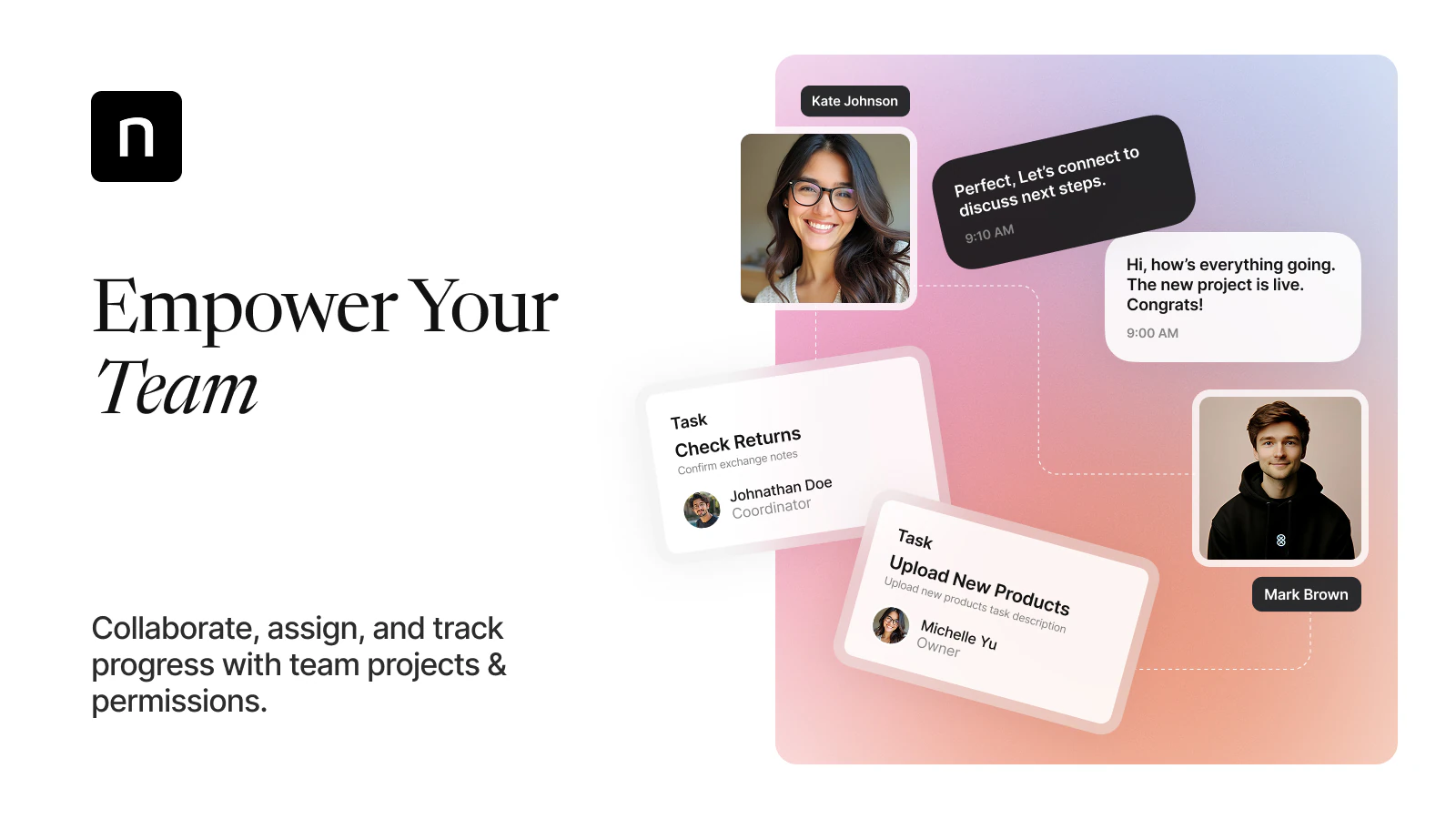
As the developer behind Shopify apps, I have seen how often merchants struggle with fragmented customer information. Staff leave notes in helpdesks, email threads, Slack messages, or not at all. NoteDesk fixes that by making customer notes, order notes, and internal context easier to store and act on where your team is already working.
That matters more than many merchants realise. A proper CRM is not always about giant dashboards and sales pipelines. Sometimes it is simply about making sure the next support agent, fulfilment manager, or founder can instantly see that a customer is VIP, had a damaged parcel last month, requested a custom handling process, or is sensitive about delivery timing.
In my experience, this kind of operational context can improve customer experience faster than installing a heavyweight platform with hundreds of unused features. Best for small and mid-sized Shopify teams, especially stores that need internal collaboration and better customer memory inside the admin.
If your store also relies on custom order handling or customer-specific instructions, this pairs naturally with stronger support tooling. That is one reason I often recommend it alongside our broader guide to customer service apps for Shopify.
Who should use NoteDesk?
NoteDesk is best for merchants who need customer context inside Shopify rather than a complex external CRM. It is especially useful for stores with repeat buyers, support-heavy operations, bespoke fulfilment needs, or team handovers.
- Small support teams that need shared customer memory
- DTC stores managing repeat buyers and edge cases
- Founder-led brands that want something fast to adopt
- Operations-heavy stores with special handling instructions
2. Why is Klaviyo one of the best CRM apps for Shopify?
Klaviyo is one of the best Shopify CRM apps because it combines customer data, email, SMS, and segmentation in one ecommerce-focused platform. It is the option I most often recommend for DTC brands focused on retention and repeat purchases.
Klaviyo is not a traditional sales CRM, but for many Shopify merchants it behaves like the most useful kind of CRM. It gives you unified customer profiles, event-based automation, and revenue reporting tied directly to store activity. The latest research still positions it as a top choice in 2026, with 117,000+ brands using both Shopify and Klaviyo together and data syncing in under 200 milliseconds.

When I test CRM tools for Shopify stores, I look closely at how fast I can build useful segments. Klaviyo is strong here. You can quickly identify high-value customers, recent first-time buyers, dormant subscribers, or people who bought a specific product but not its refill or complement.
Free plan available for smaller lists, and the platform scales well as your store grows. If your main goal is lifecycle marketing, abandoned basket recovery, post-purchase flows, and customer intelligence that actually drives revenue, Klaviyo is hard to beat.
What are Klaviyo's main pros and cons?
Klaviyo's biggest strength is ecommerce-native marketing automation. Its main downside is that it is not a full traditional CRM for pipeline-heavy sales teams.
- Pros: excellent Shopify sync, powerful segmentation, strong email and SMS, revenue attribution, mature ecommerce ecosystem
- Cons: can get expensive as lists grow, not ideal for wholesale pipeline management, more marketing-focused than service-focused
If you are just getting started with apps and retention workflows, our guide to the best Shopify apps for beginners is a useful next read.
3. Is HubSpot CRM a good fit for Shopify stores?
HubSpot CRM is a very good fit for Shopify stores that want one platform for marketing, sales, and service. It is the best all-round option here if you need a more traditional CRM structure and room to scale.
HubSpot CRM offers one of the most generous entry points on this list, with a free plan supporting up to 1 million contacts. The Shopify integration syncs customers, orders, and products automatically, which makes it far more usable for ecommerce than many generic CRMs that need heavy middleware work.
In practice, HubSpot works best for brands with a few moving parts. That might mean B2B and DTC together, a growing service team, wholesale leads, or a content and email strategy that goes beyond basic campaigns. It is rated 4.4/5 across nearly 35,000 G2 reviews, which tells you a lot about maturity and market trust.
The trade-off is complexity. HubSpot can become expensive once you add paid hubs, and smaller stores may never use half the features. Still, if you want best all-round CRM rather than the cheapest or simplest option, it deserves a place near the top.
When should you choose HubSpot over Klaviyo?
Choose HubSpot over Klaviyo if you need broader CRM functionality beyond retention marketing. Choose Klaviyo if your main focus is ecommerce messaging and customer segmentation.
| Use case | Choose HubSpot | Choose Klaviyo |
|---|---|---|
| Traditional CRM records | Yes | No |
| Sales pipeline management | Yes | No |
| Advanced ecommerce email and SMS | Good | Excellent |
| Retention-first DTC brand | Good | Best fit |
| Service plus marketing plus sales in one stack | Best fit | Limited |
4. Why do support-focused brands choose Gorgias?
Support-focused brands choose Gorgias because it brings customer support and ecommerce context together in one place. If your CRM strategy starts with service, Gorgias is one of the strongest Shopify-native options.
Gorgias is built specifically for ecommerce teams and has long been popular with Shopify merchants. It starts from $10/month and is rated 4.6/5 on G2. Its strength is not classic deal management. Its strength is helping support teams see orders, customer history, and store actions without constant tab switching.
That is a genuine CRM advantage. A lot of retention happens through support. When an agent can instantly see what a customer bought, whether they are high value, and what has gone wrong before, they can handle the conversation better and often save the relationship.
In my experience, Gorgias is best for support and retention rather than broad sales CRM use. It is especially useful for stores with high ticket volumes, subscription questions, delivery issues, or product education needs. If your support team is becoming a revenue driver, this is a serious contender.
What are the limits of Gorgias as a CRM?
Gorgias is excellent for service-led customer management, but it is not a full classic CRM for every use case. It is less suitable if you need deep sales pipeline tracking or highly custom B2B deal stages.
- Best at: support context, customer service workflows, ecommerce helpdesk operations
- Less ideal for: complex sales teams, traditional lead management, detailed account executive workflows
5. Is ActiveCampaign worth it for Shopify retention?
Yes, ActiveCampaign is worth it for Shopify stores that want advanced retention automation without going fully enterprise. It is one of the best tools here for lifecycle marketing.
ActiveCampaign starts at $15/month and has a 4.5/5 G2 rating. It is strong at automation logic, which makes it appealing for brands that want more than basic welcome emails and abandoned basket reminders. You can build nuanced journeys around purchase timing, category preferences, inactivity windows, and customer value.

Compared with Klaviyo, I would say ActiveCampaign can feel more flexible in some automation scenarios, but less obviously ecommerce-first. That matters. If your team enjoys building detailed automations and wants more control, it is a strong option. If you want the shortest path to Shopify-specific retention wins, Klaviyo is usually easier.
Best for lifecycle marketing, especially if you already think in terms of branching flows, lead scoring, and behaviour-based messaging. It can also suit hybrid brands selling through Shopify plus other channels.
6. Is Zoho CRM still worth considering for Shopify in 2026?
Yes, Zoho CRM is still worth considering if you want a budget-friendly traditional CRM and do not mind a less seamless Shopify setup. It offers a lot of features for the price.
Zoho CRM has a free plan for 3 users and paid pricing up to around $52/user/month. It remains attractive for small teams that want contact management, workflows, reporting, and broader business tooling without paying HubSpot-level prices.

The main weakness is integration smoothness. Unlike Klaviyo, HubSpot, or Gorgias, the Shopify connection is often handled via connector apps or middleware. That means more setup, more testing, and more chances for field mismatches or sync quirks. It is rated 4.1/5 on G2, which feels fair.
That said, I would not dismiss it. For a budget-conscious merchant that wants a more classic CRM structure, Zoho is still one of the better value options. Just go in expecting a slightly more technical setup than the Shopify-native leaders.
Why did I leave out Freshsales, Pipedrive, and other CRM tools?
I left them out of the main six because this list is focused on the strongest overall fit for Shopify merchants, not just generic CRM popularity. Several other tools are still worth a look depending on your business model.
Freshsales is a credible alternative, especially for affordable CRM plus built-in phone support. The latest research data places it among the top Shopify CRM options with a free plan for 3 users, native Shopify integration, and a 4.5/5 G2 rating. If you need calling features and a more traditional CRM feel, it is a sensible shortlist candidate.
Pipedrive is often excellent for sales pipelines, but it is less Shopify-native than the leaders above. I tend to recommend it more for B2B, wholesale, or high-ticket deal tracking than for standard DTC retention. Competitor roundups also mention tools like Endear, Reamaze, Metrilo, Drip, and retailCRM, but not all of them are as broadly suitable across store sizes and use cases.
If your main challenge is post-purchase revenue rather than CRM in the classic sense, you may get better ROI from a specialist app stack. For example, a support tool plus an upsell app plus a note system can outperform a bulky CRM for many stores. That is why I also suggest reading our guides to Shopify add-on apps and subscription apps for Shopify if those are closer to your growth model.
How do I choose the right CRM for my Shopify store?
The right CRM depends on whether your main bottleneck is support, retention marketing, internal operations, or sales management. Start with the problem, not the software category.
Here is the decision framework I use when advising merchants:
- If you need better customer context inside Shopify, choose NoteDesk.
- If you need retention marketing and segmentation, choose Klaviyo.
- If you need one platform for sales, marketing, and service, choose HubSpot.
- If support is your main customer relationship channel, choose Gorgias.
- If you want complex automation at a lower starting price, choose ActiveCampaign.
- If you want a lower-cost traditional CRM, choose Zoho CRM.
Also be honest about your team's capacity. In my experience, merchants overbuy CRM software all the time. A store doing under seven figures often gets more value from clean customer notes, basic segmentation, and reliable support workflows than from a huge CRM rollout.
What mistakes do Shopify merchants make when choosing a CRM?
The most common mistake is choosing a CRM based on brand name rather than workflow fit. The second most common mistake is expecting one app to solve support, retention, sales, and internal operations equally well.
- Buying too much software too early and never fully implementing it
- Ignoring integration quality and ending up with poor data sync
- Confusing email marketing with full CRM without checking actual needs
- Forgetting staff adoption and choosing tools the team will not use
- Skipping internal context even though it affects customer experience daily
I have seen merchants spend months wiring up a sophisticated CRM while customer service staff still cannot see simple order-specific notes. That is why I keep coming back to practical utility. The best CRM setup is the one that improves customer experience this week, not just the one that sounds impressive in a board meeting.
Which Shopify CRM app is best for your store size?
Smaller stores usually need simplicity and speed, while larger stores need cross-team coordination and stronger automation. Store size changes the right answer quite a bit.
| Store stage | Best CRM choice | Why |
|---|---|---|
| New or small store | NoteDesk or Klaviyo | Fast to adopt, practical customer context, strong retention basics |
| Growing DTC brand | Klaviyo or Gorgias | Better segmentation, support context, repeat purchase focus |
| Scaling multi-team business | HubSpot CRM | Sales, marketing, and service in one system |
| Budget-conscious operations | Zoho CRM | Strong feature-to-price ratio |
| Automation-heavy retention team | ActiveCampaign | Advanced workflow logic and lifecycle campaigns |
Final verdict: which Shopify CRM app would I choose?
If I wanted the most practical CRM improvement for a typical Shopify merchant, I would start with NoteDesk. It solves a real operational problem quickly and keeps customer context where teams already work.
For pure retention and customer marketing, I would choose Klaviyo. For a broader all-in-one platform, I would choose HubSpot CRM. For support-led brands, Gorgias is the better fit. For automation lovers, ActiveCampaign is excellent. And for lower-cost traditional CRM structure, Zoho CRM still earns its place.
The key is to match the tool to the job. In my experience building Shopify apps, the stores that grow fastest are not the ones with the most software. They are the ones with the clearest customer data, the fewest workflow gaps, and a team that can actually act on what they know.
External resources worth checking while you compare include G2 for current review trends, Shopify Partner resources for integration guidance, and the official Shopify App Store listings for Klaviyo, HubSpot CRM, ActiveCampaign, and Zoho via Skylio.