
If you are looking for the best ReConvert alternatives for Shopify in 2026, the strongest options right now are tools that combine pre-purchase upsells, post-purchase offers, and flat or predictable pricing. In my experience building Shopify apps, that combination usually beats a thank you page-only strategy on both total revenue impact and cost control.
ReConvert is still a well-known app, and for some stores it remains a perfectly reasonable choice. But in 2026, merchants are much more aware of Checkout Extensibility, AOV optimisation, and the downside of paying a fee that scales as the app drives more revenue.
I have worked with Shopify merchants across upsells, reviews, support, and conversion tooling, and one pattern comes up again and again: the best upsell app is not always the one with the most features. It is the one that fits your store size, your traffic profile, and the exact point in the customer journey where you want to make the offer.
If you are still comparing options more broadly, I would also read our guide to the best upsell apps for your Shopify store in 2026, because some stores are better off choosing by use case rather than by replacing one specific app.
What is ReConvert and why do merchants look for alternatives?
ReConvert is a Shopify upsell app focused mainly on post-purchase offers and thank you page optimisation. Merchants usually look for alternatives because they want more placements, simpler pricing, or a tool that captures revenue before checkout rather than only after the sale.
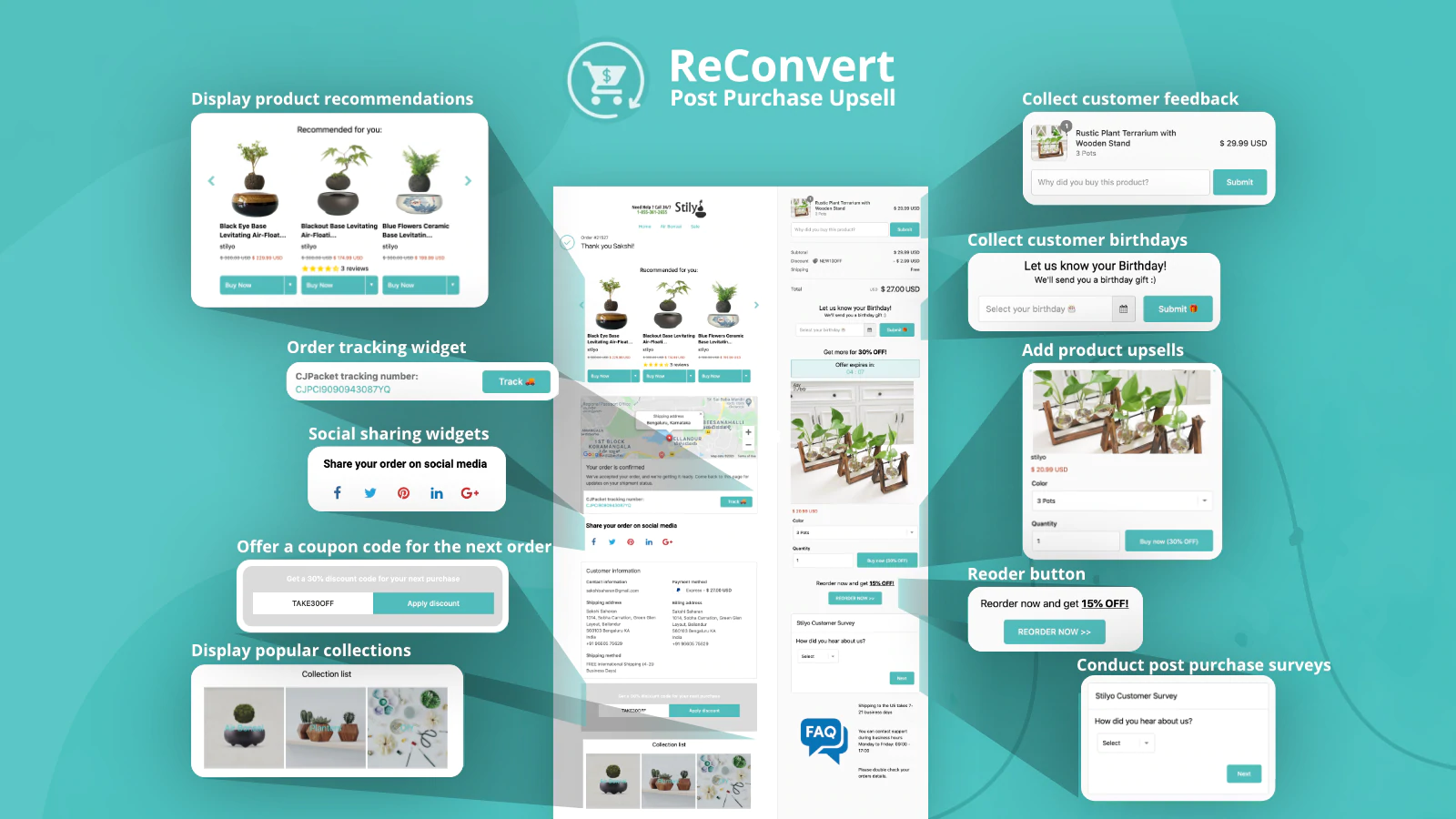
ReConvert became popular because it made the thank you page more useful. Instead of treating the order confirmation page as dead space, it lets merchants add upsells, cross-sells, reorder prompts, surveys, birthday capture, discount blocks, and other widgets.
That said, the market has moved on. In 2026, many merchants want coverage across product page, cart, checkout, post-purchase, and thank you page. They also want better attribution, A/B testing, and pricing that does not become painful as the store scales.
How much does ReConvert cost in 2026?
ReConvert uses a hybrid pricing model that combines a monthly fee with a revenue share. That is the main reason cost-conscious merchants start comparing alternatives.
The app has historically offered a 30-day free trial, with entry pricing starting around $4.99/month for lower-volume stores, then scaling up significantly for larger stores. On top of the monthly plan, ReConvert also charges up to 0.75% of attributed revenue, which means your bill rises when the app performs well.
That model is not automatically bad. If you are a small store doing modest order volume, it can feel low risk. But once your upsell engine is contributing serious revenue, many merchants would rather switch to a flat-rate app and keep more of the upside.
What are ReConvert's strengths?
ReConvert is strongest when you want to monetise the post-purchase moment without heavy development work. It is especially useful for stores that already convert well and want to squeeze more value from completed orders.
I also think ReConvert deserves credit for making the thank you page a serious conversion surface long before many merchants paid attention to it. If your store already has strong product page conversion and you simply want one-click post-purchase offers, it still has a clear place.
What are ReConvert's main limitations?
The biggest limitation is reach. A post-purchase upsell app only speaks to people who have already bought, while pre-purchase upsells can influence every visitor who reaches a product page or cart.
The second limitation is pricing. Revenue-share models can look affordable at first, but they become harder to justify once you are generating meaningful extra sales. The third is that some competitors now offer broader placement coverage, smarter AI recommendations, and better support for modern Shopify checkout experiences.
How should you choose a ReConvert alternative?
The best ReConvert alternative depends on where you want to upsell: before checkout, in checkout, after purchase, or across the whole funnel. You should choose based on placement coverage, pricing model, targeting depth, and how quickly you can launch offers.
When I test upsell apps, I usually score them on five things:
- Placement coverage - product page, cart, checkout, post-purchase, thank you page
- Offer logic - product rules, collection rules, customer tags, AI recommendations
- Pricing predictability - flat rate versus usage or revenue share
- Speed to launch - can a merchant build a working funnel in under an hour?
- Reporting quality - can you clearly see lift in AOV, conversion, and offer acceptance?
If your main pain point is cost, prioritise flat-fee apps. If your pain point is limited reach, prioritise pre-purchase and cart upsells. If your pain point is complexity, pick something with templates and a simpler rule builder.
For stores actively working on conversion rate as well as AOV, our Shopify conversion rate optimisation guide is worth reading alongside this one. Upsells work best when the underlying journey is already clean and friction-free.
What are the 5 best ReConvert alternatives for Shopify in 2026?
The best ReConvert alternatives for Shopify in 2026 are EasyApps Suite, AiTrillion, Selleasy, Wiser AI, and Upsell by AMP. These apps stand out because they give merchants more control over placement, better long-term pricing, or stronger personalisation than a post-purchase-only setup.
I am also including a few honourable mentions later, because some merchants will still be better served by tools like SellUp, Candy Rack, Honeycomb, or One Click Upsell depending on their funnel.
| App | Best for | Main advantage over ReConvert | Potential drawback |
|---|---|---|---|
| EasyApps Suite | Stores wanting pre-purchase revenue growth | Flat or free pricing and broader visitor reach | Best results may require using multiple EasyApps tools |
| AiTrillion | Merchants wanting an all-in-one growth stack | More than just upsells, with wider retention tooling | Can be more than you need if you want only upsells |
| Selleasy | Small to mid-sized stores wanting flexible upsells | Versatile placements and strong value | Less specialised in thank you page customisation |
| Wiser AI | Stores wanting personalised recommendations | AI-driven recommendations across the funnel | Best performance depends on enough product and order data |
| Upsell by AMP | Merchants replacing revenue-share pricing | More predictable long-term cost | May not have the same thank you page brand familiarity as ReConvert |
1. Why is EasyApps Suite the best overall ReConvert alternative?
EasyApps Suite is the best overall ReConvert alternative if your goal is to increase AOV before checkout rather than only after the order is complete. Its biggest advantage is simple: pre-purchase placements reach far more shoppers than thank you page widgets do.
Competitor research in 2026 repeatedly highlights EasyApps as the strongest alternative because it focuses on pre-purchase conversion opportunities such as upsells, free shipping nudges, and rewards messaging. That is a smart angle, because if your store converts at 2 to 4%, the vast majority of visitors will never see a post-purchase offer.
In practical terms, EasyApps is best for merchants who want to influence behaviour on the path to checkout. A well-placed free shipping threshold or cart add-on can outperform a thank you page upsell simply because it appears earlier and to more people.
The other major advantage is pricing. Instead of taking a cut of the revenue it helps generate, EasyApps is known for flat pricing and free plans. For growing stores, that can make budgeting much easier and preserve margin as order volume rises.
Best for: stores focused on pre-purchase AOV growth and predictable costs.
Not ideal if: your entire strategy revolves around post-purchase one-click offers and thank you page customisation.
2. Is AiTrillion a good alternative to ReConvert?
AiTrillion is a strong ReConvert alternative if you want an all-in-one growth platform rather than a single-purpose upsell app. It is particularly appealing for merchants who want to combine AOV growth, customer retention, and marketing automation in one place.
In several 2026 roundups, AiTrillion is ranked near the top for increasing average order value. That is not just because of upsells. It also benefits from being part of a broader ecosystem that can support repeat purchases, loyalty, segmentation, and customer engagement.
From a merchant perspective, that can reduce app sprawl. I have seen stores stack separate apps for upsells, loyalty, email, and analytics, only to end up with overlapping scripts and messy reporting. An all-in-one tool can simplify that, provided the upsell module itself is strong enough for your needs.
The trade-off is focus. If you only want a lightweight replacement for ReConvert, AiTrillion may feel broader than necessary. But if you are trying to build a more connected retention engine, it is a serious contender.
Best for: merchants wanting one platform for AOV and retention.
Not worth it unless: you will actually use the wider feature set.
3. Why do so many merchants choose Selleasy instead of ReConvert?
Selleasy is popular because it gives merchants flexible upsell placements and a relatively approachable setup without the complexity of a more enterprise-style stack. It is one of the most consistently recommended upsell apps in 2026 rankings.
Selleasy works well for stores that want to show relevant offers on product pages, in cart, and around the purchase flow without overcomplicating things. In my experience, that middle ground matters a lot. Many merchants do not need a giant optimisation suite. They need an app that helps them launch sensible offers quickly and measure whether they work.
Compared with ReConvert, Selleasy is often a better fit for stores that feel limited by a post-purchase-first approach. If your catalog has natural add-ons, accessories, or bundle opportunities, pre-purchase placements can produce more consistent lift in AOV and attach rate.
It is also a good option for merchants who want to test upsells without committing to a pricing model that scales aggressively with success. That makes it especially attractive for small and medium-sized stores.
Best for: small to mid-sized stores that want practical upsells in multiple placements.
Potential downside: less emphasis on thank you page customisation than ReConvert's original core strength.
4. Is Wiser AI better than ReConvert for personalisation?
Wiser AI is often better than ReConvert if your priority is AI-powered product recommendations and personalised upsell logic across the store. It is especially useful for larger catalogues where manual offer mapping becomes time-consuming.
Wiser shows up consistently in 2026 best-of lists because merchants increasingly want recommendations that adapt to browsing and purchase patterns. That matters if you sell across multiple collections, seasonal ranges, or large SKU counts where hand-built funnels are difficult to maintain.
When recommendation quality is good, personalisation can do two things at once: increase average order value and reduce the feeling that the upsell is forced. That is the sweet spot. Customers are more receptive when the offer feels like a natural extension of what they already want.
The caveat is data. AI systems generally perform better when they have enough product relationships and order history to learn from. If you are a brand new store with a tiny catalogue, a simpler rules-based app may be easier to control initially.
Best for: stores with larger catalogues and a need for smarter recommendations.
Best feature angle: personalisation at scale.
5. Should you switch from ReConvert to Upsell by AMP?
Upsell by AMP is a strong choice if you like the idea of a dedicated upsell tool but want better long-term pricing predictability than ReConvert. It is often mentioned as a direct rival for merchants who dislike revenue-share billing.
For scaling stores, predictability matters more than many app roundups admit. Once you are processing meaningful volume, you start caring less about a low entry price and more about whether the app remains economical at 5,000, 10,000, or 50,000 orders a month.
That is where AMP-style alternatives appeal. They position themselves as feature-rich options without tying your bill as tightly to attributed revenue. If your finance team or agency wants cleaner cost forecasting, that is a real advantage.
I would shortlist Upsell by AMP if you are happy with the idea of an upsell-focused app but no longer happy with how ReConvert's pricing scales as you grow.
Best for: merchants replacing revenue-share pricing.
Strongest reason to switch: cost control at scale.
How do the top ReConvert alternatives compare side by side?
The main difference between these apps is whether they focus on pre-purchase reach, all-in-one retention, AI personalisation, or pricing efficiency. There is no single winner for every merchant.
| Alternative | Primary focus | Best store type | Why choose it over ReConvert |
|---|---|---|---|
| EasyApps Suite | Pre-purchase AOV growth | Growth stores wanting more reach | Targets more visitors and avoids % fees |
| AiTrillion | All-in-one growth stack | Brands consolidating apps | Combines upsells with retention tools |
| Selleasy | Flexible upsell placements | SMBs and practical operators | Good balance of simplicity and coverage |
| Wiser AI | AI recommendations | Large catalogues | Better personalisation across more touchpoints |
| Upsell by AMP | Predictable upsell pricing | Scaling stores | More cost-efficient long term |
What if you still want a more traditional upsell app like ReConvert?
If you still want a more traditional Shopify upsell app, there are several strong alternatives that feel closer to ReConvert's style. The best known options include SellUp, Candy Rack, Honeycomb, and One Click Upsell.
These are not my top five based on current 2026 SERP intent, but they are still highly relevant for merchants comparing established Shopify upsell tools.
Is SellUp still worth considering in 2026?
Yes, SellUp is still worth considering if you want a straightforward app for on-page offers, cart upsells, and post-purchase opportunities. It is especially good for merchants who value quick setup and clear offer placement.
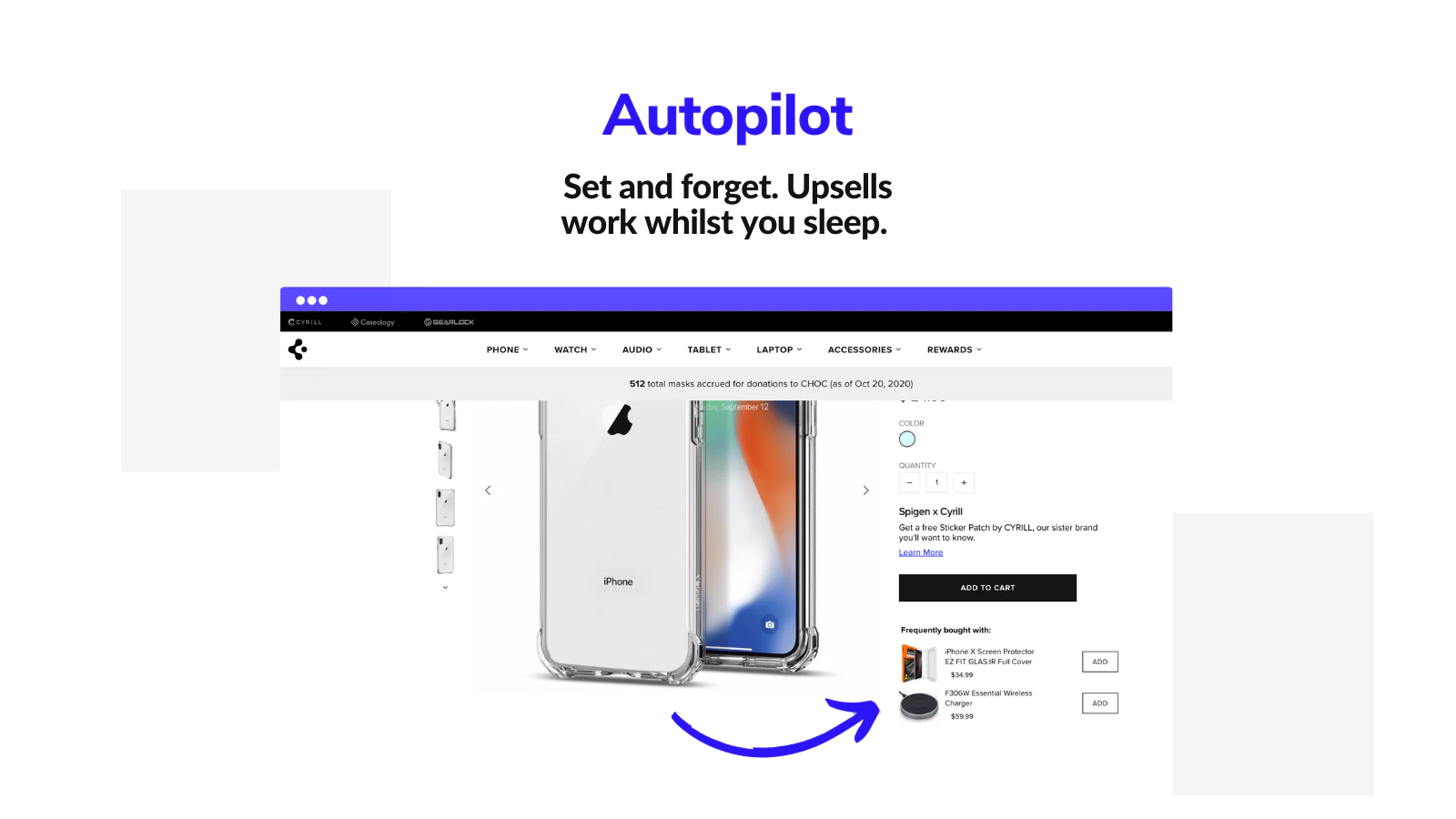

I know this app particularly well because SellUp is one of the apps I have built for Shopify merchants. My bias is obvious, so I will keep this practical: SellUp works best when you want to launch product page offers, cart page upsells, and thank you page offers without overengineering the funnel.
You can install SellUp and get live offers running quickly. For many merchants, that matters more than having dozens of advanced widgets they never use. I have seen stores get better results simply by showing one relevant accessory offer in the right place with clear copy.
SellUp can also work alongside a thank you page-focused tool if you want broader coverage. If your store needs both pre-purchase and post-purchase opportunities, combining approaches can make sense.
If you are exploring add-ons more generally, our list of the best Shopify add-on apps covers similar use cases.
Is Honeycomb a good fit for growing stores?
Yes, Honeycomb Upsell & Cross Sell is a good fit for growing stores that want funnel-based upsells, A/B testing, and broad placement support. It is often shortlisted by merchants who want more experimentation than simple static offers.
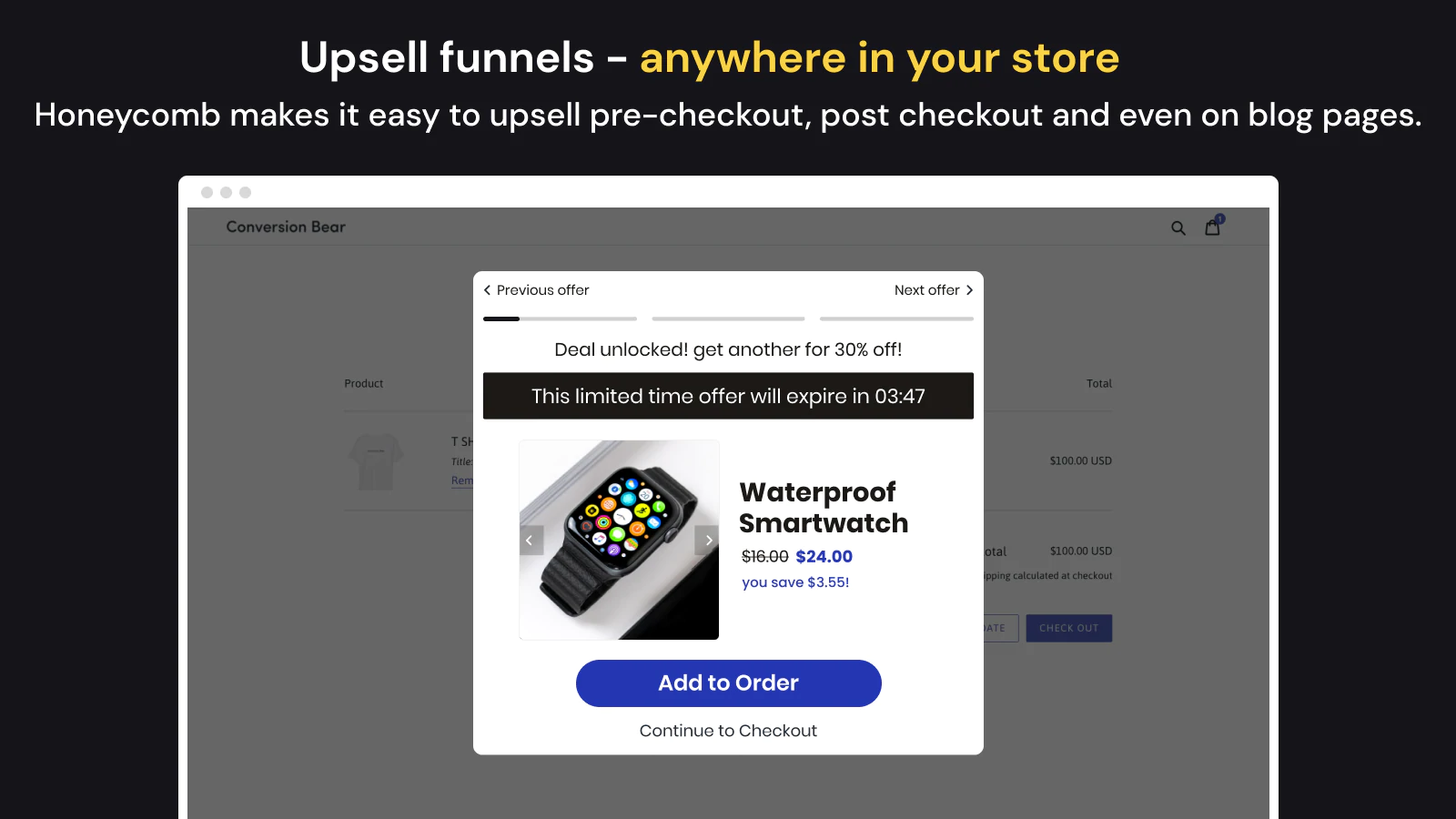

Honeycomb Upsell & Cross Sell is built around the idea of chaining offers together and testing what works. That makes it useful for merchants who want to optimise rather than just install and forget.
It also offers a free plan with limited funnel views, which is useful if you want to validate the concept before paying more. For scaling brands, that can be a sensible stepping stone before committing to a larger optimisation stack.
Should you consider One Click Upsell instead of ReConvert?
One Click Upsell is worth considering if your store is heavily focused on post-purchase funnels, downsells, and more advanced upsell sequencing. It is one of the better-known names in the Shopify upsell space for a reason.
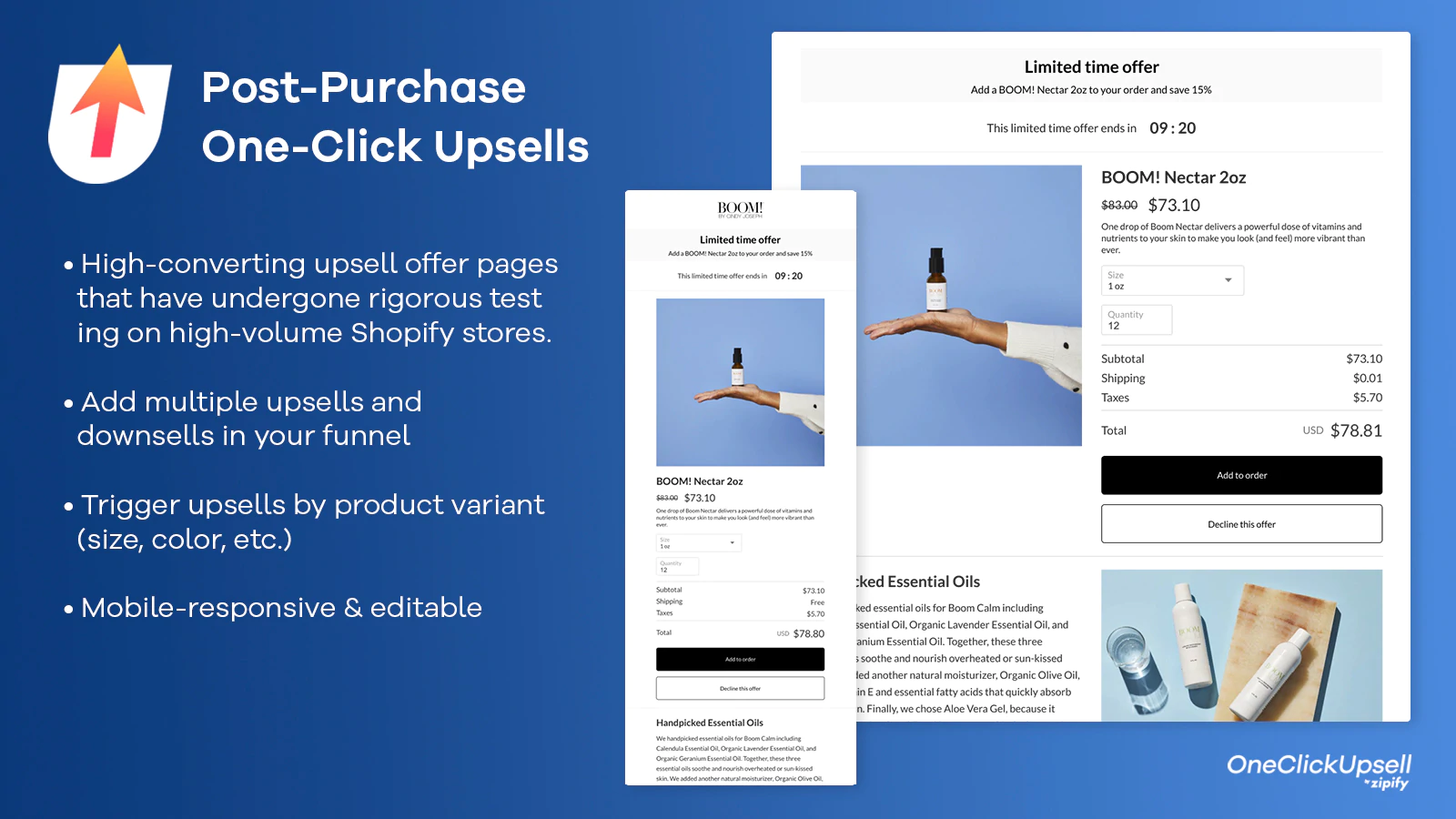

One Click Upsell is particularly useful when you want to build more structured post-purchase flows. Compared with ReConvert, it can be a better fit for merchants who think in terms of funnels rather than just widgets on the thank you page.
If your catalogue lends itself to upgrades, bundles, and second-chance offers, OCU can be very effective. It is less about decorating the order confirmation page and more about turning the post-purchase sequence into a deliberate revenue flow.
Which ReConvert alternative is best for your store size?
The best app depends heavily on store size. Small stores usually need ease of use and low risk, while larger stores need coverage, analytics, and pricing that scales sensibly.
| Store type | Best fit | Why |
|---|---|---|
| New store | Selleasy or SellUp | Fast setup, practical placements, lower complexity |
| Growing DTC brand | EasyApps Suite or Honeycomb | Better reach and more room to optimise |
| Large catalogue store | Wiser AI | Personalisation helps manage SKU complexity |
| Retention-focused brand | AiTrillion | All-in-one stack beyond upsells |
| Scaling high-volume store | Upsell by AMP or OCU | Better economics and stronger funnel tooling |
How do I migrate away from ReConvert without hurting conversions?
The safest way to migrate from ReConvert is to replace one placement at a time, track AOV and conversion rate closely, and avoid changing your whole funnel in one go. A careful migration reduces the risk of losing revenue while you test a new app.
- Audit your current offers. Export or document every active upsell, trigger, and thank you page element.
- Identify top performers. Keep the offers with the highest acceptance rate or attributed revenue.
- Choose your new placement strategy. Decide whether you are moving to pre-purchase, post-purchase, or a hybrid setup.
- Rebuild the highest-impact offers first. Do not start with edge-case funnels.
- Run a controlled test period. Compare AOV, conversion rate, RPM, and attach rate over at least 2 to 4 weeks.
- Only then remove the old app fully. This avoids a sudden drop caused by configuration gaps.
In my experience, merchants get into trouble when they migrate based on price alone and forget to map the actual customer journey. A cheaper app is not a better app if it leaves your best offers unimplemented.
What features matter most in a Shopify upsell app in 2026?
The most important upsell app features in 2026 are native Shopify compatibility, fast loading, multi-placement coverage, targeting rules, and clear analytics. Merchants also increasingly care about Checkout Extensibility readiness and mobile UX.
- Checkout Extensibility support where relevant
- One-click acceptance for post-purchase offers
- AI or rules-based recommendations
- A/B testing or at least offer-level reporting
- Theme-safe installation with minimal performance impact
- Predictable pricing as order volume grows
If you are also experimenting with bundles, that is another reason to think beyond ReConvert. We have a separate guide to the best bundle apps for Shopify and another on creating mix and match bundles, both of which can complement your upsell strategy nicely.
So which ReConvert alternative would I choose?
If I were choosing a ReConvert alternative in 2026, I would start with the app that matches the part of the funnel I most want to improve. For most stores, that means EasyApps Suite for broader pre-purchase reach, Selleasy for flexible value, or Wiser AI for personalisation.
If I specifically wanted a more direct replacement for a classic upsell setup, I would also consider SellUp, Honeycomb Upsell & Cross Sell, and One Click Upsell. They are all credible options, just aimed at slightly different merchant needs.
The key takeaway from everything I have seen building apps for Shopify merchants is this: do not choose based on brand familiarity alone. Choose based on where your customers are most likely to accept an offer, how much control you need, and whether the pricing still makes sense when your store grows.