UGC for candles on Shopify is one of the fastest ways to build trust, increase conversion rate, and make your products feel real before a customer ever lights the wick. In my experience building Shopify apps and working with merchants on conversion problems, candle brands benefit more than most from customer photos, creator videos, and TikTok-first content because scent is hard to sell with static product shots alone.
If you sell candles, wax melts, diffusers, or home fragrance products, your shoppers want proof of three things: how the candle looks in a real room, whether the scent matches the description, and if it feels gift-worthy. That is exactly where user-generated content wins.
What is the best UGC strategy for Shopify candle brands in 2026?
The best UGC strategy for Shopify candle brands in 2026 is a mix of review collection, customer photo and video galleries, micro-creator seeding, and TikTok-native content repurposed into ads. The strongest stores do not treat UGC as one widget on the product page. They use it across product pages, collection pages, email, paid ads, and social proof blocks.
Recent ecommerce research is hard to ignore here. UGC can increase conversion rates by 50-150% when placed near pricing and Add to Cart, and some 2026 data sets show 144% higher conversions and 162% higher revenue per visitor when real customer content is part of the shopping journey. For candle brands, that makes sense because shoppers are buying mood, gifting appeal, and lifestyle fit as much as the wax itself.
I have seen this pattern repeatedly with Shopify merchants. When a product is sensory or aesthetic, real-life context beats polished studio content. A candle on a styled nightstand, a first-burn reaction, or a short clip showing the jar size in a real apartment tends to answer objections faster than a long sales paragraph.

Why does UGC matter so much for candle brands on Shopify?
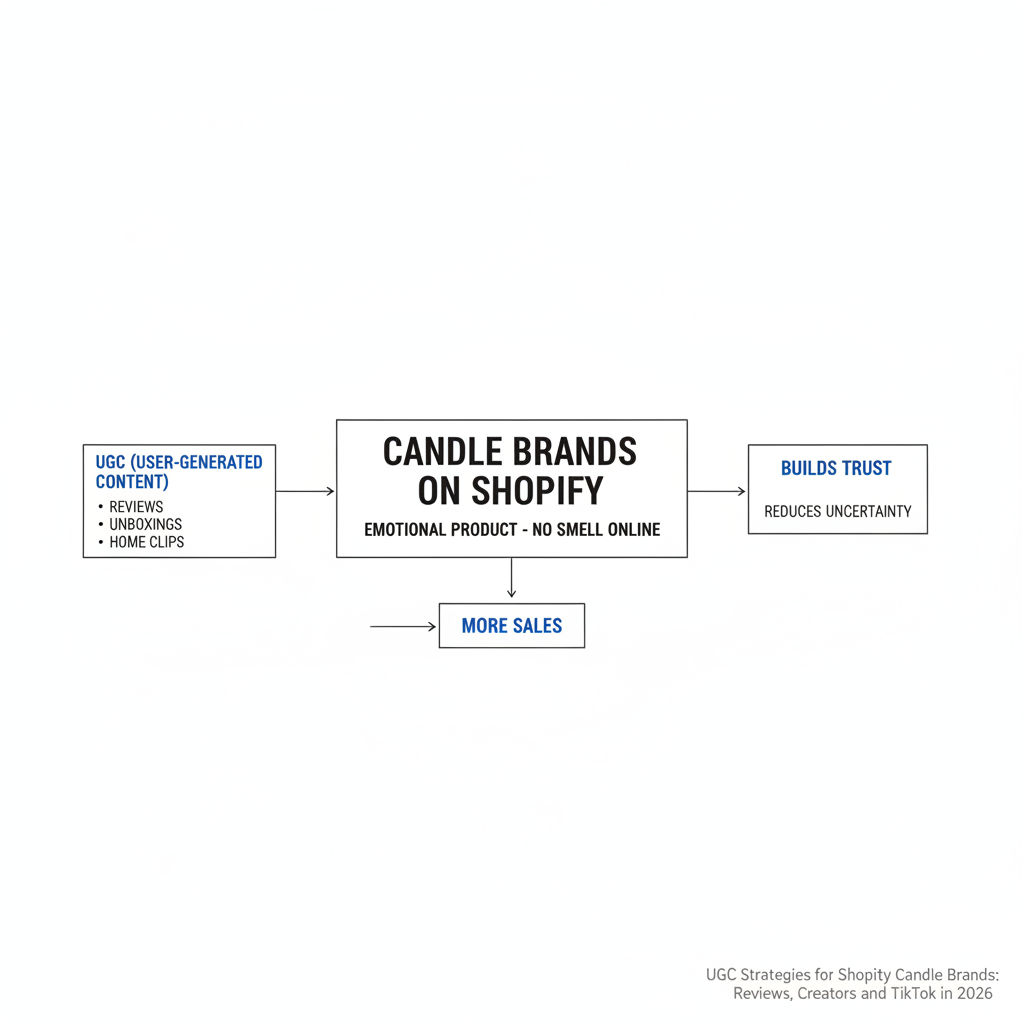
UGC matters for candle brands because candles are emotional products that customers want to imagine in their own homes. Reviews, room setup photos, unboxings, and TikTok clips reduce uncertainty and make a scent-based product easier to trust online.
Candles are tricky to sell because customers cannot smell them through a screen. That means your store has to compensate with other trust signals. Verified reviews, burn videos, and creator explanations of scent throw, packaging quality, and gifting use cases help shoppers fill in that gap.
There is also a strong visual component. Candle buyers care about jar color, label design, flame behavior, and how the product fits into a cozy bedroom, bathroom, or kitchen setup. In my experience, candle brands that rely only on brand photography often look nice but still underperform because the content feels too controlled.
If you are also working on overall store conversion, I would pair your UGC rollout with a broader CRO pass. We covered that in How to Optimize Your Conversion Rate on Shopify: 2026 Guide, and many of the same principles apply here.
How do I collect more customer reviews and photos for candle products?
The easiest way to collect more candle UGC is to ask at the right moment and make the request specific. Post-purchase email flows, package inserts with QR codes, and simple incentives like a free wick trimmer or discount on the next order work especially well.
Generic review requests usually underperform. Candle customers respond better when you ask for a specific type of feedback, such as “Show us your first burn setup” or “Tell us which room you use this scent in”. That gives them a prompt and makes the content more useful for future shoppers.
My recommended flow is simple:
- Send a delivery confirmation email.
- Wait 7-10 days for the first burn experience.
- Request a review with photo or video.
- Follow up 5-7 days later with a softer reminder.
- Feature the best submissions on product and home pages.
For candle brands, package inserts are still underrated. A small card with a QR code and a clear CTA like “Share your #CandleGlowMoment” can materially increase submissions. The 2026 research you shared suggests 2-3x more UGC submissions from QR-coded inserts, and that lines up with what I have seen merchants achieve when the ask is frictionless.

What should candle brands ask customers to include in reviews?
The best candle reviews mention scent accuracy, scent throw, burn quality, jar size expectations, and where the candle is used. These details reduce purchase anxiety and make reviews more persuasive.
- What room did you use it in?
- How strong was the scent throw?
- Did the scent match the product description?
- Was it bought for yourself or as a gift?
- Would you reorder this scent?
- Can you share a photo of your setup?
Those prompts do two jobs at once. They improve review quality, and they create reusable merchandising content for your store.
Where should I place UGC on a Shopify candle store?
The best places to display candle UGC are near the Add to Cart button, below the product description, on collection pages, and on the homepage. Placement matters almost as much as the content itself.
A lot of stores bury reviews at the very bottom of the page, which wastes their impact. If your UGC is strong, it should be visible before the customer has to commit. I usually recommend showing star rating summaries near the title and price, then placing a scrollable photo or video gallery within the main buying area.
For candle stores specifically, collection pages are a missed opportunity. Shoppers often browse by scent family, season, or gift type, so showing aggregated ratings and a few lifestyle thumbnails on collection grids can improve click-through into product pages.

| Placement | What to Show | Why It Works |
|---|---|---|
| Product page near price | Star rating, review count, verified purchase badge | Builds immediate trust before Add to Cart |
| Below description | Customer photo and video gallery | Shows real-life scale, styling, and burn experience |
| Collection pages | Average ratings and select UGC thumbnails | Improves browsing confidence across scents and variants |
| Homepage | Best room setups, gifting moments, unboxings | Introduces social proof early in the session |
| Email campaigns | Top customer photos and review snippets | Raises click-through and reinforces trust |
If you want more ideas for making product pages easier to discover and convert, our post on SEO tips for Shopify product pages is also worth reading. Strong UGC helps conversion, but it also supports richer product content.
What apps can help candle brands showcase UGC on Shopify?
The best Shopify apps for candle UGC depend on whether you want reviews, shoppable galleries, or creator content workflows. For most candle brands, I would combine a review app with a gallery or social commerce layer.
Two tools that are often mentioned for visual merchandising are Foursixty and Covet.pics. These are useful when you want to turn Instagram-style or customer-submitted visuals into shoppable galleries. If your brand has a lot of room styling content, that format can work very well.
For review-heavy strategies, many candle merchants also pair galleries with a dedicated review app. If you are comparing options, our guide to the best user-generated content Shopify apps is a good next step because it covers the tradeoffs in more detail.
| Tool | Best For | How Candle Brands Use It |
|---|---|---|
| Foursixty | Shoppable UGC galleries | Homepage lookbooks, gifting guides, room inspiration pages |
| Covet.pics | Photo and video galleries | Product page galleries and collection page social proof |
| Pitchlo | Finding creators and UGC deals | Recruiting micro-creators for unboxing and tutorial content |
| Influee | TikTok-style UGC workflows | Briefing creators for native-feeling short-form video |
How do I find UGC creators for a candle brand?
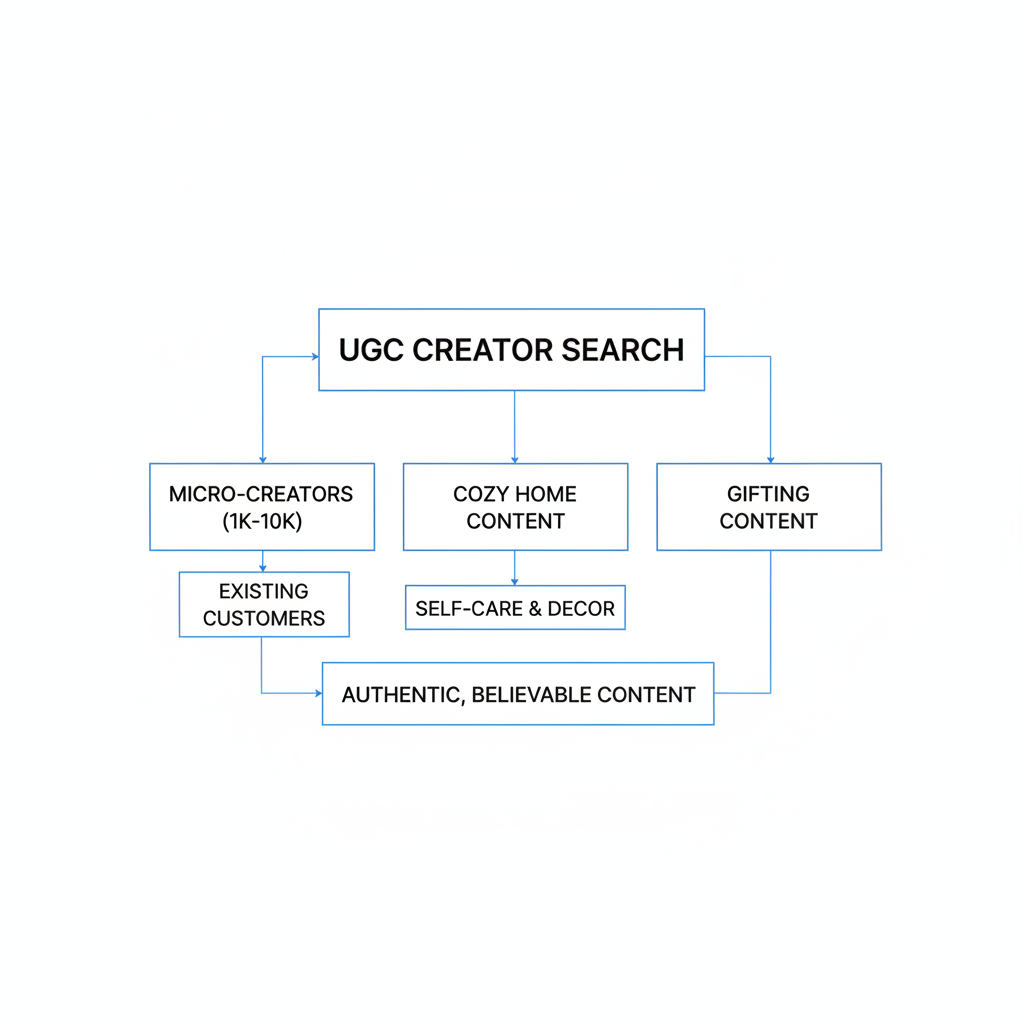
The best UGC creators for candle brands are usually micro-creators with 1,000 to 10,000 followers, existing customers, or people already posting cozy home, self-care, decor, and gifting content. You do not need celebrity influencers to make this work.
In fact, for candles, smaller creators often outperform bigger ones because the content feels more believable. A creator filming a nighttime routine, a bath setup, or a bookshelf styling clip is often more persuasive than a polished influencer ad. The 2026 benchmark data suggests many Shopify brands pay $100 to $500 per unboxing or tutorial asset, which is relatively accessible for small brands.
My favorite approach is to start with people who already like the product category. Search TikTok and Instagram for terms like candle haul, cozy room decor, self-care routine, and gift guide. Then shortlist creators who speak naturally on camera, have decent lighting, and already know how to show products in context.
Should candle brands pay for creators or just seed free products?
The best answer is usually both. Product seeding is good for testing, while paid creator briefs are better when you need consistent output and licensing rights for ads.
If you are a smaller candle brand, I would begin by sending free product to 10-20 relevant micro-creators. Expect only a portion to post. Once you identify creators whose content converts or at least looks strong, move those relationships into paid packages so you can request specific deliverables and usage rights.
This is where many brands get sloppy. If you plan to use creator content in paid social, make sure you have clear permission and licensing terms. A simple gifted post is not the same as a paid ad asset.
What kind of UGC content works best for candles on TikTok?
The best TikTok UGC for candles is content that feels native to the For You Page. First-burn videos, unboxings, room transformation clips, gift reactions, and scent storytelling usually outperform polished brand ads.
TikTok rewards content that looks like content, not commercials. That matters a lot for candle brands because the product naturally fits lifestyle formats. A quick clip of someone lighting a candle during a rainy evening routine can communicate more than a studio shoot with expensive props.
Industry data cited across 2026 UGC studies shows that TikTok UGC can be 22% more effective than brand-created videos, and Shopify-focused UGC ads can see 4x higher CTR with 50% lower CPC compared with polished creative. Those are big gains if you are trying to make Meta or TikTok ads profitable.

What TikTok hooks work for candle brands?
The strongest hooks are sensory, specific, and slightly curiosity-driven. “This candle made my apartment smell like a hotel lobby” will usually beat “Try our new candle”.
- I did not expect this candle to smell this expensive
- POV: your bedroom needed a fall reset
- Testing the candle TikTok made me buy
- If you like clean girl scents, watch this
- My favorite hostess gift under $30
- Lighting this every night changed my routine
These hooks work because they lead with a use case or feeling. They do not sound like ad copy.
How do I turn candle customer content into paid ads?
The best way to turn candle UGC into paid ads is to license the top-performing organic posts, edit lightly, and keep the content native-looking. The goal is not to overproduce it. The goal is to preserve authenticity while tightening the message.
I like the model described in SocialNative-style workflows and what many brands now do manually. First, identify organic content that already got strong engagement. Second, ask for usage rights. Third, test it against your polished brand creative. In many cases, the organic-style asset wins because it already proved it could stop the scroll.
For candle brands, I would test these ad angles first:
- Giftability - birthdays, hostess gifts, holidays
- Room mood - bedroom, bath, office, kitchen
- Scent identity - “smells like...” positioning
- First burn reaction - unboxing plus lighting
- Routine integration - reading, journaling, skincare, winding down
If you are selling through social channels too, our guides on Shopify social commerce apps and integrating Shopify with TikTok Shop can help connect the content side with the sales side.
Should candle brands run hashtag campaigns on TikTok?
Yes, but only if the hashtag is simple, on-brand, and tied to a clear content behavior. The best candle hashtag campaigns encourage customers and creators to show a mood, room, or ritual rather than just posting a random product shot.
A branded tag like #CandleGlowMoment or #MyScentStory works better when it appears in multiple places: your packaging, post-purchase emails, thank you page, and TikTok bio. The ask should be easy. For example, “Show us your cozy setup for a chance to win a seasonal box” is much more compelling than “Tag us in your post”.
In my experience, the best campaign structure is:
- Create a simple branded hashtag.
- Show examples from your own account first.
- Include the hashtag on package inserts and email flows.
- Reward participation with store credit, gifts, or featured placement.
- DM the best participants about ambassador or creator deals.
What does a practical 30-day UGC plan look like for a Shopify candle brand?
A good 30-day plan starts with your existing customers, then expands into creator outreach and TikTok testing. You do not need a huge budget to begin. You need a repeatable system.
| Week | Action | Goal |
|---|---|---|
| Week 1 | Add review stars and a visual UGC gallery to your top 5 product pages and homepage | Improve trust and on-site conversion |
| Week 2 | Launch post-purchase review emails and print QR insert cards for outgoing orders | Increase review and photo submissions |
| Week 3 | Seed products to 10-20 micro-creators in home, decor, self-care, and gifting niches | Generate fresh content at low cost |
| Week 4 | License 3-5 top videos and test them as TikTok or Meta ads | Validate which UGC angles drive clicks and purchases |
This is very close to the quick-start playbook in current 2026 research, and I think it is the right order. Start with owned UGC on your store, then move into creator production, then scale with paid distribution.
What mistakes should Shopify candle brands avoid with UGC?
The biggest UGC mistakes are hiding reviews too low on the page, overproducing creator content, not asking for usage rights, and failing to respond to customer submissions quickly. UGC works best when it feels active and current.
I would also avoid chasing vanity metrics. A creator with 100,000 followers is not automatically better than one with 3,000. For candle brands, aesthetic fit and believable storytelling matter much more than audience size alone.
Another common issue is using vague review prompts. If you want better content, ask better questions. Request photos of the candle in use, ask about scent throw, and prompt customers to mention whether they bought it as a gift or for themselves.
Finally, keep content fresh. For seasonal candle brands especially, recent UGC under 6 months old tends to perform better because shoppers want to know the brand is active and trusted right now.
Is UGC still worth it for candle brands in 2026?
Yes, UGC is absolutely still worth it for Shopify candle brands in 2026. In many cases, it is more important now because shoppers are more skeptical of polished brand messaging and more likely to trust peer content.
The market is noisier than it was a few years ago, but that actually strengthens the case for UGC. When every candle brand has beautiful product photography, the differentiator becomes proof. Real homes, real reactions, and real customer language help your products stand out.
From what I have seen across Shopify, the brands that win are not necessarily the ones with the biggest ad budgets. They are the ones with the best feedback loop. They collect customer content, feature it prominently, recruit creators who match the brand vibe, and reuse top-performing assets across the store and social channels.
If your goal is to grow ugc candles shopify performance this year, I would start small but start now. Add a visual review layer to your top products, ask for specific customer content, seed to a handful of creators, and test the winners on TikTok. That is a practical system, and for candle brands, it is one of the highest-leverage marketing plays available in 2026.