

User-generated content Shopify apps help you collect, manage, and display customer reviews, photos, videos, and social posts that make your products feel more trustworthy. If you want a quick answer, the strongest options right now are Loox, Stamped, Pixlee TurnTo, Flowbox, Cevoid, and Socialphotos, with each one suiting a slightly different stage of growth.
In my experience building Shopify apps and working with merchants on conversion problems, UGC is one of the few tactics that improves trust, click-through rate, and conversion rate at the same time. It is easier to believe a real customer photo than a polished brand image, and that matters even more on mobile where shoppers make fast decisions.
The search results for this topic have changed a lot since this post was first published. Recent roundups now focus more on shoppable galleries, video reviews, Google rich snippets, and whether an app can turn UGC into something usable across product pages, landing pages, email, and paid social.
So in this updated guide, I am not just listing six apps. I am comparing what each app is actually best at, where it fits in a real Shopify stack, and what I would choose depending on whether you are a small store, a visual brand, or a scaling DTC business.

What is a Shopify UGC app?
A Shopify UGC app is a tool that helps you collect and display customer-created content such as reviews, ratings, photos, videos, and social media posts. The best UGC apps also make that content shoppable, searchable, and reusable across your store.
Most merchants first meet UGC through review apps, but the category is broader than that now. A modern UGC app can request photo reviews after delivery, pull tagged Instagram content into a gallery, moderate submissions, ask for usage rights, and surface the best content on product detail pages.
That matters because shoppers rarely buy based on your product copy alone. They want proof from other customers, and they want it close to the point of purchase. If you are also working on your product page layout, my guide to product detail page apps for Shopify pairs well with this one.
Why are UGC apps so effective for Shopify stores?
UGC apps are effective because they turn customer feedback into social proof that reduces purchase anxiety. In practical terms, they help shoppers answer the question, "Will this actually look good, work well, and arrive as expected?"
Industry roundups and app vendors regularly point to 20-30% higher conversions from strong UGC implementations, especially when visual reviews and shoppable galleries are used well. I would not treat every headline stat as universal, but I have seen enough stores improve add-to-cart rate after adding review blocks and customer photos to take those numbers seriously.
There are three reasons UGC works especially well on Shopify:
- It saves content production time because customers create part of the asset library for you.
- It improves trust because buyers see real people using the product.
- It supports conversion optimisation because the content appears where buying decisions happen.
For merchants focused on increasing basket value after trust is established, I would also look at these best upsell apps for Shopify. UGC and upsells work very well together when the recommendations are backed by reviews or customer photos.
How do I choose the best UGC app for my Shopify store?
The best Shopify UGC app depends on what type of UGC you need most. If you mainly want photo and video reviews, choose a review-led app. If you rely heavily on Instagram or TikTok, choose a shoppable gallery tool.
When I evaluate apps as a developer, I look at six things first:
- Collection methods - email requests, post-purchase flows, social hashtag imports, on-site submissions
- Display options - product page widgets, homepage galleries, carousels, collection page embeds
- Moderation and rights management - especially important for social content
- SEO value - rich snippets, indexable review content, structured data support
- Integrations - Klaviyo, Google Shopping, Meta, loyalty tools, helpdesk apps
- Pricing fit - some apps are excellent but overkill for smaller stores
If you are early-stage, do not overbuy. A lot of merchants need a good review and photo app, not an enterprise creator platform. If you are a more visual brand in fashion, beauty, or homeware, a gallery-first app can make far more sense.
What are the 6 best user-generated content Shopify apps?
The best six Shopify UGC apps I would shortlist in 2026 are Loox, Stamped, Pixlee TurnTo, Flowbox, Cevoid, and Socialphotos. They cover the main use cases merchants actually care about: review collection, visual social proof, shoppable galleries, influencer content, and social commerce.
I have kept this list focused on apps with clear Shopify relevance and practical UGC use cases. Some recent competitor lists include broader review platforms like Yotpo or Judge.me, and both are strong products, but for this specific rewrite I am prioritising the apps already central to this post while updating the analysis to match current search intent.
| App | Best for | Main strength | Pricing signal | Verdict |
|---|---|---|---|---|
| Loox | Most Shopify stores | Photo and video reviews with strong automation | Starts from $9.99/month | Best all-rounder |
| Stamped | Growing stores | Reviews, Q&A, UGC, and broader retention features | Free plan, paid from $15/month | Best for scaling brands |
| Pixlee TurnTo | UGC plus influencer workflows | Customer and creator content across the journey | Custom or higher-tier focus | Best for advanced visual commerce |
| Flowbox | Fashion and lifestyle brands | Shoppable social galleries and content curation | Typically premium | Best for social-first brands |
| Cevoid | Community-led brands | UGC collection, galleries, and ambassador-style engagement | Mid-market leaning | Best for community building |
| Socialphotos | Simple social proof setups | Instagram-linked galleries and visual merchandising | Check app store | Best lightweight gallery option |
1. How good is Loox for Shopify UGC?
Loox is the best Shopify UGC app for most merchants because it makes photo and video review collection simple, affordable, and effective. If you want one app that improves trust quickly without a heavy setup, this is usually the one I would start with.
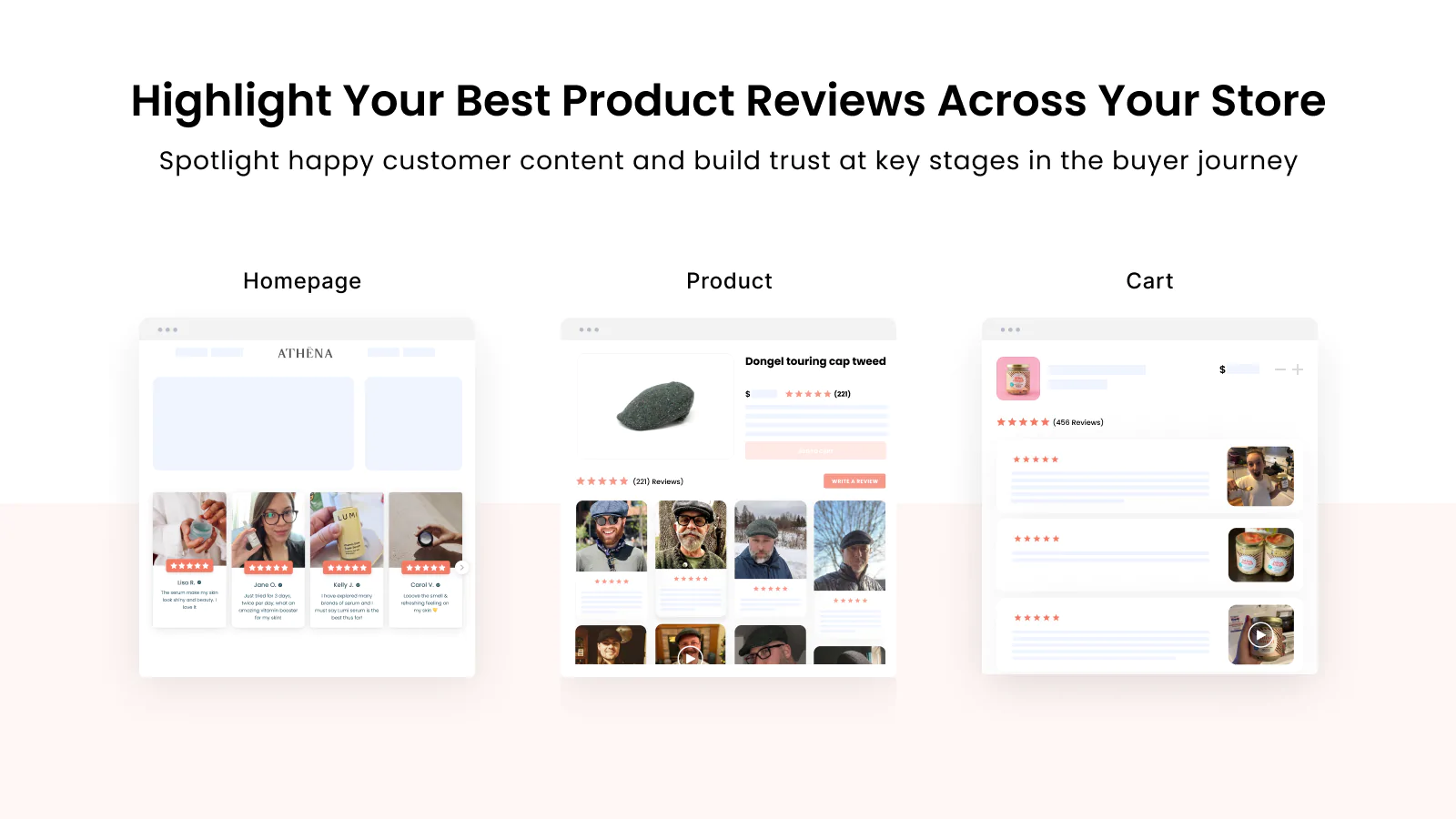

Loox has been one of the most consistently recommended UGC apps for years, and there is a reason for that. It is built around a very practical merchant need: collect visual reviews automatically and display them in a way that helps products sell.
In my experience, Loox works especially well for stores with products that benefit from real-life proof. Think skincare, jewellery, fashion, home accessories, gifts, and one-product stores. If customers can show the product in context, conversion usually improves.
Its strongest features include:
- Automated review request emails
- Photo and video review collection
- Customisable review widgets
- Referral features that extend social proof into acquisition
- Multi-language support for international stores
Loox is also one of the easier apps to justify on cost. With pricing starting at $9.99/month, it is accessible for smaller merchants, but still polished enough for bigger brands. That combination is why I would call it best for small to mid-sized stores.
One thing I like is that Loox does not try to be everything. It focuses on the kind of UGC that sits closest to the conversion point. If your main goal is to improve the product page rather than build a huge creator programme, that focus is a plus, not a limitation.
What is Loox best for?
Loox is best for merchants who want visual reviews that convert without a complicated setup. It is particularly strong for stores that need quick wins on product pages.
If you are already thinking about increasing average order value, Loox can also support that by making related product recommendations feel more credible. That is one reason it often appears alongside apps in my best Shopify add-on apps and one product store apps recommendations.
2. Is Stamped a better choice for growing Shopify brands?
Stamped is often a better fit than Loox for merchants who want a broader customer marketing stack around reviews and UGC. It is a strong option for brands that are already growing and need reviews, Q&A, visual UGC, and retention features in one place.

Stamped Reviews has stayed relevant because it covers more than basic review collection. It supports product reviews, photo reviews, video reviews, Q&A, and social proof widgets, and it is commonly shortlisted by merchants who want something a bit more expansive than a pure review app.
Recent research roundups still place Stamped among the top Shopify UGC tools, especially for merchants who want a balance between conversion support and customer retention features. The presence of a free plan and paid tiers from around $15/month also makes it easier to test before committing.
Where I think Stamped shines is in stores that have already proven product-market fit. At that point, you often need more than star ratings. You want richer customer feedback, stronger merchandising blocks, and possibly integrations with loyalty or email tools.
If your store is moving beyond the basics and you want a more mature social proof system, Stamped is well worth shortlisting.
What is Stamped best for?
Stamped is best for scaling DTC brands that want reviews and UGC to feed a wider retention strategy. It gives you more room to grow than many entry-level review apps.
For merchants also comparing checkout and post-purchase tools, it can be helpful to pair this with my guide to Shopify checkout apps, because social proof and post-purchase optimisation often go hand in hand.
3. When should I choose Pixlee TurnTo for Shopify?
Pixlee TurnTo is best when you want to combine customer UGC and influencer content across the full buyer journey. It is more advanced than a standard review app and suits brands treating content as a serious growth channel.


Pixlee TurnTo Social UGC has long positioned itself around customer-powered commerce rather than basic review collection. That means the platform is built to help brands source, curate, manage, and publish visual content from both customers and creators.
That wider scope is useful if your UGC strategy goes beyond PDP widgets. For example, if you want to show creator content on landing pages, repurpose customer imagery in campaigns, or manage rights and approvals more carefully, Pixlee starts to make more sense.
In practical terms, I would consider Pixlee if:
- You work with influencers or creators alongside customers
- You want visual storytelling across more than product pages
- Your team needs better content organisation and moderation
- You have enough traffic and content volume to justify a more advanced platform
For smaller stores, Pixlee can be more platform than you need. For established brands, though, it can become a proper content operations tool rather than just a widget app. That makes it best for advanced visual commerce teams.
4. Is Flowbox a strong Shopify app for shoppable social galleries?
Flowbox is a strong choice for brands that want to turn social content into shoppable galleries across the storefront. It is especially appealing for fashion, beauty, and lifestyle stores where visual merchandising does a lot of the heavy lifting.

Flowbox sits closer to the social commerce end of the UGC market. Instead of focusing mainly on reviews, it helps brands curate content from social channels and present it in a way that shoppers can browse and buy from.
That distinction matters. Some UGC apps are there to reassure. Others are there to inspire. Flowbox leans heavily into inspiration, which is exactly what some categories need. If your products are highly visual and often discovered through Instagram or TikTok-style content, that can be a better fit than a review-first setup.
From what I have seen, Flowbox is strongest when a merchant already has a decent amount of social content to work with. If you have very little customer imagery or low social engagement, you may not get enough value from a gallery-led tool yet.
Choose Flowbox if your brand already thinks in terms of lookbooks, style inspiration, creator imagery, and discovery-led shopping. It is best for social-first retail brands.
5. What makes Cevoid different from other Shopify UGC apps?
Cevoid stands out because it is built around community participation as much as on-site display. It is a good fit for brands that want customers not just to review products, but to actively share content, join campaigns, and become part of the brand experience.

Cevoid has become a notable option for merchants who want to collect UGC in a more intentional way. Rather than relying only on review requests, it encourages customers to submit visual content and engage through branded community experiences.
That can be powerful for niche DTC brands with strong identity. Think activewear, beauty, pet products, or lifestyle brands where customers enjoy showing off purchases publicly. In those cases, UGC is not just proof. It becomes part of the brand loop.
The trade-off is that Cevoid may require more active participation from your team than a simpler review app. You need to think about campaigns, incentives, moderation, and how the community element fits your brand. If you are willing to do that, the upside can be significant.
I would call Cevoid best for community-led brands rather than every merchant by default.
6. Is Socialphotos still worth considering for Shopify?
Socialphotos is still worth considering if you want a relatively straightforward way to turn social content into visual social proof on your Shopify store. It is not the flashiest option, but it can be useful for merchants who value simplicity.

Socialphotos focuses on the idea that customer and social imagery can make product pages and galleries feel more authentic. For merchants who already have tagged content or a healthy Instagram presence, that can provide a low-friction route into UGC.
Compared with some newer or broader platforms, Socialphotos is more specialised. That can be a weakness if you want advanced review automation, but it can also be a strength if you want a lighter-weight gallery tool without a lot of extra complexity.
I would not put it above Loox or Stamped for most merchants. Still, it earns a place in this list because some stores do not need a huge platform. They just need a clean way to surface authentic imagery and make the storefront feel more alive.
Which Shopify UGC app is best for different store types?
The best UGC app depends on your store model, product type, and content volume. There is no single winner for every merchant, even if Loox is the safest general recommendation.
| Store type | Best app | Why |
|---|---|---|
| New or small Shopify store | Loox | Affordable, easy to set up, strong photo review workflows |
| Scaling DTC brand | Stamped | Broader social proof and retention feature set |
| Creator-led brand | Pixlee TurnTo | Combines customer and influencer content well |
| Fashion or lifestyle brand | Flowbox | Excellent fit for shoppable visual merchandising |
| Community-first brand | Cevoid | Encourages submissions and participation beyond reviews |
| Simple social gallery use case | Socialphotos | Lightweight route to on-site visual proof |
How should I use UGC on my Shopify store for the best results?
The best way to use UGC is to place it close to buying decisions and match the format to the page. Product pages need reassurance, while homepages and landing pages benefit more from inspiration and discovery.
When I test Shopify stores, these are the placements that usually matter most:
- Product pages - star ratings, review summaries, customer photos, and video reviews near the add-to-cart area
- Below the fold on PDPs - richer galleries, Q&A, and longer-form customer feedback
- Homepage sections - social proof carousels and best-seller UGC highlights
- Collection pages - lighter trust signals if your theme supports them well
- Post-purchase email flows - request reviews after the delivery window, not immediately after fulfilment
One mistake I see often is merchants collecting UGC but not using it strategically. A great photo review hidden in a tab is wasted. A strong customer video near the buy button can do real work.
If your store also uses quizzes or guided selling, UGC can reinforce those recommendations nicely. I have covered that angle in this roundup of Shopify quiz apps.
What features matter most in a 2026 Shopify UGC app?
The most important UGC app features in 2026 are video support, shoppability, automation, moderation, and SEO compatibility. Basic star ratings are no longer enough for competitive stores.
Here is what I would prioritise now:
- Photo and video review collection - visual proof beats text-only reviews for many categories
- Automated request timing - especially based on fulfilment or delivery events
- Shoppable galleries - useful for discovery-led categories
- Google rich snippets - helps search visibility and click-through rate
- Rights management - important if you reuse social content in marketing
- Moderation tools - essential for keeping quality high
- Integrations with email, loyalty, and advertising platforms
As a developer, I would add one more point: check how cleanly the app fits your theme and storefront performance. A feature-rich app that slows the page down or injects messy widgets can undo some of its own conversion benefit.
Are Shopify UGC apps worth paying for?
Yes, Shopify UGC apps are usually worth paying for if your store has enough order volume to generate reviews consistently. Even a modest improvement in conversion rate can justify a £10 to £50 per month app very quickly.
For example, if a store does 1,500 monthly visitors and converts at 2%, that is 30 orders. If stronger social proof lifts conversion to 2.4%, that becomes 36 orders. On a healthy average order value, the app often pays for itself many times over.
The exception is when a merchant installs a premium UGC platform before they have enough customers, enough content, or enough traffic. In that situation, the issue is not the app. It is timing. Start with the simplest tool that solves your current problem, then upgrade when your content operation gets more sophisticated.
Final verdict: which UGC Shopify app would I pick?
If I had to choose just one app for most Shopify merchants, I would pick Loox. It is the most balanced option on this list for ease of setup, visual review quality, automation, and price.
If I were advising a larger DTC brand with a broader retention stack, I would shortlist Stamped as well. And if the brand was highly visual and creator-led, I would look seriously at Pixlee TurnTo Social UGC or Flowbox.
The biggest takeaway is simple: UGC works best when it is visible, relevant, and easy to trust. The app is only part of the equation. The real win comes from collecting the right content and placing it where customers actually need reassurance.
If you are already improving your store stack, you might also want to browse my related guides on upsell apps and product page apps, because those are often the next two levers merchants tackle after social proof.