
Shopify pricing in 2026 starts at $5/month for Starter, $39/month for Basic, $105/month for Grow, $399/month for Advanced, and from $2,300 to $2,500/month for Shopify Plus. Your real cost is not just the subscription - it also includes card processing fees, possible third-party gateway fees, apps, themes, and occasional one-off setup costs.
I build Shopify apps for a living, and one of the most common questions I see from merchants is simple: which Shopify plan is actually worth paying for? The confusing bit is that Shopify’s headline pricing looks straightforward, but your true monthly cost depends heavily on how you take payments, how many orders you process, and whether you need features like staff accounts, advanced reporting, or checkout customisation.
If you are launching your first store, migrating from another platform, or trying to work out whether it is time to upgrade, this guide breaks down Shopify’s 2026 pricing and fees in plain English. I will cover the monthly plans, transaction fees, hidden costs, real-world examples, and when it actually makes sense to move from Basic to Grow, Advanced, or Plus.
If you have not started a store yet, it is also worth reading my Shopify free trial guide and my Shopify store launch checklist, because plan choice is only one part of getting your setup right.
What does Shopify cost in 2026?
Shopify costs between $5 and $2,500 per month in 2026, depending on the plan you choose and whether you pay monthly or annually. Annual billing saves roughly 25% on the main standard plans, which is one of the easiest ways to reduce your fixed platform costs.
For most merchants, the practical plan range is Basic, Grow, or Advanced. Starter is very limited, and Shopify Plus is aimed at brands with more complex operational needs, larger teams, or revenue high enough to justify enterprise tooling.
| Plan | Month-to-month | Annual billing equivalent | Best for |
|---|---|---|---|
| Starter | $5/month | N/A | Social selling and simple product links |
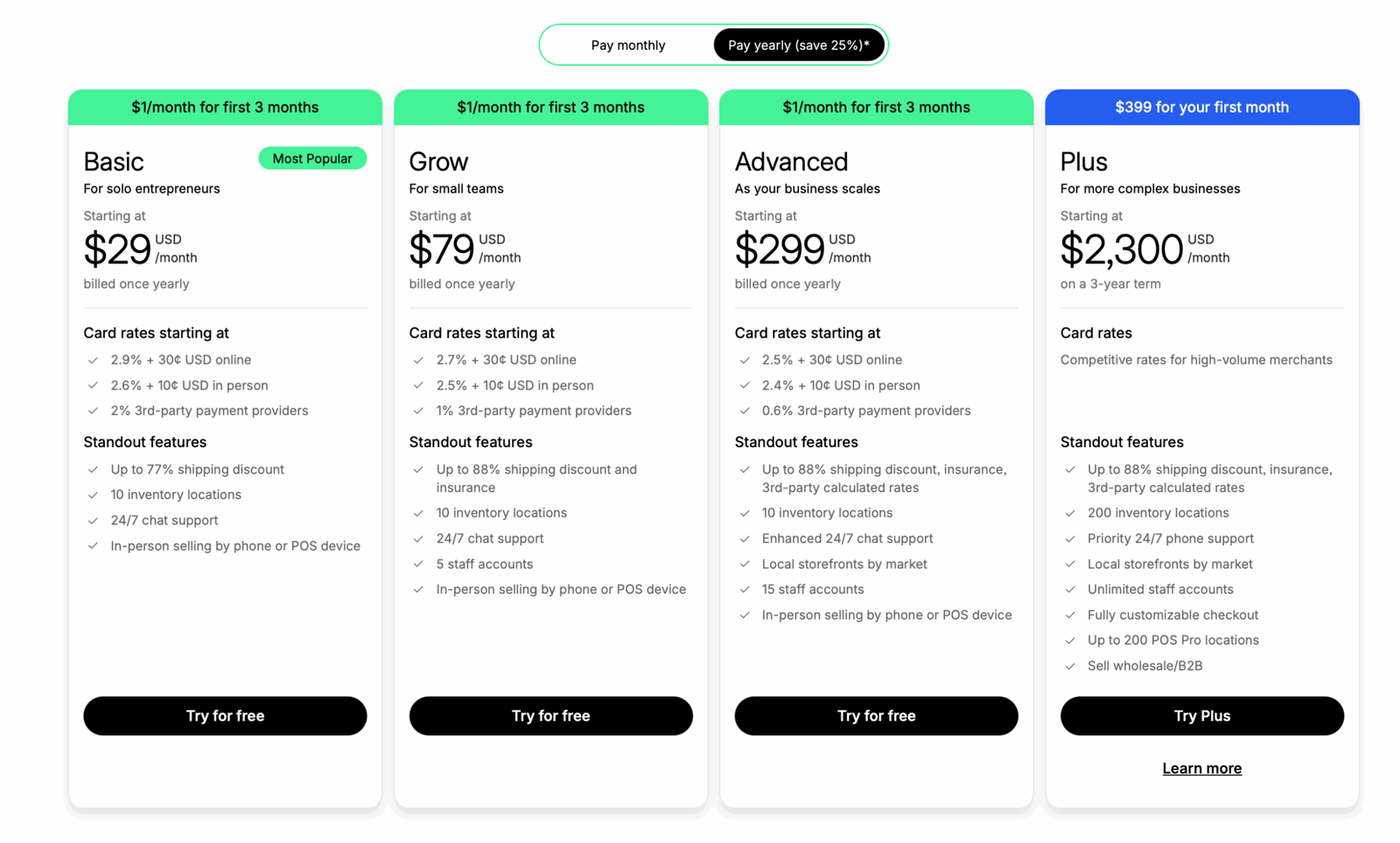
| Basic | $39/month | $29/month billed annually | Solo founders and small stores |
| Grow | $105/month | $79/month billed annually | Growing teams and established stores |
| Advanced | $399/month | $299/month billed annually | Scaling brands with more operational complexity |
| Shopify Plus | $2,500/month on shorter term | from $2,300/month on longer commitment | Enterprise and high-growth merchants |
Shopify also frequently runs a free trial and promotional intro offer, often framed as a short free period followed by $1/month for 3 months on eligible plans. Promotions can change, so always verify current terms on the official Shopify pricing page.
An overview of monthly Shopify pricing plans for 2026
The main difference between Shopify plans is not just the monthly fee. It is also the combination of payment rates, reporting, staff access, shipping features, and operational tools you unlock as you move up.
In my experience building Shopify apps, merchants often upgrade either too early because they assume higher plans automatically mean more sales, or too late and lose money through higher transaction costs and missing features. The right plan is usually the one that fits your current workflow, not the one that looks most impressive on paper.
1. What is the Shopify Starter plan best for?
Shopify Starter is best for creators, influencers, and very small sellers who want to sell through social media, DMs, WhatsApp, email, or link-in-bio style product pages. It is not a full online store plan in the way Basic is.
Starter works well if you are testing demand before committing to a full storefront. I would only recommend it if your main sales channel is already established elsewhere and you just need a lightweight way to take payments and share products.
Price: $5/month
- Sell via product links and social channels
- Accept online and in-person payments
- Simple storefront rather than a full custom site
- Basic order management
- 24/7 support
- Fraud analysis and tax tools
Typical payment fees: online card rates are generally higher than on larger plans, and third-party gateway fees can reach 2% if you do not use Shopify Payments.
My verdict: best for testing an idea cheaply, but not ideal for SEO, content marketing, or brand building. If you want a proper store with collections, blog content, and stronger conversion opportunities, skip to Basic.
2. Is Shopify Basic enough for a real online store?
Yes, Shopify Basic is enough for most new ecommerce stores. It gives you a full hosted storefront, checkout, blog, product management, and access to the Shopify ecosystem without paying for features you probably will not use on day one.
This is the plan I most often recommend to new merchants. It is also the plan many app developers, including me when testing new store concepts, use as the baseline because it covers the essentials without unnecessary overhead.
Price: $39/month or $29/month billed annually
- Full online store and blog
- Unlimited products
- Custom domain support
- 2 staff accounts
- 10 inventory locations
- POS Lite
- Discount codes, manual orders, abandoned checkout support
- SEO basics and content publishing
- International CDN, SSL, hosting, and bandwidth included
Payment fees on Shopify Payments: 2.9% + 30c online, 2.6% + 10c in person. If you use a third-party gateway instead, Shopify adds a 2.0% extra transaction fee.
My verdict: best for small stores, side hustles, early-stage DTC brands, and anyone validating product-market fit. If you are still deciding on design, my guide to the best free Shopify themes is a good next step.
3. When should you upgrade to Shopify Grow?
Shopify Grow is worth it when you need better reporting, more staff accounts, lower card rates, and a bit more operational breathing room. It is the plan that starts to make sense once your store is no longer a solo project.
Shopify renamed the old standard Shopify plan to Grow, and the positioning is clearer now. This is the plan for merchants who have traction, a team, and enough order volume that even a small reduction in payment fees can start to matter.
Price: $105/month or $79/month billed annually
- Everything in Basic
- 5 staff accounts
- Lower card processing rates
- Better shipping discounts
- Standard reports
- More robust operational support for growing teams
Payment fees on Shopify Payments: 2.7% + 30c online, 2.5% + 10c in person. Third-party gateway fee drops to 1.0%.
My verdict: best for growing teams and stores doing enough revenue that the lower payment rate offsets the higher subscription. If you are actively working on AOV and retention, this is usually the tier where merchants start getting more serious about upsells, reviews, and CRM.
For that stage of growth, I would also look at my guides on how to upsell on Shopify and the best CRM for Shopify.
4. What does Shopify Advanced include?
Shopify Advanced is designed for scaling brands that need lower fees, more reporting depth, and third-party calculated shipping rates. It is usually a finance and operations decision as much as a marketing one.
In practice, merchants move to Advanced when they start feeling friction with forecasting, international selling, or shipping logic. It is also the highest standard plan before you step into Shopify Plus territory.
Price: $399/month or $299/month billed annually
- Everything in Grow
- 15 staff accounts
- Live third-party carrier-calculated shipping
- More advanced reporting
- Better support for international selling and regional optimisation
Payment fees on Shopify Payments: 2.5% + 30c online, 2.4% + 10c in person. Third-party gateway fee drops again to 0.6%.
My verdict: best for scaling brands where fee savings and shipping features justify the jump. If shipping setup is becoming a bottleneck, my guides on the best Shopify shipping apps and adding a new shipping carrier in Shopify are worth reading.
5. How much does Shopify Plus cost?
Shopify Plus starts from $2,300/month on longer commitments and around $2,500/month on shorter contracts. It is built for brands that need checkout customisation, enterprise workflows, B2B tooling, and much larger team access.
Plus is not just “Shopify but more expensive”. It is a different operational category. In my experience, the strongest reasons to move to Plus are usually checkout extensibility, B2B complexity, launch management, automation, and organisational scale, not just raw revenue alone.
Price: from $2,300/month, often depending on term length and contract structure
- Everything in Advanced
- Unlimited staff accounts
- Customisable checkout
- Up to 200 POS Pro locations
- B2B catalogues and wholesale tooling
- Advanced automation with Shopify Flow and Launchpad
- Priority support
- Lower payment and third-party transaction rates
Payment fees on Shopify Payments: around 2.15% + 30c online in the latest pricing data, with country-specific variations. Third-party gateway fee can fall to 0.2%.
Some enterprise merchants may also encounter a revenue-based component beyond certain thresholds, depending on contract terms. If you are evaluating Plus, get a written quote and model the full annual cost, not just the advertised starting price.
My verdict: not worth it unless you genuinely need enterprise features. Plenty of brands can stay on Advanced longer than they think.
What payment processing fees does Shopify charge?
Shopify charges card processing fees on every sale, and these often matter more than the monthly subscription. The higher your sales volume, the more important it becomes to compare plan fee rates rather than just the monthly sticker price.
The cheapest plan is not always the cheapest overall. A merchant doing serious volume on Basic can easily pay more in total than they would on Grow or Advanced once processing fees are factored in.
| Plan | Online card rate | In-person rate | Third-party gateway fee |
|---|---|---|---|
| Basic | 2.9% + $0.30 | 2.6% + $0.10 | 2.0% |
| Grow | 2.7% + $0.30 | 2.5% + $0.10 | 1.0% |
| Advanced | 2.5% + $0.30 | 2.4% + $0.10 | 0.6% |
| Shopify Plus | 2.15% + $0.30 | Varies by country | 0.2% |
Key point: if you use Shopify Payments, Shopify does not charge the extra third-party transaction fee. If you use an external gateway, such as certain local providers, you pay both the processor’s charges and Shopify’s additional fee.
PayPal is also worth checking carefully because the merchant experience can vary by region and setup. Always read the latest country-specific payment documentation in the Shopify Help Centre.
How much will Shopify really cost per month?
Your real Shopify cost is your plan fee plus payment fees plus apps and optional extras. For many merchants, the subscription is actually the smallest part of the monthly bill.
Here is a simple example. If a Basic store processes $10,000/month in online sales through Shopify Payments, the rough processing cost at 2.9% is about $290, plus fixed transaction charges. Add the $29 annual-billing plan cost, and you are already near $329/month or more before apps.
That is why I always tell merchants to model costs based on expected revenue and order count, not plan price alone. A low AOV store with lots of small orders gets hit harder by the fixed 30c per transaction component than a high-ticket store.
Example monthly cost scenarios
These examples are simplified, but they are useful for budgeting. They show why transaction fees can quickly outweigh subscription fees.
| Scenario | Plan | Monthly sales | Estimated platform + processing cost |
|---|---|---|---|
| New store, low volume | Basic annual | $5,000 | About $174+ before apps |
| Growing store | Grow annual | $25,000 | About $754+ before apps |
| Scaling brand | Advanced annual | $100,000 | About $2,799+ before apps |
These are directional estimates only, because actual fees depend on order count, country, payment method mix, refunds, chargebacks, and whether some sales are in person rather than online.
What hidden Shopify costs should you budget for?
Shopify does not have many true hidden fees, but it does have common extra costs that catch merchants off guard. The biggest ones are usually apps, premium themes, paid email tools, design work, and external payment fees.
In my experience, app spend is the one that creeps up fastest. A merchant might start with one review app and one upsell app, then add subscriptions, bundles, returns, loyalty, search, email capture, analytics, and support tools. Suddenly the app stack is costing more than the plan itself.
- Apps: often $5 to $500+/month depending on complexity
- Premium themes: usually $250 to $400 one-off
- Custom development: variable, often the biggest one-off cost
- Domain name: usually annual
- Email/SMS tools: can scale quickly with list size
- POS hardware: relevant for retail merchants
- Chargebacks and refunds: operational cost, not just platform cost
If you want to keep costs lean, choose apps carefully and remove overlap. I say this as an app developer myself: you do not need five apps doing 80% of the same job.
Which Shopify plan is best for your business size?
The best Shopify plan depends on your stage, team size, and transaction volume. For most merchants, the right answer is simpler than they expect.
Here is the framework I use when advising merchants and when thinking about app compatibility for different store sizes.
| If you are... | Best plan | Why |
|---|---|---|
| Testing a product on social channels | Starter | Cheapest way to sell without a full store |
| Launching a proper ecommerce brand | Basic | Best value for a full store and blog |
| Managing a growing team and store | Grow | Better rates, reports, and staff access |
| Scaling internationally or operationally | Advanced | Shipping logic and fee improvements matter more |
| Running enterprise operations or B2B | Plus | Checkout customisation and enterprise tooling |
When is Shopify Plus actually worth it?
Shopify Plus is worth it when its extra features create measurable ROI. That usually means either checkout improvements, operational efficiency, or lower fee impact at large scale.
The common benchmark you will see is around $1M+ annual revenue, but revenue alone is not enough. I have seen stores below that threshold justify Plus because they needed B2B workflows or checkout control, and I have seen stores above it stay happily on Advanced because their setup was simple.
Ask yourself these questions:
- Do you need custom checkout logic that standard Shopify cannot provide?
- Are staff and permissions becoming a bottleneck?
- Do you need B2B catalogues or wholesale functionality?
- Will automation tools like Flow and Launchpad save meaningful time?
- Do the lower fees offset a chunk of the subscription at your volume?
If the answer is no to most of those, Advanced is probably enough.
How does Shopify compare with other ecommerce platforms on pricing?
Shopify is rarely the absolute cheapest option, but it is often the most predictable and operationally efficient. That is why so many merchants stay on it as they grow.
When merchants compare Shopify with WooCommerce, BigCommerce, or Magento, they often focus too much on subscription price and not enough on maintenance time, plugin risk, hosting, checkout reliability, and support.
| Platform | Upfront cost | Ongoing complexity | Best fit |
|---|---|---|---|
| Shopify | Low to medium | Low | Most merchants who want speed and reliability |
| WooCommerce | Can look low | Medium to high | Technical users who want more control |
| BigCommerce | Medium | Medium | Brands comparing SaaS options closely |
| Magento / Adobe Commerce | High | High | Large businesses with development resources |
If you are considering a move from WordPress ecommerce, my WooCommerce to Shopify migration guide covers the practical trade-offs in more detail.
How can you reduce Shopify fees without hurting growth?
The best way to reduce Shopify fees is to optimise the whole stack, not just chase the lowest subscription. That means annual billing, sensible app choices, better conversion rates, and the right payment setup.
These are the tactics I recommend most often:
- Pay annually if you are confident in Shopify and want the roughly 25% plan saving
- Use Shopify Payments where available to avoid extra transaction fees
- Audit your apps every quarter and remove overlap
- Improve conversion rate so fees are spread across more revenue
- Increase AOV with bundles, upsells, and better merchandising
- Choose the right plan at the right time, rather than upgrading emotionally
On that last point, a lot of merchants can effectively offset fee pressure by improving conversion and AOV before changing plans. My guide on optimising conversion rate on Shopify is a good place to start.
What is my honest verdict on Shopify pricing in 2026?
Shopify pricing in 2026 is fair, scalable, and usually good value, but only if you choose the plan based on your real business needs. The platform is not the cheapest on paper, yet it is often the most cost-effective in practice because it reduces technical overhead and lets merchants move faster.
In my experience building apps for Shopify merchants, Basic is the sweet spot for most new stores, Grow is the best upgrade for merchants with traction, and Advanced is where operational efficiency starts to matter more than headline price. Shopify Plus is powerful, but it should be justified by complexity and ROI, not status.
If you want the shortest version of the decision:
- Choose Starter if you only need social selling
- Choose Basic if you want a real online store
- Choose Grow when your team and sales are expanding
- Choose Advanced when shipping, reporting, and fee savings become material
- Choose Plus only when enterprise features will clearly pay for themselves
For the latest official details, always cross-check Shopify’s own pricing page and relevant help docs like Shopify plan documentation and Shopify Payments documentation.