
Shopify checkout statistics 2026 show a clear pattern: the stores winning more revenue are not just getting more traffic, they are removing friction at checkout. In 2026, Shopify stores generally convert at 1.4% to 1.8%, while checkout completion averages 72.5%, and stores using Shop Pay, one-page checkout, and the new Checkout Extensibility stack are consistently outperforming that baseline.
As someone who builds Shopify apps and spends a lot of time testing how merchants use checkout upsells, custom fields, and post-purchase flows, I think the biggest story this year is simple: extensibility is no longer a technical migration project. It is now a conversion lever. If you treat it like a compliance task, you will miss the upside.
What are the most important Shopify checkout statistics for 2026?
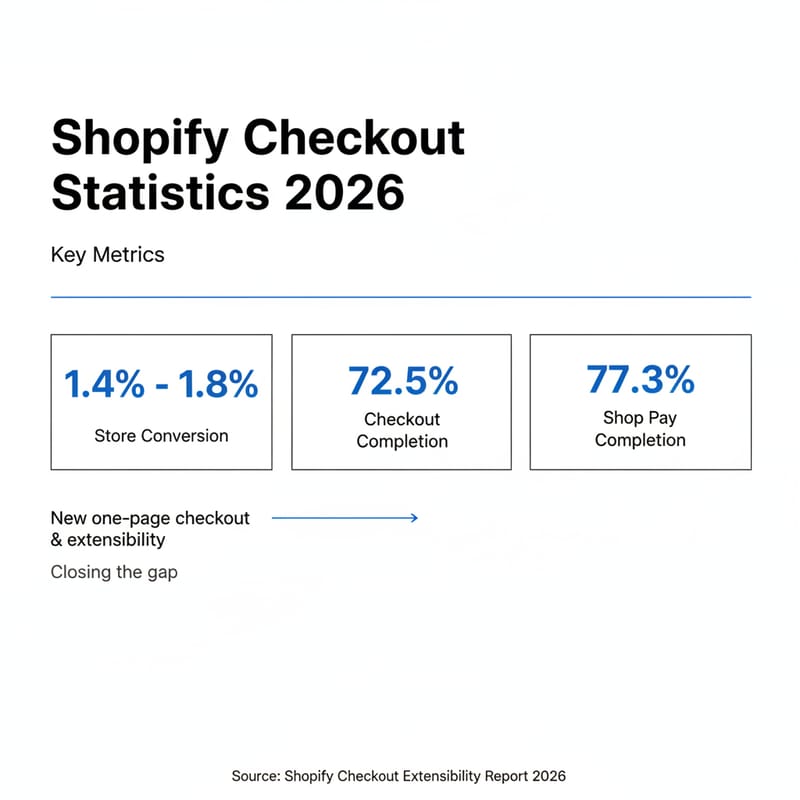
The most important Shopify checkout statistics for 2026 are that overall store conversion rates average 1.4% to 1.8%, checkout completion averages 72.5%, and Shop Pay checkout completion reaches 77.3%. The new one-page checkout and Checkout Extensibility framework are helping close the gap between average stores and top performers.
Here are the numbers I would pay attention to first if I were auditing a Shopify store this year:
- Average Shopify conversion rate: 1.4% to 1.8%
- Top-performing stores: 3.5% to 5%+
- Checkout completion rate: 72.5%
- Shop Pay completion rate: 77.3%
- Industry checkout completion benchmark: 62.6%
- Standard cart abandonment: 27.5%
- Shop Pay cart abandonment: 22.7%
- Top 20% of Shopify stores: above 3.2% conversion
- Top 10% of Shopify stores: above 4.7% conversion
Those numbers matter because they show two things at once. First, Shopify still has a checkout advantage versus broader ecommerce benchmarks. Second, there is a huge spread between average merchants and the best operators, which means execution still matters more than platform selection alone.
| Metric | Shopify Average | Top Performer or Shop Pay | Industry Average | What It Means |
|---|---|---|---|---|
| Overall conversion rate | 1.4% to 1.8% | 3.5% to 5%+ | About 2% to 3% | Most stores are still under-optimized before checkout |
| Checkout completion | 72.5% | 77.3% with Shop Pay | 62.6% | Shopify checkout remains a strong competitive advantage |
| Cart abandonment | 27.5% | 22.7% with Shop Pay | 37.4% | Accelerated checkout reduces drop-off |
| Healthy checkout CVR | 45% to 55% | 55%+ | N/A | Useful benchmark for stores measuring cart-to-order efficiency |
What is Shopify Checkout Extensibility in 2026?
Shopify Checkout Extensibility is Shopify’s modern framework for customizing checkout using app blocks, UI extensions, branding tools, and sandboxed functionality instead of old checkout.liquid hacks. In 2026, it is the standard path for checkout customization and a major reason checkout performance is improving.
If you have been around Shopify long enough, you probably remember the old era of fragile scripts, checkout.liquid edits, and custom code that worked until the next platform update broke everything. In my experience building Shopify apps, the biggest benefit of extensibility is not just flexibility. It is stability, speed, and safer customization.
That matters because checkout is the one place where merchants cannot afford breakage. A product page bug is annoying. A checkout bug is revenue loss in real time. The new system reduces that risk while still letting merchants add useful experiences like custom delivery messaging, upsells, trust elements, post-purchase offers, loyalty prompts, and custom fields.
Why does extensibility affect conversion rates?
Extensibility affects conversion rates because it makes checkout customizations faster, more reliable, and less intrusive. It helps merchants add value without recreating the friction that older custom code often introduced.
From what I have seen, the old way of customizing checkout often created hidden problems: slower loading, broken tracking, mobile layout issues, and scripts that failed silently. With extensibility, Shopify controls the environment much more tightly. That means fewer broken checkouts, better mobile consistency, and safer app integrations.
It also changes what merchants can test. Instead of asking a developer to patch checkout code every time you want to validate a new field or offer, you can often use an app-based or extension-based approach. That lowers the cost of experimentation, and lower testing friction usually leads to better conversion optimization.
How much does one-page checkout improve Shopify conversion rates?
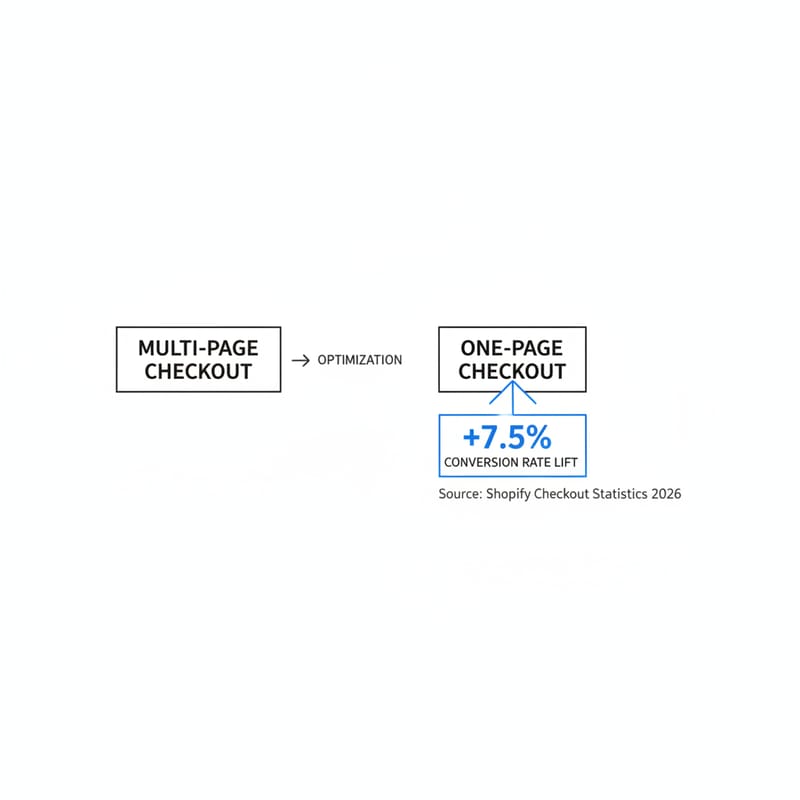
One-page checkout improves Shopify conversion rates by roughly 7% to 10% in many reported cases, with several 2026 sources citing around 7.5% better conversion than multi-page layouts. The exact lift depends on traffic quality, mobile share, and how cluttered the old flow was.
This is one of those stats that lines up with what I would expect from user behavior. When shoppers can see contact, shipping, and payment in a single view, the process feels shorter even if the number of fields is similar. Perceived effort matters almost as much as actual effort.
For mobile-heavy stores, the impact can be even more meaningful. Research cited in the 2026 data suggests mobile checkout conversion has improved into the 68.9% to 74.1% range, which is important because mobile is usually where friction shows up first. If your store gets most of its traffic from paid social, one-page checkout is not a silver bullet, but it is one of the cleaner wins available.
For a deeper look at checkout structure and what changed recently, I recommend reading The Shopify Checkout Guide: Everything You Need to Know in 2026.
| Checkout Format | Expected Effect | Best Use Case | Main Risk |
|---|---|---|---|
| One-page checkout | About 7% to 10% higher conversion | Most stores, especially mobile-heavy brands | Clutter if too many extensions are added |
| Multi-step checkout | Lower perceived speed | Legacy setups and some complex B2B flows | More drop-off between steps |
| Shop Pay accelerated checkout | Highest completion rates | Returning customers and mobile users | Less room for custom persuasion in-flow |
Why do shoppers still abandon checkout on Shopify in 2026?
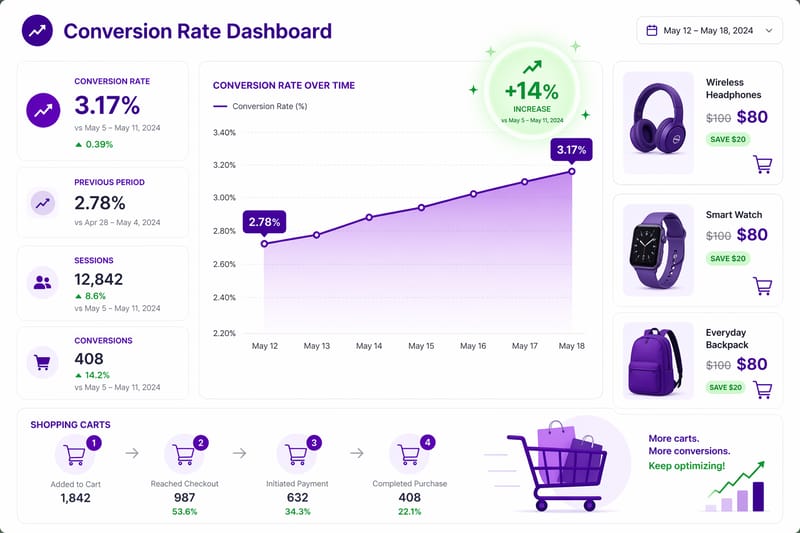
Shoppers still abandon checkout on Shopify in 2026 mainly because of extra costs, slow delivery, forced account creation, and checkout complexity. Extensibility helps, but it does not fix poor pricing, weak shipping strategy, or confusing UX on its own.
Based on the research data, the biggest abandonment triggers are:
- 39% abandon because of extra costs
- 21% abandon because delivery is too slow
- 19% abandon because the store forces account creation
- 18% abandon because checkout feels too long or complex
That list is useful because it keeps merchants focused on the right problems. In practice, I often see stores obsess over tiny cosmetic checkout tweaks while ignoring the fact that shipping costs appear too late, delivery estimates are unclear, or discount logic is confusing. The biggest conversion wins usually come from reducing uncertainty, not adding more persuasion widgets.
What does extensibility actually solve?
Extensibility solves the technical side of checkout friction better than the commercial side. It makes it easier to present the right information in the right place, but it cannot make bad shipping economics disappear.
For example, merchants can now use checkout extensions to surface clearer delivery messaging, loyalty information, upsell modules, or custom trust content without relying on brittle scripts. That is valuable. But if the customer sees a surprise $14.99 shipping fee at the end, the platform architecture is not the main issue anymore.
How does Shop Pay compare with standard Shopify checkout in 2026?
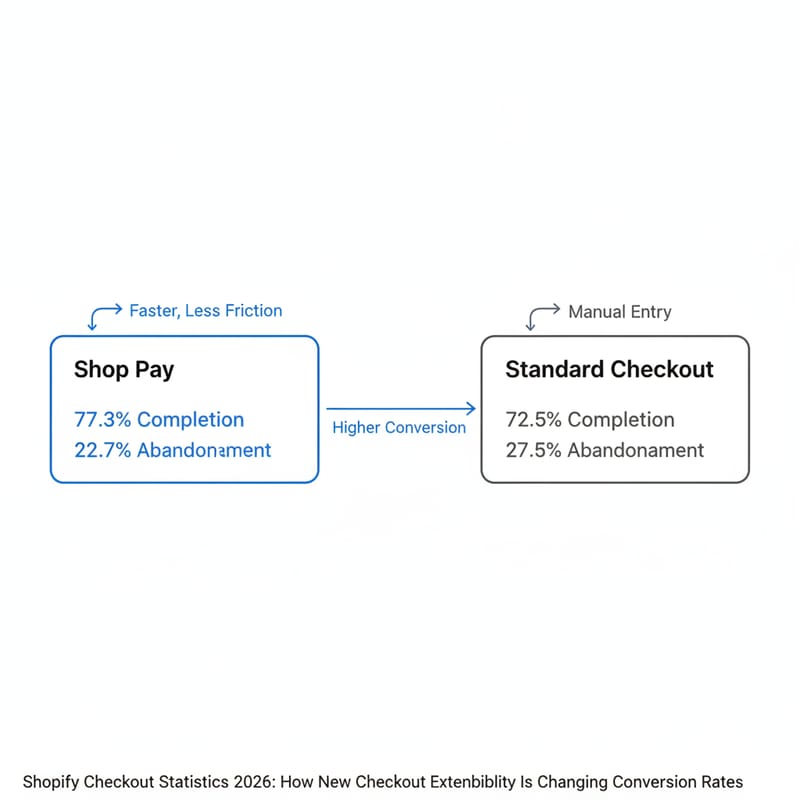
Shop Pay outperforms standard checkout in 2026 with a 77.3% checkout completion rate versus the broader Shopify average of 72.5%. It also reduces cart abandonment to 22.7%, making it one of the strongest conversion tools available to Shopify merchants.
I have always viewed Shop Pay as one of Shopify’s biggest structural advantages. It removes typing, reduces payment friction, and creates a familiar, trusted experience across stores. For repeat buyers, especially on mobile, that matters a lot.
The tradeoff is that accelerated checkout can reduce the amount of in-flow persuasion you can do compared with a fully customized path. But in most cases, fewer steps beats more messaging. If your checkout is already reasonably optimized, enabling and promoting Shop Pay is usually a higher-impact move than adding more content blocks.
Shopify has also published broader enterprise-focused conversion claims on its platform advantage, which are worth reviewing at Shopify’s ecommerce platform comparison and its revenue generation article.
What benchmarks should merchants use for checkout performance in 2026?
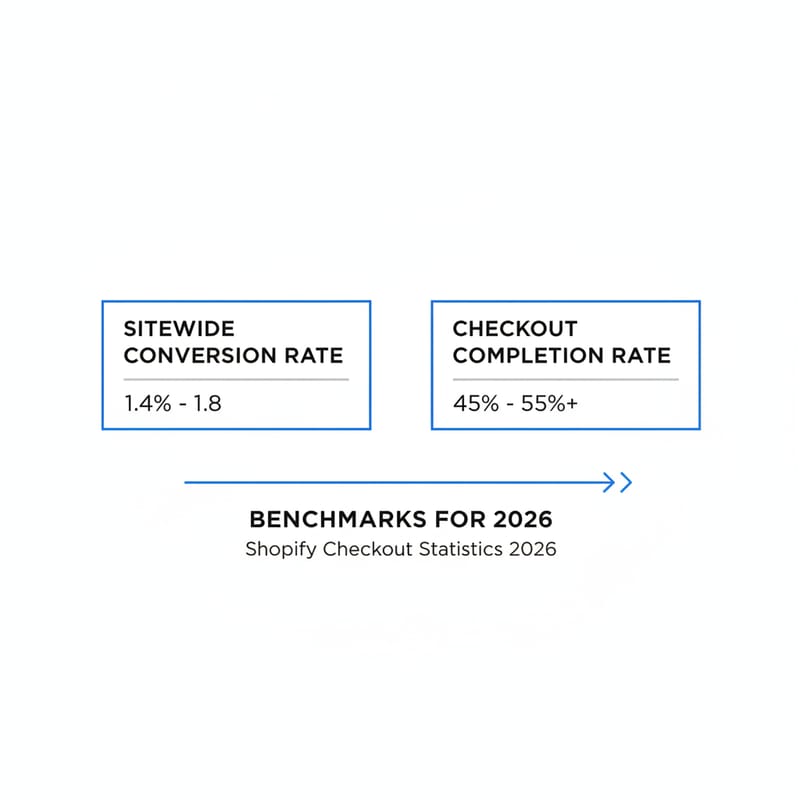
Merchants should benchmark both sitewide conversion rate and checkout completion rate in 2026. A healthy Shopify store often lands around 1.4% to 1.8% overall conversion, while a strong checkout completion rate is typically 45% to 55% or higher depending on how you define the funnel stage.
Here is how I think about it when reviewing store performance:
- Below 1% overall conversion usually means there are major issues with traffic quality, offer clarity, or product-market fit.
- 1.4% to 1.8% is broadly average for Shopify in 2026.
- 2% to 3% is solid for many brands with mixed traffic.
- 3.2%+ puts you into top-20% territory.
- 4.7%+ is top-10% performance and usually reflects a very strong offer, strong retention, or high-intent traffic.
Traffic source also changes the story. Organic search and email often convert in the 3.6% to 5% range, while paid social can sit closer to 1%. So if you compare your paid Meta traffic to an email-heavy retention brand, you may end up diagnosing the wrong problem.
If you want a broader conversion improvement framework beyond checkout itself, check out How to Optimize Your Conversion Rate on Shopify: 2026 Guide.
| Benchmark Tier | Overall Conversion Rate | What It Usually Indicates |
|---|---|---|
| Underperforming | Below 1% | Traffic mismatch, weak offer, UX friction, or trust issues |
| Average | 1.4% to 1.8% | Normal range for many Shopify stores in 2026 |
| Strong | 2% to 3% | Good merchandising and checkout efficiency |
| Top 20% | 3.2%+ | High-intent traffic and disciplined CRO |
| Top 10% | 4.7%+ | Excellent funnel, strong retention, and strong brand trust |
How should merchants use Checkout Extensibility without hurting conversion?
Merchants should use Checkout Extensibility to remove friction, not add clutter. The best checkout customizations are contextual, fast, and relevant to purchase completion.
This is where I see the most mistakes. Once merchants realize they can customize checkout more safely, they are tempted to add too much: banners, upsells, delivery notes, loyalty prompts, survey questions, gift options, and reassurance copy all at once. Just because you can extend checkout does not mean you should fill every available slot.
My rule of thumb is simple: every extension should justify its existence in one of three ways.
- It reduces uncertainty
- It increases order value without distraction
- It captures essential information for fulfillment or support
If it does not do one of those things, it probably belongs somewhere else in the funnel.
What checkout elements tend to help the most?
The checkout elements that help the most are usually delivery clarity, payment acceleration, trust reinforcement, and tightly targeted upsells. These improve buyer confidence without creating decision fatigue.
Examples that often work well include:
- Estimated delivery messaging for reducing shipping anxiety
- Shop Pay visibility to encourage faster completion
- Post-purchase upsells instead of pre-payment distractions
- Gift options or order notes only when they are genuinely useful
- Localized trust and payment messaging for international buyers
For merchants interested in checkout add-ons and upsell strategy, these LaunchTip guides are relevant: 6 Best Checkout Apps to Extend the Shopify Checkout in 2026 and How to Optimize Shopify Checkout & Increase Conversions: 3 Methods.
What are the biggest migration mistakes with Shopify checkout extensibility?
The biggest migration mistakes are broken tracking, trying to recreate old checkout.liquid behavior exactly, overloading checkout with unnecessary extensions, and failing to test on mobile. Most conversion losses after migration come from implementation mistakes, not from the framework itself.
I have seen merchants assume that if the checkout still loads, the migration was successful. That is not enough. You need to verify analytics, payment methods, discount behavior, custom fields, post-purchase offers, and mobile rendering. A technically complete migration is not the same as a conversion-safe migration.
Common mistakes include:
- Not auditing old scripts and pixels before migration
- Assuming all apps are fully extensibility-ready
- Adding too many UI blocks after upgrade
- Ignoring sandbox limitations and expecting old DOM hacks to work
- Skipping test orders across devices and payment methods
The Midday article on migration mistakes is a useful reference if you want another perspective: Shopify Checkout Extensibility in 2026: 7 Mistakes That Break Conversion.
How can merchants improve checkout conversion rates after migrating?
Merchants can improve checkout conversion after migrating by simplifying the path to payment, prioritizing Shop Pay, making delivery expectations obvious, and moving non-essential persuasion to post-purchase. The best optimization work happens after migration, not during it.
Here is the process I would use for a practical post-migration audit:
-
Measure baseline metrics
Record current add-to-cart rate, checkout start rate, checkout completion rate, and device split. Without a baseline, you are guessing. -
Review every extension block
Ask whether each one reduces friction or adds it. Remove anything decorative or repetitive. -
Promote accelerated payment methods
Make sure Shop Pay and other relevant accelerated options are visible and functioning correctly. -
Clarify shipping and delivery
Show expected delivery timing as early as possible. Slow or unclear delivery remains a major abandonment driver. -
Test mobile first
In many stores, mobile is the majority of sessions. If checkout feels crowded on a phone, conversion will suffer quickly. -
Shift upsells to better moments
In my experience, post-purchase upsells and thank-you page offers often outperform in-checkout interruptions for many categories. -
Validate analytics and attribution
Broken event tracking makes optimization harder because you stop trusting the data.
If upsells are part of your checkout strategy, these related posts may help: Boost Your Shopify Store's Revenue with One Check Upsells in 2026 and Shopify Upsell Case Study: 27% Increase in Average Order Value.
Which apps can help extend Shopify checkout in 2026?
The best apps for extending Shopify checkout in 2026 are the ones that are clearly built for the new extensibility model and solve a focused problem. Merchants should choose apps that improve conversion, support, or average order value without slowing the buying experience.
Since I build Shopify apps myself, I am biased toward tools that do one job well and integrate cleanly. Bloated apps are especially risky in checkout-related workflows because they can create operational confusion even if they do not directly break the interface.
Here are a few LaunchTip app ecosystem examples relevant to checkout-adjacent optimization:
- SellUp - upsells and cross-sells designed to increase AOV
- NoteDesk - order notes and custom messaging for operational clarity
- Kartify - cart-focused merchandising and conversion support
- Lumo Reviews - social proof that supports trust before checkout
- Quizive - zero-party data and guided selling before checkout
- Delivery Timer - delivery expectation setting to reduce hesitation
For broader app comparisons, Shopify’s app store remains the best starting point: Shopify App Store.
What should merchants expect from Shopify checkout performance by the end of 2026?
By the end of 2026, merchants should expect checkout performance gains to come less from dramatic redesigns and more from incremental optimization on top of extensibility. The stores that benefit most will be the ones that treat checkout as a system, not a page.
I expect the gap to widen between merchants who simply migrated and merchants who actively optimize. Once everyone is on the same technical foundation, competitive advantage comes from execution: better shipping communication, better payment adoption, better mobile UX, better post-purchase monetization, and better testing discipline.
That is why the 2026 checkout stats matter. They are not just a benchmark report. They are a reminder that Shopify’s checkout is getting stronger, but the best results still go to merchants who keep simplifying the path to purchase.
Where can I learn more about Shopify checkout statistics and extensibility?
The best places to learn more are Shopify’s own enterprise and developer resources, the Shopify App Store, and practical implementation guides from teams actively working in the ecosystem. You should cross-check platform claims with real merchant benchmarks and your own analytics.
Here are the sources and references I would review next:
- Shopify Enterprise: What Does Revenue Generation Mean for Ecommerce?
- Shopify Enterprise: Ecommerce Platform Comparison
- Shopify Dev Docs: Build for Checkout
- Shopify Dev Docs: Checkout and Post-Purchase Offers
- Charle Agency: Shopify One-Page Checkout Guide
- Midday: Checkout Extensibility Mistakes
- Shopify App Store
If you are actively working on checkout optimization, I would also keep a close eye on your own funnel by device, payment method, and traffic source. In the end, your store’s best checkout statistic is the one you can improve next month.