

Editing customer orders in Shopify is possible, but only within clear limits. In most cases, you can edit unfulfilled orders directly in Shopify admin, while fulfilled orders usually need a workaround such as a draft order, cancellation and recreation, or a specialist app.
I have worked on Shopify apps for years, and order changes are one of the most common support issues merchants face. A customer picks the wrong size, forgets to add an item, enters the wrong address, or asks for a discount after checkout. If you handle these requests well, you can save the sale, reduce refunds, and avoid unnecessary back-and-forth.
This guide explains what you can edit, what you cannot edit, and the best workflow for each scenario in 2026.
How do I edit a customer order in Shopify?
To edit a customer order in Shopify, go to Shopify Admin > Orders, open the order, and click Edit where available. Shopify lets you update line items, quantities, shipping details, contact information, notes, and tags, but product-level changes are generally limited to unfulfilled orders.
The exact options you see depend on the order status, payment state, fulfilment progress, and whether inventory is being tracked. Shopify recalculates totals after eligible edits, and if the total changes, you may need to collect extra payment or issue a refund.
For Shopify's current documentation, see Shopify's order editing guide and the related Shopify developer documentation.
What can you change in a Shopify order?
You can change several parts of a Shopify order, but not every field is editable in every situation. The most important rule is that unfulfilled line items are editable, while fulfilled items are much more restricted.
In practice, merchants most often edit orders to swap variants, remove products, add missed items, or fix shipping details. In my experience building Shopify apps, these four cases account for the vast majority of post-purchase change requests.
- Add products to an eligible order
- Remove products from an eligible order
- Adjust quantities on unfulfilled items
- Apply manual discounts in supported edit flows
- Update shipping address before fulfilment locks it in
- Edit email address or phone number from the contact information section
- Add internal notes and tags for staff workflows
- Update shipping fees in supported scenarios
What you cannot usually do natively is just as important. Shopify's native editing tools are not designed for deep post-fulfilment changes, customer self-service, or highly customised pricing logic.
What are Shopify's main order editing limitations?
The main limitation is simple: once fulfilment has started, native product edits become restricted. After that point, you often need a workaround or an app.
According to Shopify's own guidance, order edits can affect payments, inventory, fulfilment, reporting, and customer communication. That is why Shopify is cautious about what can be changed after the order moves further through the lifecycle.
- Fulfilled orders usually cannot be fully edited natively
- Only unfulfilled line items can typically be changed
- Inventory levels may update automatically when products are added or removed
- Order totals recalculate after edits
- Additional payment may need to be collected if the total increases
- Refunds may be needed if the total decreases
For merchants handling a lot of bespoke or corrected orders, this is where operational friction starts. If your team regularly changes orders after checkout, it is worth tightening your process and deciding which edits are allowed before packing begins.
What is the best way to change a customer's order in Shopify?
The best way to change a customer's order in Shopify is to edit the original order directly if it is still unfulfilled. If the order is already fulfilled or the change is more complex, the best option is usually a draft order or a specialist order editing app.
This is the decision tree I recommend to merchants:
| Scenario | Best method | Why |
|---|---|---|
| Wrong size or colour on an unfulfilled order | Native order edit | Fastest option for variant or quantity changes |
| Customer wants to add another item before dispatch | Native edit or draft order | Depends on fulfilment stage and payment collection needs |
| Shipping address typo caught quickly | Edit shipping address | Simple if fulfilment has not progressed |
| Order already fulfilled | Draft order, cancellation, or app | Native product edits are usually no longer available |
| Customer self-service order changes | Order editing app | Native Shopify does not provide a strong self-edit flow |
| Major order overhaul | Cancel and recreate | Cleaner record when many items or prices need changing |
When I tested workflows across stores with different fulfilment setups, native edits worked well for simple corrections. But once merchants needed self-service edits, store credit, post-fulfilment changes, or edit windows, apps became far more practical.
How do I add new products to a customer's Shopify order?
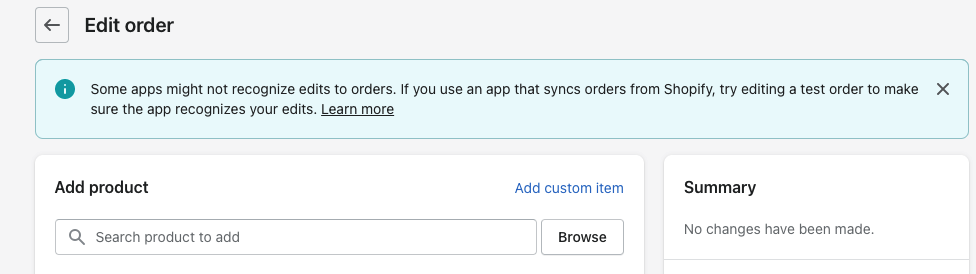
You can add new products to a Shopify order if the order is still eligible for editing. The standard route is to open the order, click Edit, then use Add product or Add custom item.
This is the simplest way to handle a customer who forgot to include an item at checkout. It keeps the order history cleaner than asking them to place a completely separate replacement order.
- Go to Shopify Admin > Orders.
- Open the order that needs updating.
- Click Edit.
- Click Add product.
- Search for the product and select the correct variant.
- Adjust the quantity if needed.
- Alternatively, use Add custom item for a manual line item.
- Optionally enter a reason for edit for internal reference.
- Review the updated total carefully.
- Save or update the order.
If the new total is higher, Shopify may prompt you to collect the outstanding balance. If you need to send a payment request, LaunchTip already has a full guide on how to send an invoice to a customer in Shopify.
When should you use a draft order instead of editing the original order?
You should use a draft order when the original order cannot be edited natively or when the payment change is easier to handle separately. This is often the cleanest method for adding extra items after the original order is locked.
My rule of thumb is simple: if fulfilment has started, or if the merchant wants a very clear paper trail, draft orders are safer. You can link the draft back to the original order with a note and fulfil them together if appropriate.
- Go to Orders > Drafts.
- Click Create order.
- Add the same customer from the original order.
- Add the extra item or replacement item.
- Apply discounts or custom pricing if needed.
- Add a note such as Supplement to order #1234.
- Save the draft order.
- Send the invoice to the customer.
This method is especially useful for stores selling add-ons, gift wrap, rush processing, or custom upgrades after checkout.
How do I remove products from a customer's Shopify order?
You can remove products from an order by opening the order editor and deleting the relevant line item. This works best for unfulfilled orders, and Shopify will usually recalculate the total automatically.
If inventory tracking is enabled, the removed item is often restocked automatically. Always double-check the restock setting before saving, especially if you are dealing with limited stock or made-to-order items.
- Go to Orders in Shopify admin.
- Open the order.
- Click Edit.
- Find the product you want to remove.
- Click the remove or x option next to that line item.
- Review whether restock units should remain enabled.
- Add an internal reason for edit if useful.
- Review the updated total and save.
If the order total drops, you may need to issue a partial refund. If you are splitting fulfilment or adjusting what ships now versus later, you may also find this LaunchTip guide useful: How to Split Orders into Multiple Shipments in Shopify.
How do I change quantities or swap variants in Shopify orders?
You can change quantities or swap variants on eligible unfulfilled items from the order edit screen. This is the standard fix when a customer ordered the wrong size, colour, or quantity.
In practice, this is one of the most valuable native Shopify features because it prevents unnecessary cancellations. Instead of asking the customer to reorder, you can often fix the issue in under a minute.
- Open the order and click Edit
- Increase or decrease the quantity on the line item
- Remove the incorrect variant if needed
- Add the correct variant as a new line item
- Check stock availability before saving
- Review the payment difference and update the order
If you deal with a lot of size swaps or option changes, it can be worth reviewing your product page setup as well. Clearer variant labels, size charts, and pre-purchase messaging often reduce these support requests significantly.
Can I edit the shipping address, email address, or phone number on an order?
Yes, Shopify lets you edit contact information such as email and phone in the order, and you can often edit the shipping address before fulfilment progresses too far. These are among the most common customer correction requests.
Address edits are especially time-sensitive. If your warehouse, 3PL, or shipping app has already pulled the order, changing the address in Shopify may not be enough on its own.
How do I edit contact details on a Shopify order?
To edit contact details, open the order and go to the Contact information section. Click Edit, update the email address or phone number, and save the change.
- Go to Shopify Admin > Orders.
- Open the relevant order.
- Scroll to Contact information.
- Click Edit.
- Update the email or phone number.
- Click Save.
This is useful if the customer entered the wrong email and is missing notifications. If that is a recurring issue in your store, you may also want to review your email workflows. Related reading: How to Check Emails Sent to Your Customers from Shopify.
How do I edit the shipping address on a Shopify order?
To edit the shipping address, open the order and click Edit next to the shipping address section where available. Save the updated address before fulfilment or label purchase locks the order into downstream systems.
In my experience, the biggest mistake merchants make is assuming the address update is enough by itself. If you use a fulfilment app, shipping app, or external warehouse, make sure the revised address has synced everywhere it needs to.
- Open the order in Shopify admin
- Locate the Shipping address section
- Click Edit
- Update the address fields
- Save the changes
- Confirm the change in any connected fulfilment system
How do I apply discounts or adjust pricing on an order?
You can apply manual discounts during eligible order edits, but pricing flexibility in native Shopify has limits. For more complex pricing changes, many merchants use draft orders or an order editing app.
Discount-related edits are where merchants most often get caught out, because the order total can change in ways that affect payment collection, tax, and reporting. Always review the final total before saving.
- Open the order and click Edit
- Select the relevant line item or new item
- Apply a manual discount
- Choose a percentage or fixed amount
- Add a reason for internal clarity
- Review taxes, shipping, and final total
If the customer now owes money, you can send an invoice. If you need a quotation workflow before the customer commits, see How to Create a Customer Quotation in Shopify.
What should I do if the order has already been fulfilled?
If the order has already been fulfilled, the best option is usually not to force a native edit. Instead, use a draft order, cancel and recreate the order, or use an order editing app that supports more advanced post-purchase workflows.
This is where many articles stop too early. The reality is that plenty of merchants need changes after fulfilment starts, especially if they use delayed dispatch, partial fulfilment, subscriptions, or custom products.
Method 1: Use a draft order for add-ons or adjustments
A draft order is usually the least disruptive option when the customer wants to add something extra after the original order is no longer editable. It preserves the original order while letting you collect payment cleanly.
This works well for upsells, gift wrap, replacement items, and shipping upgrades.
Method 2: Cancel and recreate the order
Cancel and recreate the order when there are major errors or the order needs a full rebuild. This is more disruptive, but it can be the cleanest option if multiple products, prices, or shipping details are wrong.
The downside is obvious: it can affect order history, tracking continuity, and customer confidence if not communicated clearly.
Method 3: Use a specialist order editing app
An order editing app is the best choice if you need customer self-service, post-fulfilment changes, edit windows, or more advanced payment and refund workflows. For busy stores, apps can reduce support tickets substantially.
Based on current merchant workflows, apps like Account Editor, Revize, and Cleverific are often mentioned for advanced order editing use cases. I would always test the exact edge cases you care about before rolling one out store-wide.
What are the best Shopify apps for advanced order editing?
The best Shopify order editing apps are the ones that match your actual workflow, not just the ones with the broadest feature list. Most merchants need a combination of customer self-service, address changes, variant swaps, and clear edit rules.
In my experience building Shopify apps, the biggest win from these tools is not just convenience. It is reduced support load and fewer manual mistakes.
| App | Best for | Typical use case |
|---|---|---|
| Account Editor | Customer self-service edits | Letting customers change address, variants, or order details after purchase |
| Revize | Post-purchase order changes | Operational flexibility for support teams |
| Cleverific | Complex order workflows | Editing, automation, and more advanced order management scenarios |
If you are evaluating apps, test these points before installing permanently:
- How long is the edit window?
- Can customers self-edit without contacting support?
- Does it support fulfilled or partially fulfilled orders?
- How are refunds, extra charges, and store credit handled?
- Does it sync cleanly with your fulfilment workflow?
What are the best practices for editing customer orders in Shopify?
The best practices are to set a clear edit policy, limit manual exceptions, and make changes before fulfilment starts. Good process matters as much as the tool you use.
Stores that handle order edits well usually have a documented workflow for support, fulfilment, and finance. Stores that struggle tend to improvise each request, which leads to missed payments, incorrect stock, and shipping errors.
- Set a customer-facing edit window, such as 30 minutes, 2 hours, or before dispatch.
- Document what support can and cannot change.
- Add internal reasons for edits so your team can track patterns.
- Check inventory impact before saving changes.
- Confirm payment differences immediately.
- Sync address changes with any 3PL or shipping app.
- Use tags for orders that need manual review.
- Audit your most common edit requests to fix the root cause on product pages or checkout.
If customised or complex orders are a regular issue, it helps to create better order tracking and internal workflows. This guide may help: How to Track Customized Orders in Shopify.
How can I reduce customer order edit requests in the first place?
You can reduce order edit requests by making the buying journey clearer before checkout. Better product information, variant labels, shipping messaging, and post-purchase communication all help lower support volume.
As an app developer, I see this pattern constantly: merchants look for a tool to fix order edits, but the real gains often come from preventing avoidable mistakes upstream.
- Improve size guides and variant naming
- Use clear delivery messaging before checkout
- Highlight customisation choices clearly on product pages
- Show order summaries prominently before payment
- Use post-purchase pages to confirm next steps and reassure customers
If you want to optimise the post-purchase experience, these related guides are useful: How to Customize the Order Status Page on Shopify and The Shopify Checkout Guide: Everything You Need to Know.
Frequently asked questions about editing customer orders in Shopify
These are the questions merchants ask most often when they are trying to change an order quickly and safely.
Can I edit a fulfilled order in Shopify?
Not fully, not natively. Once an order is fulfilled, Shopify's built-in editing options become much more limited. In most cases, you will need a draft order, a cancellation and recreation workflow, or an app.
Can I change a customer's email address on an order?
Yes. You can edit the email address or phone number in the Contact information section of the order.
Can I change the shipping address after an order is placed?
Usually yes, if fulfilment has not progressed too far. Update it in the order, then make sure any connected fulfilment or shipping systems also receive the change.
Can I add an item to an order after checkout?
Yes, sometimes. If the order is still editable, use the native order editor. If not, create a draft order and send the customer an invoice for the extra item.
Can customers edit their own Shopify orders?
Not well with native Shopify alone. For self-service order changes, you will usually need a dedicated app.
Is Shopify's native order editing enough for most stores?
For many small and mid-sized stores, Shopify's native order editing is good enough for basic corrections. It handles common issues like quantity changes, variant swaps, address fixes, and line-item edits before fulfilment.
But if your store has high order volume, custom products, subscriptions, or a support team dealing with constant post-purchase changes, native editing will start to feel limited. At that point, a more structured workflow or a specialist app is usually worth it.
My honest view is this: Shopify handles simple order edits well, but advanced post-purchase editing still needs extra tooling. If you only get occasional change requests, stick with native tools. If order edits are a daily operational bottleneck, move beyond the basics.